


Completed



Olive Baboon
Papio anubis
Silhouette: Margot Michaud · PhyloPic
- KingdomAnimalia (Animals)
- PhylumChordata (Chordates)
- ClassMammalia (Mammals)
- OrderPrimates
- FamilyCercopithecidae (Old World Monkeys)
- GenusPapio (Baboons)
- SpeciesPapio anubis (Olive Baboon)
In 3 days ~50% in a week ~80%
15 Verified sightings at Amboseli National Park From 2019 to 2026
2,118 In all 23 parks
June Best month
☀️ Diurnal When it's spotted
About the Olive Baboon
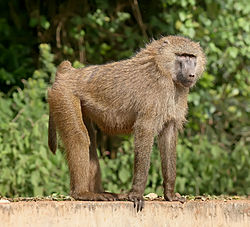
The olive baboon (Papio anubis), also called the Anubis baboon, is a member of the family Cercopithecidae Old World monkeys. The species is the most wide-ranging of all baboons, being native to 25 countries throughout Africa, extending from Mali eastward to Ethiopia and Tanzania. Isolated populations are also present in some mountainous regions of the Sahara. It inhabits savannahs, steppes, and forests. The common name is derived from its coat colour, which is a shade of green-grey at a distance. A variety of communications, vocal and non-vocal, facilitate a complex social structure.
The olive baboon is named for its coat, which, at a distance, is a shade of green-grey. At closer range, its coat is multicoloured, due to rings of yellow-brown and black on the hairs. The hair on the baboon's face is coarser and ranges from dark grey to black. This coloration is shared by both sexes, although males have a mane of longer hair that tapers down to ordinary length along the back.
Besides the mane, the male olive baboon differs from the female in terms of weight, body and canine tooth size; males are, on average, 70 cm (28 in) tall while standing and females measure 60... Wikipedia →
Sounds
Recording0:17
Tanzania · 2018
© Bernard BOUSQUET · XC1059040 · CC BY-NC-SA 4.0
Call0:42
Ghana · 2021
© Daan Drukker · XC959766 · CC BY-NC-ND 4.0
Recording0:45
Kenya · 2022
© Maksymilian Wojtkiewicz · iNaturalist · CC BY-NC 4.0
Recent sightings of Olive Baboon in Amboseli National Park
LIVEiNaturalistGlobal Distribution
Parks Where Found
| # | Park | Country | Daily sighting probability |
|---|---|---|---|
| 1 | Akagera National Park | 🇷🇼 Rwanda | |
| 2 | Arusha National Park | 🇹🇿 Tanzania | |
| 3 | Lake Nakuru National Park | 🇰🇪 Kenya | |
| 4 | Lake Manyara National Park | 🇹🇿 Tanzania | |
| 5 | Kibale National Park | 🇺🇬 Uganda | |
| 6 | Bale Mountains National Park | 🇪🇹 Ethiopia | |
| 7 | Meru National Park | 🇰🇪 Kenya | |
| 8 | Samburu National Reserve | 🇰🇪 Kenya | |
| 9 | Murchison Falls National Park | 🇺🇬 Uganda | |
| 10 | Nairobi National Park | 🇰🇪 Kenya | |
| 11 | Tarangire National Park | 🇹🇿 Tanzania | |
| 12 | Lake Mburo National Park | 🇺🇬 Uganda | |
| 13 | Awash National Park | 🇪🇹 Ethiopia | |
| 14 | Queen Elizabeth National Park | 🇺🇬 Uganda | |
| 15 | Nyungwe National Park | 🇷🇼 Rwanda | |
| 16 | Aberdare National Park | 🇰🇪 Kenya | |
| 17 | Semuliki National Park | 🇺🇬 Uganda | |
| 18 | Ngorongoro Conservation Area | 🇹🇿 Tanzania | |
| 19 | Serengeti National Park | 🇹🇿 Tanzania | |
| 20 | Masai Mara National Reserve | 🇰🇪 Kenya | |
| 21 | Bwindi Impenetrable National Park | 🇺🇬 Uganda | |
| 22 | Virunga National Park | 🇨🇩 Democratic Republic of the Congo | |
| 23 | Amboseli National Park | 🇰🇪 Kenya |
Zoos & Centres Where Found
Closest Relatives at Amboseli National Park


Before you go
What are the chances of seeing an Olive Baboon in Amboseli National Park?
Possible
About 20% of wildlife watchers report an Olive Baboon sighting in Amboseli National Park on a given day, based on 15 verified sightings from GBIF citizen-science data from 2019 to 2026. It is the 22nd most-seen of the 30 mammals we can rate there. Over three days the chance rises to about 50%, and over a week to about 80%, if each day is a fresh chance.
When is the best time to see an Olive Baboon in Amboseli National Park?
June and December
In those months about 40% of wildlife watchers report an Olive Baboon in Amboseli National Park on a given day, against under 5% in January, May, August and October–November, the lowest months.
What time of day is best to see an Olive Baboon?
Between 9 am and noon
Across all the parks we cover, that three-hour window holds the most Olive Baboon sightings with a recorded time, and about 9 in 10 of them come between 6 am and 6 pm: it is a daytime animal.
Is Amboseli National Park the best place to see an Olive Baboon?
23rd of 23
Of the 23 parks where we can rate Olive Baboon sightings, Amboseli National Park ranks 23rd at about 20%. The best odds are in Akagera National Park (Rwanda, about 80%), Arusha National Park (Tanzania, about 80%) and Lake Nakuru National Park (Kenya, about 80%). All parks ranked.
Where does the Olive Baboon sighting chance come from?
GBIF citizen-science records
It is estimated from how often the Olive Baboon is recorded against all the mammals logged in Amboseli National Park (15 verified sightings from 2019 to 2026), calibrated against known sighting rates. Figures are rounded to the nearest 10% because citizen-science data supports honest approximations, not decimals, and months with records from fewer than five people show "—". How it works.
