


Completed


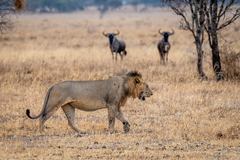

Lion
Panthera leo
Silhouette: PhyloPic
- KingdomAnimalia (Animals)
- PhylumChordata (Chordates)
- ClassMammalia (Mammals)
- OrderCarnivora (Carnivorans)
- FamilyFelidae (Felids)
- GenusPanthera (Roaring Cats)
- SpeciesPanthera leo (Lion)
In 3 days ~90% in a week >90%
139 Verified sightings at Amboseli National Park From 2019 to 2026
8,383 In all 38 parks
June Best month
☀️ Diurnal When it's spotted


Completed


Completed

Completed


Completed


Completed


Completed
About the Lion
The lion (Panthera leo) is a large cat of the genus Panthera, currently ranging only in Sub-Saharan Africa and India. It has a muscular, broad-chested body; a short, rounded head; round ears; and a dark, hairy tuft at the tip of its tail. It is sexually dimorphic; adult male lions are larger than females and have a prominent mane that extends from the head to the shoulders and chest.
The lion inhabits grasslands, savannahs, and shrublands. It is an apex and keystone predator, preying mostly on medium-sized and large hooved mammals. It is usually more diurnal than other wild cats, but when persecuted, it adapts to being active at night and at twilight. It is a social species, forming groups called prides. A lion pride consists of related females and cubs, and a few or one adult male who is unrelated to the females. Groups of female lions usually hunt together. Adult males often compete to keep or gain their membership in the pride.
During the Neolithic period, the lion ranged throughout Africa and Eurasia, from Southeast Europe to India. Still, it has been reduced to fragmented populations in sub-Saharan Africa and one population in western India. It has been listed as Vulnerable on the IUCN Red List since 1996 because populations in African countries have declined by about 43% since the early 1990s. Lion populations are untenable outside designated protected areas. Although the cause of the decline is not fully understood, habitat loss and conflicts with humans are the greatest causes for concern.
The lion has been extensively depicted in sculptures and paintings, on national flags, and in literature and films. It is one of the most widely recognised animal symbols in human culture. Lions have been kept in menageries since the time of the Roman Empire and have been a key species sought for exhibition in zoological gardens across the world since the late 18th century. Cultural depictions of lions have occurred worldwide, particularly as a symbol of power and royalty. They figure prominently as symbols and deities in ancient religions. Wikipedia →
Recent sightings of Lion in Amboseli National Park
LIVEiNaturalistGlobal Distribution
Parks Where Found
Zoos & Centres Where Found
| # | Zoo / Centre | Country | |
|---|---|---|---|
| 1 | Disney's Animal Kingdom | 🇺🇸 United States | |
| 2 | Everland | 🇰🇷 South Korea | |
| 3 | Busch Gardens Tampa | 🇺🇸 United States | |
| 4 | SeaWorld San Diego | 🇺🇸 United States | |
| 5 | San Diego Zoo | 🇺🇸 United States | |
| 6 | Six Flags Great Adventure | 🇺🇸 United States | |
| 7 | Moscow Zoo | 🇷🇺 Russia | |
| 8 | Pairi Daiza | 🇧🇪 Belgium | |
| 9 | National Zoological Park | 🇺🇸 United States | |
| 10 | Yangon Zoological Gardens | 🇲🇲 Myanmar (Burma) | |
| 11 | Shedd Aquarium | 🇺🇸 United States | |
| 12 | ZooParc de Beauval | 🇫🇷 France | |
| 13 | Denver Zoo | 🇺🇸 United States | |
| 14 | Copenhagen Zoo | 🇩🇰 Denmark | |
| 15 | Natura Artis Magistra | 🇳🇱 Netherlands | |
| 16 | Dublin Zoo | 🇮🇪 Ireland | |
| 17 | Cleveland Metroparks Zoo | 🇺🇸 United States | |
| 18 | Cincinnati Zoo and Botanical Garden | 🇺🇸 United States | |
| 19 | California Academy of Sciences | 🇺🇸 United States | |
| 20 | Lisbon Oceanarium | 🇵🇹 Portugal | |
| 21 | Planckendael Zoo | 🇧🇪 Belgium | |
| 22 | Islamabad Zoo | 🇵🇰 Pakistan | |
| 23 | Le Pal | 🇫🇷 France | |
| 24 | North Carolina Zoo | 🇺🇸 United States | |
| 25 | Zlín-Lešná Zoo | 🇨🇿 Czechia | |
| 26 | Cabarceno Natural Park | 🇪🇸 Spain | |
| 27 | Ostrava Zoo | 🇨🇿 Czechia | |
| 28 | Kolmården Wildlife Park | 🇸🇪 Sweden | |
| 29 | Tulsa Zoo | 🇺🇸 United States | |
| 30 | Izhevsk Zoo | 🇷🇺 Russia | |
| 31 | Paris Zoological Park | 🇫🇷 France | |
| 32 | Zoo Pilsen | 🇨🇿 Czechia | |
| 33 | Taman Safari Bali (Bali Safari) | 🇮🇩 Indonesia | |
| 34 | Fota Wildlife Park | 🇮🇪 Ireland | |
| 35 | Liberec Zoo | 🇨🇿 Czechia | |
| 36 | Bali Zoo | 🇮🇩 Indonesia | |
| 37 | Réserve africaine de Sigean | 🇫🇷 France | |
| 38 | Olomouc Zoo | 🇨🇿 Czechia | |
| 39 | Zoo de Doué | 🇫🇷 France | |
| 40 | Aquarium de Lyon | 🇫🇷 France | |
| 41 | Yekaterinburg Zoo | 🇷🇺 Russia | |
| 42 | Rostov Zoo | 🇷🇺 Russia | |
| 43 | Kaliningrad Zoo | 🇷🇺 Russia | |
| 44 | Aquarium du palais de la Porte Dorée | 🇫🇷 France | |
| 45 | Hodonín Zoo | 🇨🇿 Czechia | |
| 46 | Zoobotánico Jerez | 🇪🇸 Spain | |
| 47 | La Tanière | 🇫🇷 France | |
| 48 | Karagandy Zoo | 🇰🇿 Kazakhstan | |
| 49 | Starooskolsky Zoo | 🇷🇺 Russia | |
| 50 | 清远长隆动物大越野 | 🇨🇳 China |
Closest Relatives at Amboseli National Park


Before you go
What are the chances of seeing a Lion in Amboseli National Park?
Likely
About 50% of wildlife watchers report a Lion sighting in Amboseli National Park on a given day, based on 139 verified sightings from GBIF citizen-science data from 2019 to 2026. It is the 10th most-seen of the 30 mammals we can rate there. Over three days the chance rises to about 90%, and over a week to over 90%, if each day is a fresh chance.
When is the best time to see a Lion in Amboseli National Park?
June and October
In those months about 70% of wildlife watchers report a Lion in Amboseli National Park on a given day, against about 30% in January, the lowest month. Those are among Amboseli National Park's driest months, with about 45 mm of rain a month against 220 mm in April.
What time of day is best to see a Lion?
Between 7 and 10 am
Across all the parks we cover, that three-hour window holds the most Lion sightings with a recorded time, and about 9 in 10 of them come between 6 am and 6 pm: it is a daytime animal.
Is Amboseli National Park the best place to see a Lion?
22nd of 38
Of the 38 parks where we can rate Lion sightings, Amboseli National Park ranks 22nd at about 50%. The best odds are in Ruaha National Park (Tanzania, about 80%), Gir National Park (India, about 80%) and Serengeti National Park (Tanzania, about 80%). All parks ranked.
Which relatives of the Lion live in Amboseli National Park?
Same family: Felidae
The closest relatives of the Lion that you can see in Amboseli National Park (family Felidae, Felids) are Cheetah (about 40%) and Serval (about 30%), with each one's daily chance of a sighting.
Where does the Lion sighting chance come from?
GBIF citizen-science records
It is estimated from how often the Lion is recorded against all the mammals logged in Amboseli National Park (139 verified sightings from 2019 to 2026), calibrated against known sighting rates. Figures are rounded to the nearest 10% because citizen-science data supports honest approximations, not decimals, and months with records from fewer than five people show "—". How it works.
