
Agami Heron

Agami Heron

Agamia agami

Silhouette: Sheatherius · PhyloPic

LCNTNear ThreatenedVUENCR
Daily sighting probability ~20% · Possible
at Anavilhanas National Park

In 3 days ~40% in a week ~70%

64 Verified sightings at Anavilhanas National Park From 2019 to 2026
1,078 In all 12 parks
November Best month
☀️ Diurnal When it's spotted

About the Agami Heron

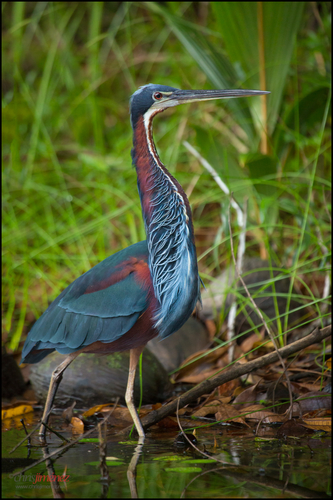
The agami heron (Agamia agami) is a medium-sized heron. It is a resident breeding bird from Central America south to Peru and Brazil. It is sometimes known as the chestnut-bellied heron, and is the only member of the genus Agamia. In Brazil it is sometimes called Soco beija-flor, meaning 'hummingbird heron', thanks to its unique coloration pattern.

The agami heron is listed as Near Threatened by the IUCN, due to predictions of future habitat destruction within its range. The agami heron was formally described in 1789 by the German naturalist Johann Friedrich Gmelin in his revised and expanded edition of Carl Linnaeus's Systema Naturae. He placed it with the herons and cranes in the genus Ardea and coined the binomial name Ardea agami. Gmelin based his description on the "Agami heron" from Cayenne that had been described in 1785 by the English ornithologist John Latham in his book A General Synopsis of Birds. Latham had in turn based his description on a specimen owned by the army officer Thamas Davies and the description and illustration of "Le Héron Agami" by the French polymath Comte de Buffon in his Histoire Naturelle des Oiseaux. The agami heron is now the only species... Wikipedia →

Sounds

Song1:21

Ecuador · 2018

© Gabriel Maldonado · XC437168 · CC BY-NC-SA 4.0

Call0:16

Ecuador · 1998

© John V. Moore · XC257327 · CC BY-NC-SA 4.0

Flight call0:10

Brazil · 2011

© Eric DeFonso · XC124594 · CC BY-NC-SA 3.0

Global Distribution

Parks Where Found

# Park Country Daily sighting probability
1 Cuyabeno Wildlife Reserve 🇪🇨 Ecuador
~20%
2 Anavilhanas National Park 🇧🇷 Brazil
~20%
3 Tenorio Volcano National Park 🇨🇷 Costa Rica
~10%
4 Yasuní National Park 🇪🇨 Ecuador
~10%
5 Cockscomb Basin Wildlife Sanctuary 🇧🇿 Belize
~10%
6 Tambopata National Reserve 🇵🇪 Peru
<5%
7 Tortuguero National Park 🇨🇷 Costa Rica
<5%
8 Manu National Park 🇵🇪 Peru
<5%
9 Darién National Park 🇵🇦 Panama
<5%
10 Parque Estadual Encontro das Águas 🇧🇷 Brazil
<5%
11 Tikal National Park 🇬🇹 Guatemala
<5%
12 Soberanía National Park 🇵🇦 Panama
<5%

Before you go

What are the chances of seeing an Agami Heron in Anavilhanas National Park?

Possible

About 20% of wildlife watchers report an Agami Heron sighting in Anavilhanas National Park on a given day, based on 64 verified sightings from GBIF citizen-science data from 2019 to 2026. It is the 74th most-seen of the 291 birds we can rate there. Over three days the chance rises to about 40%, and over a week to about 70%, if each day is a fresh chance.

When is the best time to see an Agami Heron in Anavilhanas National Park?

November

In that month about 50% of wildlife watchers report an Agami Heron in Anavilhanas National Park on a given day, against under 5% in January, May and July–August, the lowest months.

What time of day is best to see an Agami Heron?

Between 7 and 10 am

Across all the parks we cover, that three-hour window holds the most Agami Heron sightings with a recorded time, and about 8 in 10 of them come between 6 am and 6 pm: it is a daytime animal.

Is Anavilhanas National Park the best place to see an Agami Heron?

Among the best

Of the 12 parks where we can rate Agami Heron sightings, Anavilhanas National Park ranks 2nd at about 20%, level with the leaders once rounded. The best odds are in Cuyabeno Wildlife Reserve (Ecuador, about 20%).

Which relatives of the Agami Heron live in Anavilhanas National Park?

Same family: Ardeidae

The closest relatives of the Agami Heron that you can see in Anavilhanas National Park (family Ardeidae, Herons, Egrets, and Bitterns) are Cocoi Heron (about 40%), Great Egret (about 30%) and Striated Heron (about 20%), with each one's daily chance of a sighting.

Where does the Agami Heron sighting chance come from?

GBIF citizen-science records

It is estimated from how often the Agami Heron is recorded against all the birds logged in Anavilhanas National Park (64 verified sightings from 2019 to 2026), calibrated against known sighting rates. Figures are rounded to the nearest 10% because citizen-science data supports honest approximations, not decimals, and months with records from fewer than five people show "—". How it works.

← Back to Anavilhanas National Park