Ayres's Hawk-Eagle

Ayres's Hawk-Eagle

Hieraaetus ayresii

Silhouette: Andy Wilson · PhyloPic

LCLeast ConcernNTVUENCR
Daily sighting probability <5% · Rare
at Arusha National Park

In 3 days ~10% in a week ~20%

21 Verified sightings at Arusha National Park From 2019 to 2026
325 In all 18 parks
January Best month
☀️ Diurnal When it's spotted

About the Ayres's Hawk-Eagle

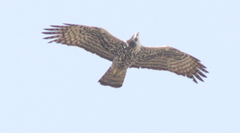
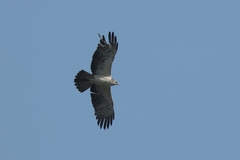
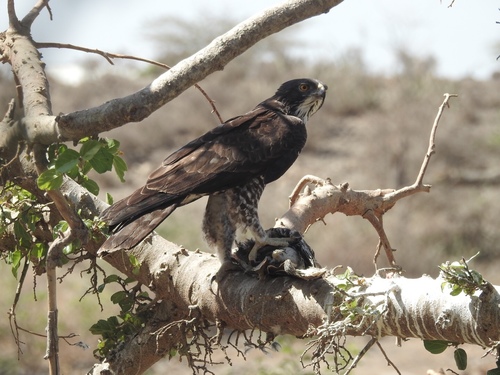
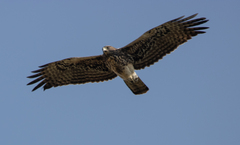
Ayres's hawk-eagle (Hieraaetus ayresii), or Ayres' eagle, is a medium-sized bird of prey in the family Accipitridae. It is native to African woodlands. Its name honours South African ornithologist Thomas Ayres. The adult male has blackish upper parts that are mottled with white and usually has a white forehead and supercilium. The upper-wing coverts are similar. The tail is ashy grey with a broad black tip and three to four narrower dark bars. Primary feathers and secondary feathers are black. The underparts are white, with heavy dark brown spots and blotches on the breast and belly, becoming sparser on the thighs and vent. The legs are well-feathered and pure white. The under-wing coverts are brown and marked with white, and the underside of flight feathers is dark and heavily barred lacking any noticeable grey patch. The eyes are yellow to orange, the cere and feet yellow, and the bill is bluish horn coloured becoming paler towards the base, with a black tip. This species has a small but at times pronounced crest. The males are smaller than the females, darker and usually more densely spotted on the underparts, and have a smaller amount of white on the forehead and... Wikipedia →

Sounds

Flight call0:24

Malawi · 2015

© Frank Lambert · XC366543 · CC BY-NC-ND 4.0

Call1:21

Kenya · 2015

© Bram Piot · XC293903 · CC BY-NC-SA 4.0

Global Distribution

Parks Where Found

# Park Country Daily sighting probability
1 iSimangaliso Wetland Park 🇿🇦 South Africa
~10%
2 Semuliki National Park 🇺🇬 Uganda
~10%
3 Bale Mountains National Park 🇪🇹 Ethiopia
<5%
4 Nairobi National Park 🇰🇪 Kenya
<5%
5 Meru National Park 🇰🇪 Kenya
<5%
6 Mana Pools National Park 🇿🇼 Zimbabwe
<5%
7 Arusha National Park 🇹🇿 Tanzania
<5%
8 Lower Zambezi National Park 🇿🇲 Zambia
<5%
9 Mkomazi National Park 🇹🇿 Tanzania
<5%
10 Kibale National Park 🇺🇬 Uganda
<5%
11 Bwindi Impenetrable National Park 🇺🇬 Uganda
<5%
12 Kafue National Park 🇿🇲 Zambia
<5%
13 Ngorongoro Conservation Area 🇹🇿 Tanzania
<5%
14 Lake Manyara National Park 🇹🇿 Tanzania
<5%
15 Hwange National Park 🇿🇼 Zimbabwe
<5%
16 Volcanoes National Park 🇷🇼 Rwanda
<5%
17 Murchison Falls National Park 🇺🇬 Uganda
<5%
18 Chobe National Park 🇧🇼 Botswana
<5%

Cities Where Found

# City Country Daily sighting probability
1 Nairobi 🇰🇪 Kenya
<5%
2 Kampala 🇺🇬 Uganda
<5%

Before you go

What are the chances of seeing an Ayres's Hawk-Eagle in Arusha National Park?

Rare

Under 5% of wildlife watchers report an Ayres's Hawk-Eagle sighting in Arusha National Park on a given day, based on 21 verified sightings from GBIF citizen-science data from 2019 to 2026. It is the 239th most-seen of the 373 birds we can rate there. Over three days the chance rises to about 10%, and over a week to about 20%, if each day is a fresh chance.

When is the best time to see an Ayres's Hawk-Eagle in Arusha National Park?

January

In that month about 20% of wildlife watchers report an Ayres's Hawk-Eagle in Arusha National Park on a given day, against under 5% in February–May and September–December, the lowest months.

What time of day is best to see an Ayres's Hawk-Eagle?

Between 9 am and noon

Across all the parks we cover, that three-hour window holds the most Ayres's Hawk-Eagle sightings with a recorded time, and nearly all of them come between 6 am and 6 pm: it is a daytime animal.

Where does the Ayres's Hawk-Eagle sighting chance come from?

GBIF citizen-science records

It is estimated from how often the Ayres's Hawk-Eagle is recorded against all the birds logged in Arusha National Park (21 verified sightings from 2019 to 2026), calibrated against known sighting rates. Figures are rounded to the nearest 10% because citizen-science data supports honest approximations, not decimals, and months with records from fewer than five people show "—". How it works.
← Back to Arusha National Park