Azure Damselfly

Azure Damselfly

Coenagrion puella

Daily sighting probability ~20% · Possible
at Białowieża National Park

In 3 days ~40% in a week ~70%

14 Verified sightings at Białowieża National Park From 2019 to 2026
305 In all 10 parks
May Best month
☀️ Diurnal When it's spotted

About the Azure Damselfly

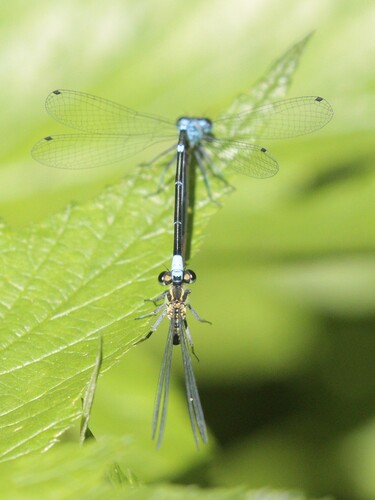
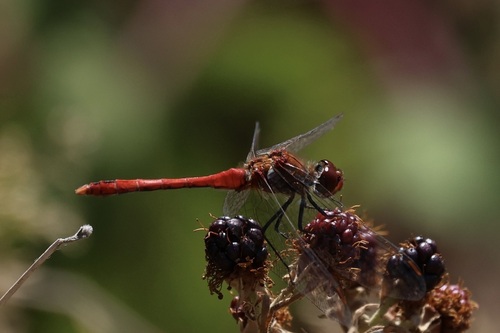
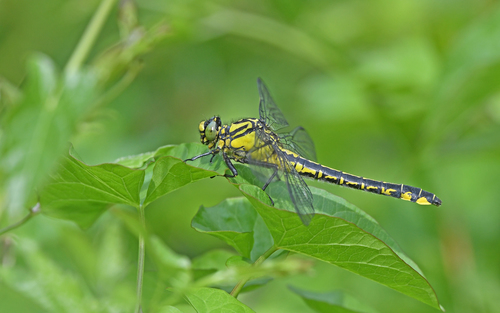
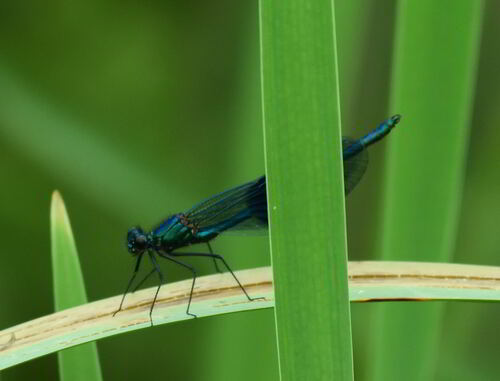
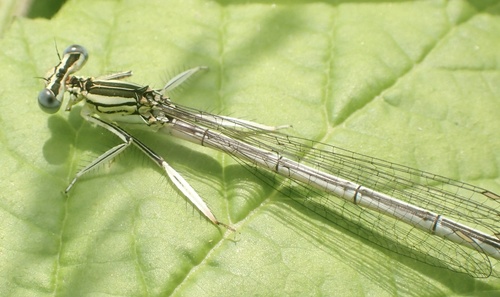
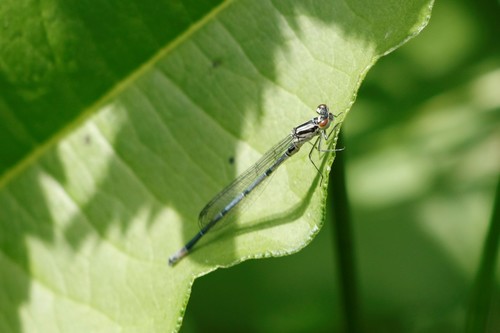
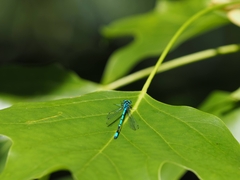
The azure damselfly (Coenagrion puella) is a species of damselfly found in most of Europe. It is notable for its distinctive black and blue colouring. They are commonly found around ponds and lakesides during the summer.

Adult male azure damselflies have a head and thorax patterned with blue and black. They have an azure blue abdomen patterned with black markings. The marking on the second segment of the abdomen is U-shaped, separated from the segment's narrow terminal black band; this distinguishes it from the variable damselfly Coenagrion pulchellum where the U-shape is joined to the terminal band with a black line.

Segments three to five are blue with broader black terminal bands, lacking the forward-pointing projection the upper surface which adult male common blue damselfly has. Segment six has a similar pattern but with more restricted blue and a broader area of black, and segment seven is mostly black, with just a narrow blue area at the base. Segment eight and much of segment nine are sky-blue, forming a noticeable contrasting patch, but there are small dark markings on the rear upper side of segment nine, which adult male common blue... Wikipedia →
Global Distribution

Parks Where Found

# Park Country Daily sighting probability
1 Plitvice Lakes National Park 🇭🇷 Croatia
~30%
2 Biebrza National Park 🇵🇱 Poland
~30%
3 Snowdonia National Park 🇬🇧 United Kingdom
~20%
4 Fertő-Hanság National Park 🇭🇺 Hungary
~20%
5 Białowieża National Park 🇵🇱 Poland
~20%
6 Mercantour National Park 🇫🇷 France
~10%
7 Bavarian Forest National Park 🇩🇪 Germany
~10%
8 Cévennes National Park 🇫🇷 France
~10%
9 Wadden Sea National Park 🇩🇪 Germany
~10%
10 Pyrénées National Park 🇫🇷 France
~10%

Cities Where Found

# City Country Daily sighting probability
1 Brussels 🇧🇪 Belgium
~20%
2 Leeds 🇬🇧 United Kingdom
~20%
3 Liverpool 🇬🇧 United Kingdom
~20%
4 London 🇬🇧 United Kingdom
~10%
5 Manchester 🇬🇧 United Kingdom
~10%
6 Budapest 🇭🇺 Hungary
~10%
7 Rostov-on-Don 🇷🇺 Russia
~10%
8 Hamburg 🇩🇪 Germany
~10%
9 Birmingham 🇬🇧 United Kingdom
~10%
10 Amsterdam 🇳🇱 Netherlands
~10%

Before you go

What are the chances of seeing an Azure Damselfly in Białowieża National Park?

Possible

About 20% of wildlife watchers report an Azure Damselfly sighting in Białowieża National Park on a given day, based on 14 verified sightings from GBIF citizen-science data from 2019 to 2026. It is the 56th most-seen of the 158 insects we can rate there. Over three days the chance rises to about 40%, and over a week to about 70%, if each day is a fresh chance.

When is the best time to see an Azure Damselfly in Białowieża National Park?

May

In that month about 30% of wildlife watchers report an Azure Damselfly in Białowieża National Park on a given day, against under 5% in September to April, the lowest months.

What time of day is best to see an Azure Damselfly?

Between noon and 3 pm

Across all the parks we cover, that three-hour window holds the most Azure Damselfly sightings with a recorded time, and about 9 in 10 of them come between 6 am and 6 pm: it is a daytime animal.

Is Białowieża National Park the best place to see an Azure Damselfly?

5th of 10

Of the 10 parks where we can rate Azure Damselfly sightings, Białowieża National Park ranks 5th at about 20%. The best odds are in Plitvice Lakes National Park (Croatia, about 30%), Biebrza National Park (Poland, about 30%) and Snowdonia National Park (United Kingdom, about 20%).

Where does the Azure Damselfly sighting chance come from?

GBIF citizen-science records

It is estimated from how often the Azure Damselfly is recorded against all the insects logged in Białowieża National Park (14 verified sightings from 2019 to 2026), calibrated against known sighting rates. Figures are rounded to the nearest 10% because citizen-science data supports honest approximations, not decimals, and months with records from fewer than five people show "—". How it works.

← Back to Białowieża National Park