


Completed


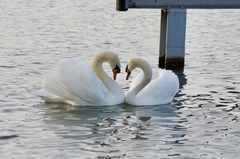
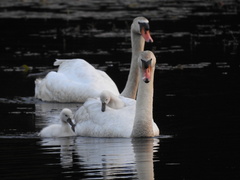
Mute Swan
Cygnus olor
Silhouette: An Ignorant Atheist · PhyloPic
- KingdomAnimalia (Animals)
- PhylumChordata (Chordates)
- ClassAves (Birds)
- OrderAnseriformes (Waterfowl)
- FamilyAnatidae (Ducks, Geese, and Swans)
- GenusCygnus (True Swans)
- SpeciesCygnus olor (Mute Swan)
In 3 days ~40% in a week ~70%
159 Verified sightings at Białowieża National Park From 2019 to 2026
12,544 In all 17 parks
September Best month
☀️ Diurnal When it's spotted
About the Mute Swan
The mute swan (Cygnus olor) is a species of swan and a member of the family Anatidae within the waterfowl order. It is native to much of Europe and parts of Asia and (as a rare winter visitor) the far north of Africa. It is an introduced species in North America, home to the largest populations outside of its native range, with additional smaller introductions in Australasia and Southern Africa. The name "mute" derives from it being less vocal than other swan species. Typically measuring 140 to 160 cm (55 to 63 in) in length, this large swan is wholly white in plumage, with an orange beak bordered with black. It is recognisable by its pronounced knob atop the beak, which is larger in males.
The mute swan was first formally named by the German naturalist Johann Friedrich Gmelin as Anas olor in 1789 and was transferred by Johann Matthäus Bechstein to the new genus Cygnus in 1803. Both cygnus and olor mean 'swan' in Latin; cygnus is a variant form of cycnus, borrowing from Greek κύκνος kyknos, a word of the same meaning.
Despite its Eurasian origin, its closest relatives are the black swan of Australia and the black-necked swan of South America, not the other Northern Hemisphere... Wikipedia →
Recent sightings of Mute Swan in Białowieża National Park
LIVEiNaturalistGlobal Distribution
Parks Where Found
| # | Park | Country | Daily sighting probability |
|---|---|---|---|
| 1 | Hortobágy National Park | 🇭🇺 Hungary | |
| 2 | Camargue | 🇫🇷 France | |
| 3 | Fertő-Hanság National Park | 🇭🇺 Hungary | |
| 4 | Biebrza National Park | 🇵🇱 Poland | |
| 5 | Kiskunság National Park | 🇭🇺 Hungary | |
| 6 | Snowdonia National Park | 🇬🇧 United Kingdom | |
| 7 | Bavarian Forest National Park | 🇩🇪 Germany | |
| 8 | Point Pelee National Park | 🇨🇦 Canada | |
| 9 | Wadden Sea National Park | 🇩🇪 Germany | |
| 10 | Białowieża National Park | 🇵🇱 Poland | |
| 11 | Cairngorms National Park | 🇬🇧 United Kingdom | |
| 12 | Triglav National Park | 🇸🇮 Slovenia | |
| 13 | Gauja National Park | 🇱🇻 Latvia | |
| 14 | Merritt Island National Wildlife Refuge | 🇺🇸 United States | |
| 15 | Tatra National Park | 🇸🇰 Slovakia | |
| 16 | Pyrénées National Park | 🇫🇷 France | |
| 17 | Great Smoky Mountains National Park | 🇺🇸 United States |
Cities Where Found
| # | City | Country | Daily sighting probability |
|---|---|---|---|
| 1 | Birmingham | 🇬🇧 United Kingdom | |
| 2 | London | 🇬🇧 United Kingdom | |
| 3 | Copenhagen | 🇩🇰 Denmark | |
| 4 | Helsinki | 🇫🇮 Finland | |
| 5 | Munich | 🇩🇪 Germany | |
| 6 | Leeds | 🇬🇧 United Kingdom | |
| 7 | Liverpool | 🇬🇧 United Kingdom | |
| 8 | Manchester | 🇬🇧 United Kingdom | |
| 9 | Belgrade | 🇷🇸 Serbia | |
| 10 | Stockholm | 🇸🇪 Sweden |
Zoos & Centres Where Found
Closest Relatives at Białowieża National Park




Before you go
What are the chances of seeing a Mute Swan in Białowieża National Park?
Possible
About 20% of wildlife watchers report a Mute Swan sighting in Białowieża National Park on a given day, based on 159 verified sightings from GBIF citizen-science data from 2019 to 2026. It is the 74th most-seen of the 182 birds we can rate there. Over three days the chance rises to about 40%, and over a week to about 70%, if each day is a fresh chance.
When is the best time to see a Mute Swan in Białowieża National Park?
September
In that month about 30% of wildlife watchers report a Mute Swan in Białowieża National Park on a given day, against under 5% in July, the lowest month.
What time of day is best to see a Mute Swan?
Between noon and 3 pm
Across all the parks we cover, that three-hour window holds the most Mute Swan sightings with a recorded time, and about 8 in 10 of them come between 6 am and 6 pm: it is a daytime animal.
Is Białowieża National Park the best place to see a Mute Swan?
10th of 17
Of the 17 parks where we can rate Mute Swan sightings, Białowieża National Park ranks 10th at about 20%. The best odds are in Hortobágy National Park (Hungary, about 60%), Camargue (France, about 60%) and Fertő-Hanság National Park (Hungary, about 50%). All parks ranked.
Where does the Mute Swan sighting chance come from?
GBIF citizen-science records
It is estimated from how often the Mute Swan is recorded against all the birds logged in Białowieża National Park (159 verified sightings from 2019 to 2026), calibrated against known sighting rates. Figures are rounded to the nearest 10% because citizen-science data supports honest approximations, not decimals, and months with records from fewer than five people show "—". How it works.
