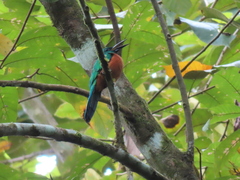
Great Jacamar

Great Jacamar

Jacamerops aureus

Silhouette: FJDegrange · PhyloPic

LCLeast ConcernNTVUENCR
Daily sighting probability ~10% · With luck
at Brownsberg Nature Park

In 3 days ~30% in a week ~50%

27 Verified sightings at Brownsberg Nature Park From 2019 to 2026
1,205 In all 10 parks
January Best month
☀️ Diurnal When it's spotted

About the Great Jacamar

The great jacamar (Jacamerops aureus) is a species of bird in the family Galbulidae. It is placed in the monotypic genus Jacamerops. It is found in Bolivia, Brazil, Colombia, Costa Rica, Ecuador, French Guiana, Guyana, Panama, Peru, Suriname, and Venezuela, where its natural habitat is subtropical and tropical moist lowland forests.

German zoologist Philipp Ludwig Statius Müller described the species in 1776. The species name is the Latin adjective aureus "golden". In 2000, the binomial name was changed from J. aurea to J. aureus so the species name agreed in gender with the genus name.

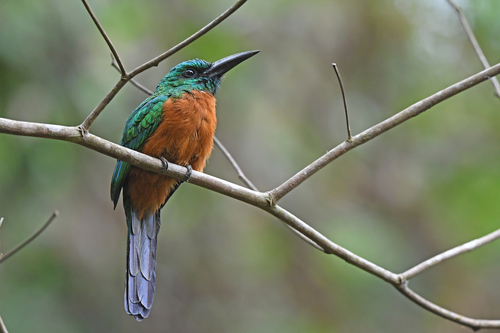
It measures 25 to 30 cm (9.8 to 11.8 in) in length and weighs between 57 and 70 g (2.0 and 2.5 oz). As indicated by its name, this is the largest species of jacamar and much bulkier than any other species in the family. The adult male chin, cheeks and upper region are all bright metallic green with gold overtones, with a blueish tinge on the chin, forehead and tail and purple copper on the back. The lower part of the throat is white and the rest of the lower region is deep rufous. The primaries are black, the tail is blue-black, below the beak is black, and the legs... Wikipedia →
Sounds

Call0:15

Ecuador · 2026

© Manuel Sánchez-Nivicela · XC1182306 · CC BY-NC-ND 4.0

Song0:53

Bolivia · 2021

© Jacob Wijpkema · XC684866 · CC BY-NC-SA 4.0

Recording1:22

Colombia · 2001

© Mauricio Álvarez-Rebolledo (Colección de Sonidos Ambientales - Instituto Humboldt) · XC525575 · CC BY-NC-SA 4.0

Global Distribution

Parks Where Found

# Park Country Daily sighting probability
1 Brownsberg Nature Park 🇸🇷 Suriname
~10%
2 Darién National Park 🇵🇦 Panama
~10%
3 Yasuní National Park 🇪🇨 Ecuador
~10%
4 Soberanía National Park 🇵🇦 Panama
~10%
5 Tambopata National Reserve 🇵🇪 Peru
<5%
6 Amacayacu National Natural Park 🇨🇴 Colombia
<5%
7 Manu National Park 🇵🇪 Peru
<5%
8 Sierra de la Macarena National Park 🇨🇴 Colombia
<5%
9 Anavilhanas National Park 🇧🇷 Brazil
<5%
10 Cuyabeno Wildlife Reserve 🇪🇨 Ecuador
<5%

Zoos & Centres Where Found

# Zoo / Centre Country
1 Boston Aquarial Gardens 🇺🇸 United States In captivity

Before you go

What are the chances of seeing a Great Jacamar in Brownsberg Nature Park?

With luck

About 10% of wildlife watchers report a Great Jacamar sighting in Brownsberg Nature Park on a given day, based on 27 verified sightings from GBIF citizen-science data from 2019 to 2026. It is the 126th most-seen of the 221 birds we can rate there. Over three days the chance rises to about 30%, and over a week to about 50%, if each day is a fresh chance.

When is the best time to see a Great Jacamar in Brownsberg Nature Park?

January and April

In those months about 20% of wildlife watchers report a Great Jacamar in Brownsberg Nature Park on a given day, against under 5% in February, August and October, the lowest months. May to July have too few records to rate.

What time of day is best to see a Great Jacamar?

Between 8 and 11 am

Across all the parks we cover, that three-hour window holds the most Great Jacamar sightings with a recorded time, and about 9 in 10 of them come between 6 am and 6 pm: it is a daytime animal.

Is Brownsberg Nature Park the best place to see a Great Jacamar?

Yes

Of the 10 parks where we can rate Great Jacamar sightings, Brownsberg Nature Park has the highest daily chance: about 10%. Next come Darién National Park (Panama, about 10%) and Yasuní National Park (Ecuador, about 10%).

Which relatives of the Great Jacamar live in Brownsberg Nature Park?

Same order: Piciformes

The closest relatives of the Great Jacamar that you can see in Brownsberg Nature Park (order Piciformes, Woodpeckers and Allies) are Golden-olive Woodpecker (about 50%), Guianan Toucanet (about 30%) and Red-necked Woodpecker (about 30%), with each one's daily chance of a sighting.

Where does the Great Jacamar sighting chance come from?

GBIF citizen-science records

It is estimated from how often the Great Jacamar is recorded against all the birds logged in Brownsberg Nature Park (27 verified sightings from 2019 to 2026), calibrated against known sighting rates. Figures are rounded to the nearest 10% because citizen-science data supports honest approximations, not decimals, and months with records from fewer than five people show "—". How it works.

← Back to Brownsberg Nature Park