Yellowhammer

Yellowhammer

Emberiza citrinella

Silhouette: Matti Virtala · PhyloPic

LCLeast ConcernNTVUENCR
Daily sighting probability <5% · Rare
at Cairngorms National Park

In 3 days ~10% in a week ~20%

73 Verified sightings at Cairngorms National Park From 2019 to 2026
5,491 In all 29 parks
May Best month
☀️ Diurnal When it's spotted

About the Yellowhammer

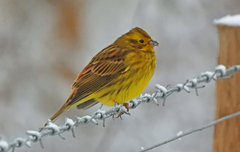
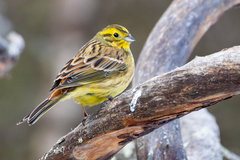
The yellowhammer (Emberiza citrinella) is a passerine bird in the bunting family that is native to Eurasia and has been introduced to New Zealand and Australia. Most European birds remain in the breeding range year-round, but the eastern subspecies is partially migratory, with much of the population wintering further south. The male yellowhammer has a bright yellow head, streaked brown back, chestnut rump, and yellow under parts. Other plumages are duller versions of the same pattern. The yellowhammer is common in open areas with some shrubs or trees, and forms small flocks in winter. Its song has a rhythm like "A little bit of bread and no cheese". The song is very similar to that of its closest relative, the pine bunting, with which it interbreeds.

Breeding commences mainly in April and May, with the female building a lined cup nest in a concealed location on or near the ground. The three to five eggs are patterned with a mesh of fine dark lines, giving rise to the old name for the bird of "scribble lark" or "writing lark". The female incubates the eggs for 12–14 days prior to hatching, and broods the altricial downy chicks until they fledge 11–13 days later. Both adults feed the chicks in the nest and raise two or three broods each year. The nest may be raided by rodents or corvids, and the adults are hunted by birds of prey. Yellowhammers feed on the ground, usually in flocks outside the breeding season. Their diet is mainly seeds, supplemented by invertebrates in the breeding season. Changes to agricultural practices have led to population declines in western Europe, but its large numbers and huge range mean that the yellowhammer is classed as being of least concern by the International Union for Conservation of Nature.

This conspicuous yellow bird has inspired poems by Robert Burns and John Clare, and its characteristic song has influenced musical works by Beethoven and Messiaen. Children's writer Enid Blyton helped to popularise the standard English representation of the song. Wikipedia →

Sounds

Call0:06

France · 2026

© Thierry THOMAS · XC1185460 · CC BY-NC-SA 4.0

Song0:46

Sweden · 2026

© Lars Edenius · XC1096279 · CC BY-NC-SA 4.0

Alarm call1:07

Sweden · 2021

© Ulf Elman · XC772004 · CC BY-NC-ND 4.0

Global Distribution

Parks Where Found

# Park Country Daily sighting probability
1 Białowieża National Park 🇵🇱 Poland
~60%
2 Biebrza National Park 🇵🇱 Poland
~60%
3 Aoraki Mount Cook National Park 🇳🇿 New Zealand
~40%
4 Mercantour National Park 🇫🇷 France
~40%
5 Ecrins National Park 🇫🇷 France
~30%
6 Bavarian Forest National Park 🇩🇪 Germany
~30%
7 Fertő-Hanság National Park 🇭🇺 Hungary
~30%
8 Arthur's Pass National Park 🇳🇿 New Zealand
~20%
9 Fiordland National Park 🇳🇿 New Zealand
~20%
10 Egmont National Park 🇳🇿 New Zealand
~20%
11 Tatra National Park 🇸🇰 Slovakia
~20%
12 Vanoise National Park 🇫🇷 France
~20%
13 Abel Tasman National Park 🇳🇿 New Zealand
~20%
14 Aigüestortes National Park 🇪🇸 Spain
~10%
15 Hortobágy National Park 🇭🇺 Hungary
~10%
16 Cévennes National Park 🇫🇷 France
~10%
17 Pyrénées National Park 🇫🇷 France
~10%
18 Picos de Europa National Park 🇪🇸 Spain
~10%
19 Hohe Tauern National Park 🇦🇹 Austria
~10%
20 Gauja National Park 🇱🇻 Latvia
~10%
21 Kiskunság National Park 🇭🇺 Hungary
~10%
22 Ordesa y Monte Perdido National Park 🇪🇸 Spain
~10%
23 Wadden Sea National Park 🇩🇪 Germany
~10%
24 Triglav National Park 🇸🇮 Slovenia
<5%
25 Plitvice Lakes National Park 🇭🇷 Croatia
<5%
26 Cairngorms National Park 🇬🇧 United Kingdom
<5%
27 Rakiura National Park 🇳🇿 New Zealand
<5%
28 Sierra Nevada National Park 🇪🇸 Spain
<5%
29 Snowdonia National Park 🇬🇧 United Kingdom
<5%

Cities Where Found

# City Country Daily sighting probability
1 Prague 🇨🇿 Czechia
~10%
2 Helsinki 🇫🇮 Finland
~10%
3 Munich 🇩🇪 Germany
~10%
4 Auckland 🇳🇿 New Zealand
~10%
5 Minsk 🇧🇾 Belarus
~10%
6 Novosibirsk 🇷🇺 Russia
~10%
7 Ramallah 🇵🇸 Palestine
~10%
8 Yerevan 🇦🇲 Armenia
<5%
9 Tehran 🇮🇷 Iran
<5%
10 Warsaw 🇵🇱 Poland
<5%

Zoos & Centres Where Found

# Zoo / Centre Country
1 Dresden Zoo 🇩🇪 Germany In captivity
2 Ogród Zoologiczny w Katowicach 🇵🇱 Poland In captivity

Before you go

What are the chances of seeing a Yellowhammer in Cairngorms National Park?

Rare

Under 5% of wildlife watchers report a Yellowhammer sighting in Cairngorms National Park on a given day, based on 73 verified sightings from GBIF citizen-science data from 2019 to 2026. It is the 101st most-seen of the 140 birds we can rate there. Over three days the chance rises to about 10%, and over a week to about 20%, if each day is a fresh chance.

When is the best time to see a Yellowhammer in Cairngorms National Park?

Any time of year

In every month with enough records, under 5% of wildlife watchers report a Yellowhammer in Cairngorms National Park on a given day, so our monthly data shows no clear season.

What time of day is best to see a Yellowhammer?

Between 8 and 11 am

Across all the parks we cover, that three-hour window holds the most Yellowhammer sightings with a recorded time, and nearly all of them come between 6 am and 6 pm: it is a daytime animal.

Where does the Yellowhammer sighting chance come from?

GBIF citizen-science records

It is estimated from how often the Yellowhammer is recorded against all the birds logged in Cairngorms National Park (73 verified sightings from 2019 to 2026), calibrated against known sighting rates. Figures are rounded to the nearest 10% because citizen-science data supports honest approximations, not decimals, and months with records from fewer than five people show "—". How it works.

← Back to Cairngorms National Park