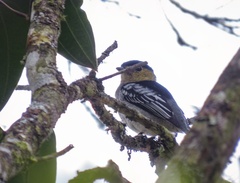
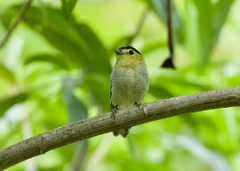
Barred Becard

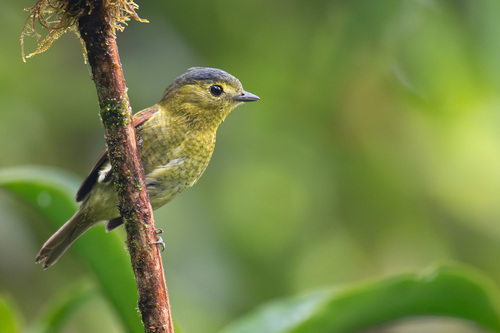
Barred Becard

Pachyramphus versicolor

Silhouette: Sheatherius · PhyloPic

LCLeast ConcernNTVUENCR
Daily sighting probability <5% · Rare
at Chingaza National Natural Park

In 3 days ~10% in a week ~20%

24 Verified sightings at Chingaza National Natural Park From 2019 to 2026
3,486 In all 14 parks
June Best month
☀️ Diurnal When it's spotted

About the Barred Becard

The barred becard (Pachyramphus versicolor) is a small passerine bird in the family Tityridae, the tityras, becards, and allies. It is found in Costa Rica, Panama, and in South America from Venezuela to Bolivia. The barred becard was originally described in 1843 as Vireo versicolor. It was later reassigned to genus Pachyramphus that George Robert Gray had erected in 1840. The genus has variously been assigned to the tyrant flycatcher family Tyrannidae and the cotinga family Cotingidae. Several early twenty-first century studies confirmed the placement of Pachyramphus in Tityridae and taxonomic systems made the reassignment. In 1998 the American Ornithological Society was unsure where to place the genus and listed its members as incertae sedis but in 2011 moved them to Tityridae.

The barred becard is 12 to 13 cm (4.7 to 5.1 in) long and weighs 14 to 17 g (0.49 to 0.60 oz). It is the smallest member of genus Pachyramphus. Adult males of the nominate subspecies have a glossy... Wikipedia →

Sounds

Song0:07

Ecuador · 2023

© Manuel Sánchez-Nivicela · XC1154730 · CC BY-NC-ND 4.0

Call0:26

Colombia · 2023

© Simon Mills · XC787267 · CC BY-NC-SA 4.0

Uncertain0:05

Peru · 2022

© David F. Belmonte · XC707837 · CC BY-NC-SA 4.0

Global Distribution

Parks Where Found

# Park Country Daily sighting probability
1 Volcán Barú National Park 🇵🇦 Panama
~20%
2 Los Quetzales National Park 🇨🇷 Costa Rica
~10%
3 Podocarpus National Park 🇪🇨 Ecuador
~10%
4 Tapantí-Macizo de la Muerte National Park 🇨🇷 Costa Rica
~10%
5 Los Nevados National Natural Park 🇨🇴 Colombia
~10%
6 Braulio Carrillo National Park 🇨🇷 Costa Rica
~10%
7 La Amistad International Park (Panama) 🇵🇦 Panama
<5%
8 Monteverde Cloud Forest Reserve 🇨🇷 Costa Rica
<5%
9 Farallones de Cali National Natural Park 🇨🇴 Colombia
<5%
10 Chingaza National Natural Park 🇨🇴 Colombia
<5%
11 Chirripó National Park 🇨🇷 Costa Rica
<5%
12 Irazú Volcano National Park 🇨🇷 Costa Rica
<5%
13 Poás Volcano National Park 🇨🇷 Costa Rica
<5%
14 Arenal Volcano National Park 🇨🇷 Costa Rica
<5%

Before you go

What are the chances of seeing a Barred Becard in Chingaza National Natural Park?

Rare

Under 5% of wildlife watchers report a Barred Becard sighting in Chingaza National Natural Park on a given day, based on 24 verified sightings from GBIF citizen-science data from 2019 to 2026. It is the 122nd most-seen of the 258 birds we can rate there. Over three days the chance rises to about 10%, and over a week to about 20%, if each day is a fresh chance.

When is the best time to see a Barred Becard in Chingaza National Natural Park?

June

In that month about 10% of wildlife watchers report a Barred Becard in Chingaza National Natural Park on a given day, against under 5% in July to May, the lowest months.

What time of day is best to see a Barred Becard?

Between 9 am and noon

Across all the parks we cover, that three-hour window holds the most Barred Becard sightings with a recorded time, and about 9 in 10 of them come between 6 am and 6 pm: it is a daytime animal.

Where does the Barred Becard sighting chance come from?

GBIF citizen-science records

It is estimated from how often the Barred Becard is recorded against all the birds logged in Chingaza National Natural Park (24 verified sightings from 2019 to 2026), calibrated against known sighting rates. Figures are rounded to the nearest 10% because citizen-science data supports honest approximations, not decimals, and months with records from fewer than five people show "—". How it works.
← Back to Chingaza National Natural Park