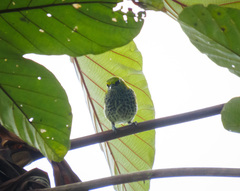
Speckled Tanager

Speckled Tanager

Ixothraupis guttata

Silhouette: Sheatherius · PhyloPic

Daily sighting probability <5% · Rare
at Chingaza National Natural Park

In 3 days <5% in a week ~10%

9 Verified sightings at Chingaza National Natural Park From 2019 to 2026
3,214 In all 14 parks
March Best month
☀️ Diurnal When it's spotted

About the Speckled Tanager

The speckled tanager (Ixothraupis guttata) is a medium-sized passerine bird. It is a resident breeder in Costa Rica, Panama, Trinidad, Venezuela, Colombia, Guyana, Suriname and the north of Brazil. There are also sight records from French Guiana.

It is probably a close relative of the spotted tanager (I. punctata) which replaces it to the south. These two species are generally presumably to be fully allopatric, but may actually be parapatric: in 1998 a speckled tanager was found in the Serranía de los Churumbelos (Colombia), just about 160 km (99 mi) north of where spotted tanagers are known to occur.

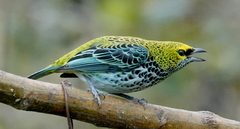
Adult speckled tanagers are 13.2 cm (5.2 in) long and weigh 18 g (0.63 oz). The upperparts are green with black spotting, and the face is yellow with a black line from the eye to the gape. The wings and tail are black edged with green, and the underparts are white spotted with black. The sexes are similar. The speckled tanager's flight call is a weak metallic chirping tsip.

The Trinidadian subspecies I. g. trinitatis has brighter and more extensive yellow on the head, and the black spotting is more conspicuous. Ixothraupis guttata is more of a subtropical species than its relative and occurs in humid montane and secondary forest, with generally not very tall trees and a dense understory. Speckled tanagers are social birds which eat mainly fruit and some insects. They are often seen with bay-headed tanagers and honeycreepers.

The small cup nest is built in a tree and the normal clutch is two brown-blotched white eggs. The female incubates the eggs for 13 days to hatching, with another 15 days before the chicks fledge. Wikipedia →

Sounds

Call0:52

Venezuela · 2024

© JAYRSON ARAUJO DE OLIVEIRA · XC939303 · CC BY-NC-SA 4.0

Flight call0:14

Brazil · 2016

© GABRIEL LEITE · XC303667 · CC BY-NC-SA 4.0

Song0:19

Colombia · 2013

© Oscar Humberto Marín Gómez · XC245067 · CC BY-NC-SA 3.0

Global Distribution

Parks Where Found

# Park Country Daily sighting probability
1 Chirripó National Park 🇨🇷 Costa Rica
~40%
2 Chagres National Park 🇵🇦 Panama
~30%
3 Henri Pittier National Park 🇻🇪 Venezuela
~20%
4 Darién National Park 🇵🇦 Panama
~10%
5 Tapantí-Macizo de la Muerte National Park 🇨🇷 Costa Rica
~10%
6 Braulio Carrillo National Park 🇨🇷 Costa Rica
~10%
7 La Amistad International Park (Panama) 🇵🇦 Panama
<5%
8 Sierra de la Macarena National Park 🇨🇴 Colombia
<5%
9 Chingaza National Natural Park 🇨🇴 Colombia
<5%
10 Arenal Volcano National Park 🇨🇷 Costa Rica
<5%
11 Los Quetzales National Park 🇨🇷 Costa Rica
<5%
12 Poás Volcano National Park 🇨🇷 Costa Rica
<5%
13 Corcovado National Park 🇨🇷 Costa Rica
<5%
14 Piedras Blancas National Park 🇨🇷 Costa Rica
<5%

Cities Where Found

# City Country Daily sighting probability
1 Caracas 🇻🇪 Venezuela
~10%
2 San José 🇨🇷 Costa Rica
<5%

Before you go

What are the chances of seeing a Speckled Tanager in Chingaza National Natural Park?

Rare

Under 5% of wildlife watchers report a Speckled Tanager sighting in Chingaza National Natural Park on a given day, based on 9 verified sightings from GBIF citizen-science data from 2019 to 2026. It is the 189th most-seen of the 258 birds we can rate there. Over three days the chance rises to under 5%, and over a week to about 10%, if each day is a fresh chance.

When is the best time to see a Speckled Tanager in Chingaza National Natural Park?

March

In that month about 10% of wildlife watchers report a Speckled Tanager in Chingaza National Natural Park on a given day, against under 5% in April to February, the lowest months.

What time of day is best to see a Speckled Tanager?

Between 8 and 11 am

Across all the parks we cover, that three-hour window holds the most Speckled Tanager sightings with a recorded time, and about 9 in 10 of them come between 6 am and 6 pm: it is a daytime animal.

Is Chingaza National Natural Park the best place to see a Speckled Tanager?

9th of 14

Of the 14 parks where we can rate Speckled Tanager sightings, Chingaza National Natural Park ranks 9th at under 5%. The best odds are in Chirripó National Park (Costa Rica, about 40%), Chagres National Park (Panama, about 30%) and Henri Pittier National Park (Venezuela, about 20%).

Where does the Speckled Tanager sighting chance come from?

GBIF citizen-science records

It is estimated from how often the Speckled Tanager is recorded against all the birds logged in Chingaza National Natural Park (9 verified sightings from 2019 to 2026), calibrated against known sighting rates. Figures are rounded to the nearest 10% because citizen-science data supports honest approximations, not decimals, and months with records from fewer than five people show "—". How it works.

← Back to Chingaza National Natural Park