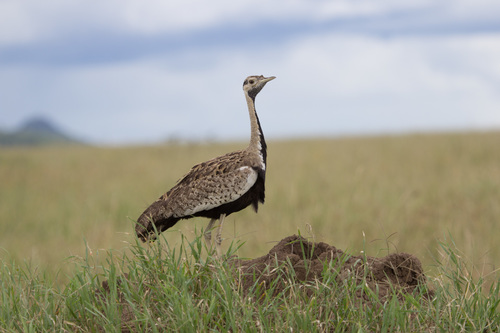
Kori Bustard

Kori Bustard

Ardeotis kori

Silhouette: TeaandBiology · PhyloPic

LCNTNear ThreatenedVUENCR
Daily sighting probability ~20% · Possible
at Chobe National Park

In 3 days ~60% in a week ~90%

487 Verified sightings at Chobe National Park From 2019 to 2026
9,203 In all 21 parks
July Best month
☀️ Diurnal When it's spotted

About the Kori Bustard

The kori bustard (Ardeotis kori) is the largest flying bird native to Africa. It is a member of the bustard family, which all belong to the order Otidiformes and are restricted in distribution to the Old World. It is one of the four species (ranging from Africa to India to Australia) in the large-bodied genus Ardeotis. The male kori bustard may be the heaviest living animal capable of flight.

This species, like most bustards, is a ground-dwelling bird and an opportunistic omnivore. Male kori bustards, which can be more than twice as heavy as the female, attempt to breed with as many females as possible and take no part in the raising of the young. The nest is a shallow hollow in the earth, often disguised by nearby obstructive objects such as trees.

English naturalist William John Burchell described the kori bustard in 1822. The specific epithet kori is derived from the Tswana name for this bird – Kgori. Two subspecies are currently recognized: Ardeotis kori kori – the relatively pale nominate race from Botswana, Zimbabwe, Namibia, southern Angola, South Africa and Mozambique.

Ardeotis kori struthiunculus – the "Somali kori" distributed in Ethiopia, Uganda, South Sudan... Wikipedia →

Sounds

Call0:09

Ethiopia · 2014

© Andrew Spencer · XC209987 · CC BY-NC-SA 4.0

Flight call0:04

South Africa · 2016

© Lynette Rudman · XC320416 · CC BY-NC-SA 4.0

Call0:23

Kenya · 2018

© Frank Lambert · XC451504 · CC BY-NC-ND 4.0

Global Distribution

Parks Where Found

# Park Country Daily sighting probability
1 Etosha National Park 🇳🇦 Namibia
~60%
2 Kgalagadi Transfrontier Park 🇿🇦 South Africa
~50%
3 Ngorongoro Conservation Area 🇹🇿 Tanzania
~50%
4 Amboseli National Park 🇰🇪 Kenya
~40%
5 Awash National Park 🇪🇹 Ethiopia
~40%
6 Serengeti National Park 🇹🇿 Tanzania
~30%
7 Samburu National Reserve 🇰🇪 Kenya
~30%
8 Hwange National Park 🇿🇼 Zimbabwe
~30%
9 Tsavo East National Park 🇰🇪 Kenya
~20%
10 Chobe National Park 🇧🇼 Botswana
~20%
11 Meru National Park 🇰🇪 Kenya
~20%
12 Pilanesberg National Park 🇿🇦 South Africa
~20%
13 Kruger National Park 🇿🇦 South Africa
~10%
14 Masai Mara National Reserve 🇰🇪 Kenya
~10%
15 Nairobi National Park 🇰🇪 Kenya
~10%
16 Tsavo West National Park 🇰🇪 Kenya
~10%
17 Waterberg Plateau Park 🇳🇦 Namibia
~10%
18 Moremi Game Reserve 🇧🇼 Botswana
~10%
19 Mkomazi National Park 🇹🇿 Tanzania
~10%
20 Tarangire National Park 🇹🇿 Tanzania
~10%
21 Lake Nakuru National Park 🇰🇪 Kenya
<5%

Zoos & Centres Where Found

# Zoo / Centre Country
1 Pairi Daiza 🇧🇪 Belgium In captivity
2 National Zoological Park 🇺🇸 United States In captivity
3 San Diego Zoo Safari Park 🇺🇸 United States In captivity
4 Al Ain Zoo 🇦🇪 United Arab Emirates In captivity
5 Living Desert Zoo and Gardens 🇺🇸 United States In captivity
6 Johannesburg Zoo 🇿🇦 South Africa In captivity
7 Birmingham Zoo 🇺🇸 United States In captivity
8 Franklin Park Zoo 🇺🇸 United States In captivity
9 Fort Worth Zoo 🇺🇸 United States In captivity
10 Montgomery Zoo 🇺🇸 United States In captivity
11 Blank Park Zoo 🇺🇸 United States In captivity
12 Cameron Park Zoo 🇺🇸 United States In captivity
13 Zoo Atlanta 🇺🇸 United States In captivity
14 bioparco 🇮🇹 Italy In captivity
15 Parc zoologique de Fréjus 🇫🇷 France In captivity
16 The Abilene Zoo 🇺🇸 United States In captivity
17 Georgia Aquarium 🇺🇸 United States In captivity
18 Glen Echo Park Aquarium 🇺🇸 United States In captivity

Before you go

What are the chances of seeing a Kori Bustard in Chobe National Park?

Possible

About 20% of wildlife watchers report a Kori Bustard sighting in Chobe National Park on a given day, based on 487 verified sightings from GBIF citizen-science data from 2019 to 2026. It is the 55th most-seen of the 373 birds we can rate there. Over three days the chance rises to about 60%, and over a week to about 90%, if each day is a fresh chance.

When is the best time to see a Kori Bustard in Chobe National Park?

February–March, May–August, October and December

In those months about 30% of wildlife watchers report a Kori Bustard in Chobe National Park on a given day, against about 10% in January and November, the lowest months.

What time of day is best to see a Kori Bustard?

Between 2 and 5 pm

Across all the parks we cover, that three-hour window holds the most Kori Bustard sightings with a recorded time, and about 9 in 10 of them come between 6 am and 6 pm: it is a daytime animal.

Which relatives of the Kori Bustard live in Chobe National Park?

Same family: Otididae

The closest relatives of the Kori Bustard that you can see in Chobe National Park (family Otididae, Bustards) are Crested Bustard (about 10%) and White-Quilled Bustard (about 10%), with each one's daily chance of a sighting.

Where does the Kori Bustard sighting chance come from?

GBIF citizen-science records

It is estimated from how often the Kori Bustard is recorded against all the birds logged in Chobe National Park (487 verified sightings from 2019 to 2026), calibrated against known sighting rates. Figures are rounded to the nearest 10% because citizen-science data supports honest approximations, not decimals, and months with records from fewer than five people show "—". How it works.

← Back to Chobe National Park