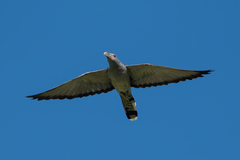
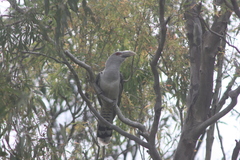
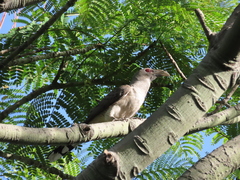
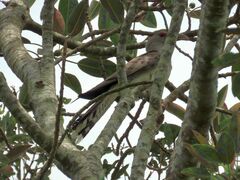

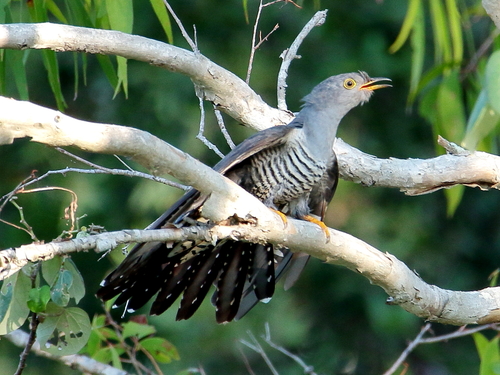
Channel-billed Cuckoo

Channel-billed Cuckoo

Scythrops novaehollandiae

Silhouette: Nicolas Huet le Jeune and Jean-Gabriel Prêtre (vectorized by T. Michael Keesey) · PhyloPic

LCLeast ConcernNTVUENCR
Daily sighting probability ~10% · With luck
at Brisbane

In 3 days ~30% in a week ~60%

2,268 Verified sightings at Brisbane
1,590 In all 10 parks From 2019 to 2026
December Best month
☀️ Diurnal When it's spotted

About the Channel-billed Cuckoo

The channel-billed cuckoo (Scythrops novaehollandiae) is a species of cuckoo in the family Cuculidae. It is monotypic within the genus Scythrops. The species is the largest brood parasite in the world, and the largest cuckoo.

It is found in Australia, New Guinea and Indonesia; additionally, it is vagrant in New Caledonia and New Zealand. The species is migratory over part of its range. There are three subspecies, one migratory, the other two resident. The species is listed as least concern by the IUCN.

Captain Arthur Phillip wrote of this (at the time) mysterious bird—calling it the 'psittaceous hornbill'—in his 1789 work The voyage of Governor Phillip to Botany Bay, consulting with ornithologist John Latham and deliberating that it had features of a parrot, hornbill or toucan, though conceding there were no toucans in the region. He gave it the name Scythrops novaehollandiae in 1790. Its generic name is derived from the Ancient Greek skuthro-/σκυθρο- 'angry' or 'sullen', and ops/ωψ 'face', 'eye' or 'countenance'. The specific epithet novaehollandiae means of New Holland, hence Australian. John White, the surgeon-general of the First Fleet to New South Wales, wrote... Wikipedia →

Sounds

Call0:06

Australia · 2024

© Stephen Matthews · XC1143777 · CC BY-NC-SA 4.0

Song0:58

Australia · 2024

© Nick Talbot · XC958124 · CC BY-NC-SA 4.0

Flight call0:09

Indonesia · 2024

© Ding Li Yong · XC924887 · CC BY-NC-ND 4.0

Global Distribution

Parks Where Found

# Park Country Daily sighting probability
1 Raja Ampat 🇮🇩 Indonesia
~20%
2 Kakadu National Park 🇦🇺 Australia
~10%
3 Royal National Park 🇦🇺 Australia
~10%
4 Tangkoko Nature Reserve 🇮🇩 Indonesia
~10%
5 Blue Mountains National Park 🇦🇺 Australia
~10%
6 Daintree National Park 🇦🇺 Australia
~10%
7 Springbrook National Park 🇦🇺 Australia
<5%
8 Nitmiluk National Park 🇦🇺 Australia
<5%
9 Noosa National Park 🇦🇺 Australia
<5%
10 Lamington National Park 🇦🇺 Australia
<5%

Cities Where Found

# City Country Daily sighting probability
1 Sydney 🇦🇺 Australia
~10%
2 Brisbane 🇦🇺 Australia
~10%
3 Melbourne 🇦🇺 Australia
<5%

Zoos & Centres Where Found

# Zoo / Centre Country
1 Territory Wildlife Park 🇦🇺 Australia In captivity
2 Perth Zoo 🇦🇺 Australia In captivity
3 Adelaide Zoo 🇦🇺 Australia In captivity
4 Featherdale Sydney Wildlife Park 🇦🇺 Australia In captivity
5 Flying High Bird Sanctuary 🇦🇺 Australia In captivity

Before you go

What are the chances of seeing a Channel-billed Cuckoo in Brisbane?

With luck

About 10% of wildlife watchers report a Channel-billed Cuckoo sighting in Brisbane on a given day, based on 2,268 verified sightings from GBIF citizen-science data. It is the 73rd most-seen of the 237 birds we can rate there. Over three days the chance rises to about 30%, and over a week to about 60%, if each day is a fresh chance.

When is the best time to see a Channel-billed Cuckoo in Brisbane?

December

In that month about 40% of wildlife watchers report a Channel-billed Cuckoo in Brisbane on a given day, against under 5% in March to August, the lowest months. That is one of Brisbane's wettest months, with about 130 mm of rain against 40 mm in July.

What time of day is best to see a Channel-billed Cuckoo?

Between 7 and 10 am

Across all the parks we cover, that three-hour window holds the most Channel-billed Cuckoo sightings with a recorded time, and about 9 in 10 of them come between 6 am and 6 pm: it is a daytime animal.

Is Brisbane the best place to see a Channel-billed Cuckoo?

Among the best

Of the 3 cities where we can rate Channel-billed Cuckoo sightings, Brisbane ranks 2nd at about 10%, level with the leaders once rounded. The best odds are in Sydney (Australia, about 10%).

Which relatives of the Channel-billed Cuckoo live in Brisbane?

Same family: Cuculidae

The closest relatives of the Channel-billed Cuckoo that you can see in Brisbane (family Cuculidae, Cuckoos) are Pheasant Coucal (about 10%), Pacific Koel (about 10%) and Fan-tailed Cuckoo (about 10%), with each one's daily chance of a sighting.

Where does the Channel-billed Cuckoo sighting chance come from?

GBIF citizen-science records

It is estimated from how often the Channel-billed Cuckoo is recorded against all the birds logged in Brisbane (2,268 verified sightings), calibrated against known sighting rates. Figures are rounded to the nearest 10% because citizen-science data supports honest approximations, not decimals, and months with records from fewer than five people show "—". How it works.

← Back to Brisbane