Masked Gnatcatcher

Masked Gnatcatcher

Polioptila dumicola

Silhouette: Sheatherius · PhyloPic

LCLeast ConcernNTVUENCR
Daily sighting probability ~50% · Likely
at Buenos Aires

In 3 days ~80% in a week >90%

7,698 Verified sightings at Buenos Aires
2,018 In all 9 parks From 2019 to 2026
June Best month
☀️ Diurnal When it's spotted

About the Masked Gnatcatcher

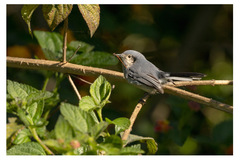
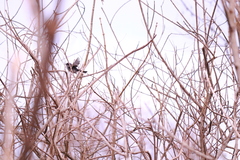
The masked gnatcatcher (Polioptila dumicola) is a small songbird in the family Polioptilidae. It is found in Argentina, Bolivia, Brazil, Paraguay, and Uruguay. The last subspecies differs in both plumage and voice from the other two and may represent a separate species.

The masked gnatcatcher is 12 to 13 cm (4.7 to 5.1 in) long and weighs 5 to 7 g (0.18 to 0.25 oz), larger than most other gnatcatchers. The nominate male has a large black mask with a thin white line below it. Its forehead, crown, nape, and upperparts are blue-gray. Its tail is mostly black with white outer feathers. Its throat is pale gray fading to whitish on the belly. The nominate female does not have a mask but instead a black crescent down from the eye. Its upperparts are duller and not as bluish. P. d. saturata is darker than the nominate; it is slate gray overall that is lighter on the underside. The P. d. berlepschi male is paler than the nominate, dull gray rather than blue-gray above and white below, and has a narrower mask... Wikipedia →

Sounds

Song0:54

Brazil · 2026

© Robson Silva e Silva · XC1151146 · CC BY-NC-SA 4.0

Call0:10

Argentina · 2025

© Marcos E. Sosa · XC1042946 · CC BY-NC-SA 4.0

Recording0:35

Argentina · 2023

© Sabrina Andrea Rendon Anaya · XC863371 · CC BY-NC-SA 4.0

Global Distribution

Parks Where Found

# Park Country Daily sighting probability
1 El Palmar National Park 🇦🇷 Argentina
~60%
2 Iberá National Park 🇦🇷 Argentina
~50%
3 El Impenetrable National Park 🇦🇷 Argentina
~40%
4 Parque Estadual Encontro das Águas 🇧🇷 Brazil
~30%
5 Emas National Park 🇧🇷 Brazil
~30%
6 Chapada dos Guimarães National Park 🇧🇷 Brazil
~10%
7 Serra da Canastra National Park 🇧🇷 Brazil
<5%
8 Iguaçu National Park 🇧🇷 Brazil
<5%
9 Iguazú National Park 🇦🇷 Argentina
<5%

Cities Where Found

# City Country Daily sighting probability
1 Rosario 🇦🇷 Argentina
~60%
2 Buenos Aires 🇦🇷 Argentina
~50%
3 Asuncion 🇵🇾 Paraguay
~40%
4 Goiânia 🇧🇷 Brazil
~30%
5 Cordoba 🇦🇷 Argentina
~20%
6 Brasilia 🇧🇷 Brazil
~20%
7 Montevideo 🇺🇾 Uruguay
~10%
8 Belém 🇧🇷 Brazil
<5%
9 Campo Grande 🇧🇷 Brazil
<5%
10 Porto Alegre 🇧🇷 Brazil
<5%

Before you go

What are the chances of seeing a Masked Gnatcatcher in Buenos Aires?

Likely

About 50% of wildlife watchers report a Masked Gnatcatcher sighting in Buenos Aires on a given day, based on 7,698 verified sightings from GBIF citizen-science data. It is the 19th most-seen of the 274 birds we can rate there. Over three days the chance rises to about 80%, and over a week to over 90%, if each day is a fresh chance.

When is the best time to see a Masked Gnatcatcher in Buenos Aires?

June and July

In those months about 60% of wildlife watchers report a Masked Gnatcatcher in Buenos Aires on a given day, against about 40% in November to March, the lowest months.

What time of day is best to see a Masked Gnatcatcher?

Between 3 and 6 pm

Across all the parks we cover, that three-hour window holds the most Masked Gnatcatcher sightings with a recorded time, and nearly all of them come between 6 am and 6 pm: it is a daytime animal.

Is Buenos Aires the best place to see a Masked Gnatcatcher?

2nd of 11

Of the 11 cities where we can rate Masked Gnatcatcher sightings, Buenos Aires ranks 2nd at about 50%. The best odds are in Rosario (Argentina, about 60%).

Which relatives of the Masked Gnatcatcher live in Buenos Aires?

Same order: Passeriformes

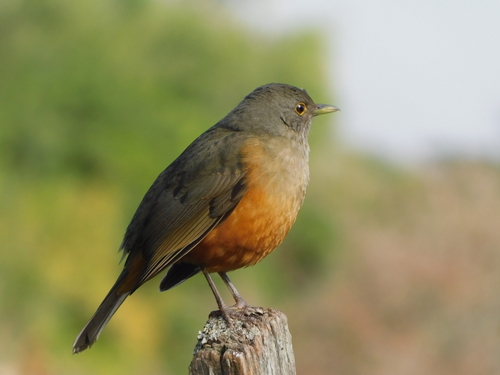
The closest relatives of the Masked Gnatcatcher that you can see in Buenos Aires (order Passeriformes, Perching Birds) are Great Kiskadee (about 90%), Rufous Hornero (about 90%) and Rufous-bellied Thrush (about 90%), with each one's daily chance of a sighting.

Where does the Masked Gnatcatcher sighting chance come from?

GBIF citizen-science records

It is estimated from how often the Masked Gnatcatcher is recorded against all the birds logged in Buenos Aires (7,698 verified sightings), calibrated against known sighting rates. Figures are rounded to the nearest 10% because citizen-science data supports honest approximations, not decimals, and months with records from fewer than five people show "—". How it works.

← Back to Buenos Aires