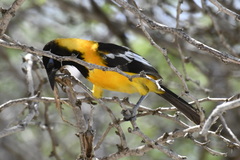
Orange-backed Oriole

Orange-backed Oriole

Icterus icterus

Silhouette: Matt Wilkins · PhyloPic

LCLeast ConcernNTVUENCR
Daily sighting probability <5% · Rare
at Campo Grande

In 3 days ~10% in a week ~20%

34 Verified sightings at Campo Grande
2,289 In all 9 parks From 2019 to 2026
August Best month
☀️ Diurnal When it's spotted

About the Orange-backed Oriole

The Venezuelan troupial, known in Venezuela as the Turpial (Icterus icterus), is the national bird of Venezuela. It is found in Colombia, Venezuela, and the Caribbean islands of Aruba, Curaçao, Bonaire, Trinidad, and Puerto Rico. Together with the orange-backed troupial and campo troupial, it was previously part of a superspecies simply named the troupial that was split.

The term troupial is from French troupiale, from troupe ("troop"), so named because they live in flocks. The Latin name icterus is from Greek ἴκτερος (íkteros, "jaundice"); the icterus was a bird the sight of which was believed to cure jaundice, perhaps the Eurasian golden oriole. It also had the more general meaning "yellow bird", which is why the name was later given to this South American bird.

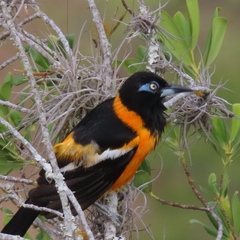
Venezuelan troupials are fairly large in size, with a long tail and a bulky bill. It has a black head and upper breast. The feathers on the front of the neck and upper breast stick outward, making an uneven boundary between the black and the orange of the bird's lower breast and underside. The rest of the orange color is found on the upper and lower back, separated by the black shoulders. The wings... Wikipedia →

Sounds

Recording0:05

Netherlands · 2018

© Anonymous · XC876579 · CC BY-NC-SA 4.0

Call0:08

Venezuela · 2023

© Francisco contreras · XC838683 · CC BY-NC-SA 4.0

Song0:23

Netherlands · 2021

© Joost van Bruggen · XC669356 · CC BY-NC-ND 4.0

Global Distribution

Parks Where Found

# Park Country Daily sighting probability
1 El Impenetrable National Park 🇦🇷 Argentina
~60%
2 Parque Estadual Encontro das Águas 🇧🇷 Brazil
~40%
3 Amacayacu National Natural Park 🇨🇴 Colombia
~20%
4 Chapada Diamantina National Park 🇧🇷 Brazil
~20%
5 Yasuní National Park 🇪🇨 Ecuador
~20%
6 Manu National Park 🇵🇪 Peru
~10%
7 Tambopata National Reserve 🇵🇪 Peru
<5%
8 Cuyabeno Wildlife Reserve 🇪🇨 Ecuador
<5%
9 Chapada dos Guimarães National Park 🇧🇷 Brazil
<5%

Cities Where Found

# City Country Daily sighting probability
1 Campinas 🇧🇷 Brazil
~10%
2 Campo Grande 🇧🇷 Brazil
<5%
3 Santa Cruz de la Sierra 🇧🇴 Bolivia
<5%
4 Bogota 🇨🇴 Colombia
<5%
5 Maracaibo 🇻🇪 Venezuela
<5%
6 São Paulo 🇧🇷 Brazil
<5%
7 Salvador 🇧🇷 Brazil
<5%
8 Vitória 🇧🇷 Brazil
<5%
9 Fortaleza 🇧🇷 Brazil
<5%
10 Brasilia 🇧🇷 Brazil
<5%

Zoos & Centres Where Found

# Zoo / Centre Country
1 Zoo Miami 🇺🇸 United States In captivity
2 Bronx Zoo 🇺🇸 United States In captivity
3 Brookfield Zoo 🇺🇸 United States In captivity
4 Audubon Zoo 🇺🇸 United States In captivity
5 Caldwell Zoo 🇺🇸 United States In captivity
6 Woodland Park Zoo 🇺🇸 United States In captivity
7 Moody Gardens 🇺🇸 United States In captivity
8 Fort Worth Zoo 🇺🇸 United States In captivity
9 Memphis Zoo 🇺🇸 United States In captivity
10 San Antonio Zoo 🇺🇸 United States In captivity
11 El Paso Zoo 🇺🇸 United States In captivity
12 Riverbanks Zoo 🇺🇸 United States In captivity
13 Rosamond Gifford Zoo 🇺🇸 United States In captivity
14 Aviario Nacional de Colombia 🇨🇴 Colombia In captivity
15 Topeka Zoo 🇺🇸 United States In captivity
16 Santa Ana Zoo 🇺🇸 United States In captivity
17 Reid Park Zoo 🇺🇸 United States In captivity
18 Como Park Zoo and Conservatory 🇺🇸 United States In captivity
19 Como Zoo 🇺🇸 United States In captivity
20 The Living Planet Aquarium 🇺🇸 United States In captivity
21 Greenville Zoo 🇺🇸 United States In captivity
22 Staten Island Zoo 🇺🇸 United States In captivity
23 Tracy Aviary 🇺🇸 United States In captivity
24 Central Park Zoo 🇺🇸 United States In captivity
25 National Aviary 🇺🇸 United States In captivity
26 Texas State Aquarium 🇺🇸 United States In captivity
27 OdySea Aquarium 🇺🇸 United States In captivity
28 Dallas World Aquarium 🇺🇸 United States In captivity
29 Cali Zoo 🇨🇴 Colombia In captivity

Before you go

What are the chances of seeing an Orange-backed Oriole in Campo Grande?

Rare

Under 5% of wildlife watchers report an Orange-backed Oriole sighting in Campo Grande on a given day, based on 34 verified sightings from GBIF citizen-science data. It is the 127th most-seen of the 221 birds we can rate there. Over three days the chance rises to about 10%, and over a week to about 20%, if each day is a fresh chance.

When is the best time to see an Orange-backed Oriole in Campo Grande?

January, May, August and October

In those months about 10% of wildlife watchers report an Orange-backed Oriole in Campo Grande on a given day, against under 5% in February–April, June–July, September and November–December, the lowest months.

What time of day is best to see an Orange-backed Oriole?

Between 7 and 10 am

Across all the parks we cover, that three-hour window holds the most Orange-backed Oriole sightings with a recorded time, and about 8 in 10 of them come between 6 am and 6 pm: it is a daytime animal.

Is Campo Grande the best place to see an Orange-backed Oriole?

2nd of 12

Of the 12 cities where we can rate Orange-backed Oriole sightings, Campo Grande ranks 2nd at under 5%. The best odds are in Campinas (Brazil, about 10%).

Where does the Orange-backed Oriole sighting chance come from?

GBIF citizen-science records

It is estimated from how often the Orange-backed Oriole is recorded against all the birds logged in Campo Grande (34 verified sightings), calibrated against known sighting rates. Figures are rounded to the nearest 10% because citizen-science data supports honest approximations, not decimals, and months with records from fewer than five people show "—". How it works.

← Back to Campo Grande