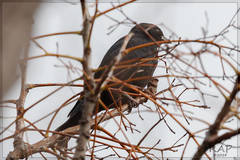
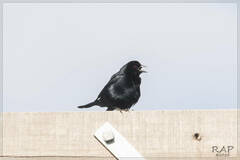
Screaming Cowbird

Screaming Cowbird

Molothrus rufoaxillaris

Silhouette: Andy Wilson · PhyloPic

LCLeast ConcernNTVUENCR
Daily sighting probability <5% · Rare
at Campo Grande

In 3 days <5%

6 Verified sightings at Campo Grande
289 In all 8 parks From 2019 to 2026
February Best month
☀️ Diurnal When it's spotted

About the Screaming Cowbird

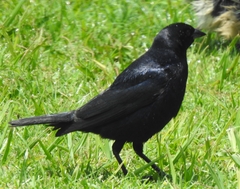
The screaming cowbird (Molothrus rufoaxillaris) is an obligate brood parasite belonging to the family Icteridae and is found in South America. It is also known commonly as the short billed cowbird. The screaming cowbird has mildly iridescent black plumage; the lesser under-wing coverts are rufous. The female is slightly duller in colour than the male. The legs are black and the iris is reddish brown. Adult body length is 18–21 cm and mean adult weight is 58 g for males and 48 g for females. The call of the screaming cowbird was first described as "impetuous screaming notes"; however, a more useful description for field identification is noisy, explosive and piercing with rasp-like calls also produced. Screaming cowbirds are mostly seen in pairs or small flocks.

Within South America, the screaming cowbird is found in north east and central Argentina, south east Bolivia, central Brazil and throughout Paraguay and Uruguay. Its natural habitat is pastureland where it forages amongst grazing animals such as cows, hence the name "cowbird". Similar to other cowbirds, it forages predominantly on the ground, eating invertebrates that have been... Wikipedia →

Sounds

Call0:17

Brazil · 2026

© JAYRSON ARAUJO DE OLIVEIRA · XC1163675 · CC BY-NC-SA 4.0

Song0:14

Brazil · 2022

© GABRIEL LEITE · XC707262 · CC BY-NC-SA 4.0

Recording0:11

Brazil · 2020

© Marcelo da Rocha · XC588183 · CC BY-NC-SA 4.0

Global Distribution

Parks Where Found

# Park Country Daily sighting probability
1 Iberá National Park 🇦🇷 Argentina
~10%
2 El Palmar National Park 🇦🇷 Argentina
~10%
3 Emas National Park 🇧🇷 Brazil
<5%
4 El Impenetrable National Park 🇦🇷 Argentina
<5%
5 Chapada dos Guimarães National Park 🇧🇷 Brazil
<5%
6 Serra da Canastra National Park 🇧🇷 Brazil
<5%
7 Iguaçu National Park 🇧🇷 Brazil
<5%
8 Iguazú National Park 🇦🇷 Argentina
<5%

Cities Where Found

# City Country Daily sighting probability
1 Cordoba 🇦🇷 Argentina
~20%
2 Buenos Aires 🇦🇷 Argentina
~20%
3 Rosario 🇦🇷 Argentina
~10%
4 Mendoza 🇦🇷 Argentina
~10%
5 Montevideo 🇺🇾 Uruguay
<5%
6 Asuncion 🇵🇾 Paraguay
<5%
7 Santa Cruz de la Sierra 🇧🇴 Bolivia
<5%
8 Porto Alegre 🇧🇷 Brazil
<5%
9 Santiago 🇨🇱 Chile
<5%
10 Curitiba 🇧🇷 Brazil
<5%

Before you go

What are the chances of seeing a Screaming Cowbird in Campo Grande?

Rare

Under 5% of wildlife watchers report a Screaming Cowbird sighting in Campo Grande on a given day, based on 6 verified sightings from GBIF citizen-science data. It is the 208th most-seen of the 221 birds we can rate there. Over three days the chance rises to under 5%, if each day is a fresh chance.

When is the best time to see a Screaming Cowbird in Campo Grande?

Any time of year

In every month with enough records, under 5% of wildlife watchers report a Screaming Cowbird in Campo Grande on a given day, so our monthly data shows no clear season.

What time of day is best to see a Screaming Cowbird?

Between 9 am and noon

Across all the parks we cover, that three-hour window holds the most Screaming Cowbird sightings with a recorded time, and about 9 in 10 of them come between 6 am and 6 pm: it is a daytime animal.

Is Campo Grande the best place to see a Screaming Cowbird?

11th of 11

Of the 11 cities where we can rate Screaming Cowbird sightings, Campo Grande ranks 11th at under 5%. The best odds are in Cordoba (Argentina, about 20%), Buenos Aires (Argentina, about 20%) and Rosario (Argentina, about 10%).

Where does the Screaming Cowbird sighting chance come from?

GBIF citizen-science records

It is estimated from how often the Screaming Cowbird is recorded against all the birds logged in Campo Grande (6 verified sightings), calibrated against known sighting rates. Figures are rounded to the nearest 10% because citizen-science data supports honest approximations, not decimals, and months with records from fewer than five people show "—". How it works.

← Back to Campo Grande