Fieldfare

Fieldfare

Turdus pilaris

Silhouette: Sharon Wegner-Larsen · PhyloPic

LCLeast ConcernNTVUENCR
Daily sighting probability ~10% · With luck
at Copenhagen

In 3 days ~20% in a week ~50%

195 Verified sightings at Copenhagen
2,621 In all 22 parks From 2019 to 2026
January Best month
☀️ Diurnal When it's spotted

About the Fieldfare

The fieldfare (Turdus pilaris) is a member of the thrush family Turdidae. It breeds in woodland and scrub in northern Europe and across the Palearctic. It is strongly migratory, with many northern birds moving south during the winter. It is a very rare breeder in the British Isles, but winters in large numbers in the United Kingdom, Southern Europe, North Africa and the Middle East. It is omnivorous, eating a wide range of molluscs, insects and earthworms in the summer, and berries, grain and seeds in the winter.

Fieldfares often nest in small colonies, possibly for protection from predators. The nest is built in a tree where five or six eggs are laid. The chicks are fed by both parents and leave the nest after a fortnight (a period of two weeks). There may be two broods in southern parts of the range but only one further north. Migrating birds and wintering birds often form large flocks, often in the company of redwings.

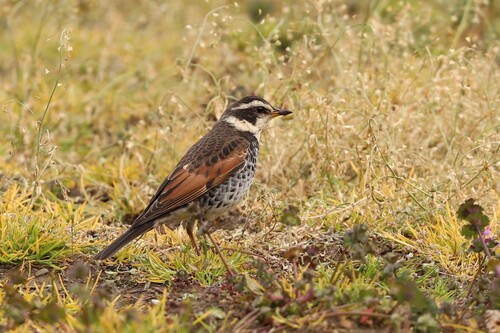
The fieldfare is 25 cm (10 in) long, with a grey crown, neck and rump, a plain brown back, dark wings and tail and white underwings. The breast and flanks are heavily spotted. The breast has a reddish wash and the rest of the underparts are white. The sexes are similar in appearance but the females are slightly more brown. The male has a simple chattering song and the birds have various guttural flight and alarm calls. Wikipedia →

Sounds

Alarm call0:20

Germany · 2026

© Kalle Nibbenhagen · XC1087166 · CC BY-NC-SA 4.0

Call1:14

Sweden · 2015

© Ulf Elman · XC969023 · CC BY-NC-ND 4.0

Song0:27

Estonia · 2023

© Uku Paal · XC804831 · CC BY-NC-SA 4.0

Global Distribution

Parks Where Found

# Park Country Daily sighting probability
1 Gauja National Park 🇱🇻 Latvia
~40%
2 Tatra National Park 🇸🇰 Slovakia
~30%
3 Biebrza National Park 🇵🇱 Poland
~30%
4 Ecrins National Park 🇫🇷 France
~20%
5 Vanoise National Park 🇫🇷 France
~20%
6 Bavarian Forest National Park 🇩🇪 Germany
~20%
7 Kiskunság National Park 🇭🇺 Hungary
~20%
8 Białowieża National Park 🇵🇱 Poland
~10%
9 Wadden Sea National Park 🇩🇪 Germany
~10%
10 Hohe Tauern National Park 🇦🇹 Austria
~10%
11 Hortobágy National Park 🇭🇺 Hungary
~10%
12 Fertő-Hanság National Park 🇭🇺 Hungary
~10%
13 Mercantour National Park 🇫🇷 France
<5%
14 Cairngorms National Park 🇬🇧 United Kingdom
<5%
15 Vatnajokull National Park 🇮🇸 Iceland
<5%
16 Snowdonia National Park 🇬🇧 United Kingdom
<5%
17 Triglav National Park 🇸🇮 Slovenia
<5%
18 Cévennes National Park 🇫🇷 France
<5%
19 Pyrénées National Park 🇫🇷 France
<5%
20 Sierra de Guadarrama National Park 🇪🇸 Spain
<5%
21 Sierra Nevada National Park 🇪🇸 Spain
<5%
22 Aigüestortes National Park 🇪🇸 Spain
<5%

Cities Where Found

# City Country Daily sighting probability
1 Moscow 🇷🇺 Russia
~70%
2 Yekaterinburg 🇷🇺 Russia
~70%
3 Minsk 🇧🇾 Belarus
~60%
4 Stockholm 🇸🇪 Sweden
~50%
5 Novosibirsk 🇷🇺 Russia
~50%
6 Nizhny Novgorod 🇷🇺 Russia
~50%
7 Kharkiv 🇺🇦 Ukraine
~50%
8 Saint Petersburg 🇷🇺 Russia
~50%
9 Warsaw 🇵🇱 Poland
~40%
10 Kyiv 🇺🇦 Ukraine
~40%

Zoos & Centres Where Found

# Zoo / Centre Country
1 Moscow Zoo 🇷🇺 Russia In captivity
2 Zoopark Limpopo 🇷🇺 Russia In captivity
3 Tiergarten Ulm 🇩🇪 Germany In captivity
4 paraZOO 🇨🇿 Czechia In captivity

Before you go

What are the chances of seeing a Fieldfare in Copenhagen?

With luck

About 10% of wildlife watchers report a Fieldfare sighting in Copenhagen on a given day, based on 195 verified sightings from GBIF citizen-science data. It is the 43rd most-seen of the 154 birds we can rate there. Over three days the chance rises to about 20%, and over a week to about 50%, if each day is a fresh chance.

When is the best time to see a Fieldfare in Copenhagen?

January

In that month about 30% of wildlife watchers report a Fieldfare in Copenhagen on a given day, against under 5% in April–May and July–September, the lowest months.

What time of day is best to see a Fieldfare?

Between 6 and 9 am

Across all the parks we cover, that three-hour window holds the most Fieldfare sightings with a recorded time, and about 8 in 10 of them come between 6 am and 6 pm: it is a daytime animal.

Is Copenhagen the best place to see a Fieldfare?

19th of 41

Of the 41 cities where we can rate Fieldfare sightings, Copenhagen ranks 19th at about 10%. The best odds are in Moscow (Russia, about 70%), Yekaterinburg (Russia, about 70%) and Minsk (Belarus, about 60%).

Where does the Fieldfare sighting chance come from?

GBIF citizen-science records

It is estimated from how often the Fieldfare is recorded against all the birds logged in Copenhagen (195 verified sightings), calibrated against known sighting rates. Figures are rounded to the nearest 10% because citizen-science data supports honest approximations, not decimals, and months with records from fewer than five people show "—". How it works.

← Back to Copenhagen