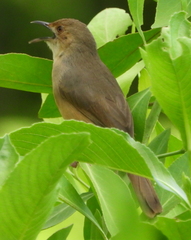
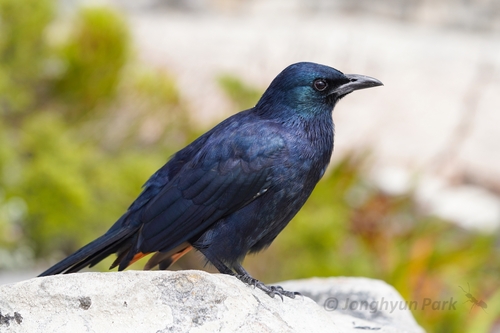
Red-faced Cisticola

Red-faced Cisticola

Cisticola erythrops

Silhouette: Sheatherius · PhyloPic

LCLeast ConcernNTVUENCR
Daily sighting probability <5% · Rare
at Durban

In 3 days <5% in a week ~10%

11 Verified sightings at Durban
2,985 In all 30 parks From 2019 to 2026
November Best month
☀️ Diurnal When it's spotted

About the Red-faced Cisticola

The red-faced cisticola (Cisticola erythrops) is a species of bird in the family Cisticolidae. It is widely present across sub-Saharan Africa (rare in southern Africa). Its natural habitats are subtropical or tropical seasonally wet or flooded lowland grassland and swamps.

The red-faced cisticola was formally described in 1857 by the German ornithologist Gustav Hartlaub under the binomial name Drymoeca erythrops based on a specimen collected near Calabar in Nigeria. The specific epithet erythrops combines the Ancient Greek ερυθρος/eruthros meaning "red" with ωψ/ōps meaning "eye" or "face". The red-faced cisticola is now one of 53 species placed in the genus Cisticola that was introduced in 1829 by the German naturalist Johann Jakob Kaup.

Six subspecies are recognised: Cisticola erythrops erythrops (Hartlaub, 1857) – Mauritania, Senegal and Gambia to Central African Republic, Congo and Gabon Cisticola erythrops pyrrhomitra Reichenow, 1916 – southeast Sudan and Ethiopia

Cisticola erythrops niloticus Madarász, G, 1914 – central Sudan Cisticola erythrops sylvia Reichenow, 1904 – northeast DR Congo and south Sudan to Kenya and central Tanzania Cisticola erythrops nyasa Lynes... Wikipedia →

Sounds

Song0:13

Kenya · 2026

© Ding Li Yong · XC1178802 · CC BY-NC-ND 4.0

Call0:37

Ghana · 2022

© Peter Boesman · XC719026 · CC BY-NC-ND 4.0

Duet0:36

Uganda · 2010

© Erik Eggenkamp · XC64944 · CC BY-NC-ND 2.5

Global Distribution

Parks Where Found

# Park Country Daily sighting probability
1 Kibale National Park 🇺🇬 Uganda
~30%
2 Kruger National Park 🇿🇦 South Africa
~20%
3 Queen Elizabeth National Park 🇺🇬 Uganda
~10%
4 Arusha National Park 🇹🇿 Tanzania
~10%
5 Ngorongoro Conservation Area 🇹🇿 Tanzania
~10%
6 Nairobi National Park 🇰🇪 Kenya
~10%
7 Hluhluwe-Imfolozi Park 🇿🇦 South Africa
~10%
8 Kafue National Park 🇿🇲 Zambia
~10%
9 Semuliki National Park 🇺🇬 Uganda
~10%
10 Virunga National Park 🇨🇩 Democratic Republic of the Congo
~10%
11 Gonarezhou National Park 🇿🇼 Zimbabwe
~10%
12 Gorongosa National Park 🇲🇿 Mozambique
~10%
13 Murchison Falls National Park 🇺🇬 Uganda
~10%
14 Kidepo Valley National Park 🇺🇬 Uganda
<5%
15 Mikumi National Park 🇹🇿 Tanzania
<5%
16 South Luangwa National Park 🇿🇲 Zambia
<5%
17 Aberdare National Park 🇰🇪 Kenya
<5%
18 Ruaha National Park 🇹🇿 Tanzania
<5%
19 iSimangaliso Wetland Park 🇿🇦 South Africa
<5%
20 Lake Mburo National Park 🇺🇬 Uganda
<5%
21 Lake Manyara National Park 🇹🇿 Tanzania
<5%
22 Lower Zambezi National Park 🇿🇲 Zambia
<5%
23 Akagera National Park 🇷🇼 Rwanda
<5%
24 Tarangire National Park 🇹🇿 Tanzania
<5%
25 uMkhuze Game Reserve 🇿🇦 South Africa
<5%
26 Chobe National Park 🇧🇼 Botswana
<5%
27 Bwindi Impenetrable National Park 🇺🇬 Uganda
<5%
28 Masai Mara National Reserve 🇰🇪 Kenya
<5%
29 Nyungwe National Park 🇷🇼 Rwanda
<5%
30 Serengeti National Park 🇹🇿 Tanzania
<5%

Cities Where Found

# City Country Daily sighting probability
1 Yaoundé 🇨🇲 Cameroon
~30%
2 Nairobi 🇰🇪 Kenya
~20%
3 Harare 🇿🇼 Zimbabwe
~20%
4 Kigali 🇷🇼 Rwanda
~10%
5 Lusaka 🇿🇲 Zambia
~10%
6 Dar es-Salaam 🇹🇿 Tanzania
~10%
7 Kampala 🇺🇬 Uganda
~10%
8 Accra 🇬🇭 Ghana
<5%
9 Maputo 🇲🇿 Mozambique
<5%
10 Durban 🇿🇦 South Africa
<5%

Before you go

What are the chances of seeing a Red-faced Cisticola in Durban?

Rare

Under 5% of wildlife watchers report a Red-faced Cisticola sighting in Durban on a given day, based on 11 verified sightings from GBIF citizen-science data. It is the 168th most-seen of the 219 birds we can rate there. Over three days the chance rises to under 5%, and over a week to about 10%, if each day is a fresh chance.

When is the best time to see a Red-faced Cisticola in Durban?

Any time of year

In every month with enough records, under 5% of wildlife watchers report a Red-faced Cisticola in Durban on a given day, so our monthly data shows no clear season.

What time of day is best to see a Red-faced Cisticola?

Between 7 and 10 am

Across all the parks we cover, that three-hour window holds the most Red-faced Cisticola sightings with a recorded time, and about 9 in 10 of them come between 6 am and 6 pm: it is a daytime animal.

Is Durban the best place to see a Red-faced Cisticola?

10th of 10

Of the 10 cities where we can rate Red-faced Cisticola sightings, Durban ranks 10th at under 5%. The best odds are in Yaoundé (Cameroon, about 30%), Nairobi (Kenya, about 20%) and Harare (Zimbabwe, about 20%).

Where does the Red-faced Cisticola sighting chance come from?

GBIF citizen-science records

It is estimated from how often the Red-faced Cisticola is recorded against all the birds logged in Durban (11 verified sightings), calibrated against known sighting rates. Figures are rounded to the nearest 10% because citizen-science data supports honest approximations, not decimals, and months with records from fewer than five people show "—". How it works.

← Back to Durban