
Indian Gray Mongoose

Indian Gray Mongoose

Herpestes edwardsi

Silhouette: Margot Michaud · PhyloPic

Daily sighting probability ~10% · With luck
at Kochi

In 3 days ~30% in a week ~60%

25 Verified sightings at Kochi
91 In all 9 parks From 2019 to 2026
July Best month
🌅 Crepuscular When it's spotted

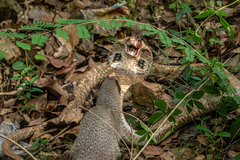
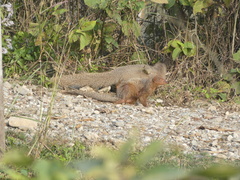
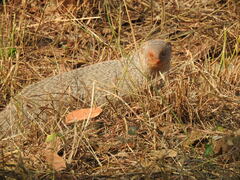
About the Indian Gray Mongoose

The Indian grey mongoose or Asian grey mongoose (Urva edwardsii) is a mongoose species native to the Indian subcontinent and West Asia. It is listed as least concern on the IUCN Red List. The grey mongoose inhabits open forests, scrublands and cultivated fields, often close to human habitation. It lives in burrows, hedgerows and thickets, among groves of trees, and takes shelter under rocks or bushes and even in drains. It is bold and inquisitive but wary, seldom venturing far from cover. It is an excellent climber and usually lives singly or in pairs. Its prey includes rodents, snakes, birds' eggs and hatchlings, lizards and a variety of invertebrates. Along the Chambal River it occasionally feeds on gharial eggs. It breeds throughout the year.

Ichneumon edwardsii was the scientific name proposed by Étienne Geoffroy Saint-Hilaire in 1817. It was later classified in the genus Herpestes, but all Asian mongooses are now classified in the genus Urva. Wikipedia →

Global Distribution

Parks Where Found

# Park Country Daily sighting probability
1 Mudumalai National Park 🇮🇳 India
~40%
2 Gir National Park 🇮🇳 India
~40%
3 Udawalawe National Park 🇱🇰 Sri Lanka
~30%
4 Ranthambore National Park 🇮🇳 India
~30%
5 Wilpattu National Park 🇱🇰 Sri Lanka
~30%
6 Royal Bardia National Park 🇳🇵 Nepal
~30%
7 Yala National Park 🇱🇰 Sri Lanka
~30%
8 Minneriya National Park 🇱🇰 Sri Lanka
~30%
9 Chitwan National Park 🇳🇵 Nepal
~30%

Cities Where Found

# City Country Daily sighting probability
1 Thiruvananthapuram 🇮🇳 India
~30%
2 Chennai 🇮🇳 India
~30%
3 Kolkata 🇮🇳 India
~30%
4 Kollam 🇮🇳 India
~20%
5 Pune 🇮🇳 India
~20%
6 Kozhikode 🇮🇳 India
~20%
7 Jaipur 🇮🇳 India
~20%
8 Mumbai 🇮🇳 India
~10%
9 Bengaluru 🇮🇳 India
~10%
10 Kochi 🇮🇳 India
~10%

Before you go

What are the chances of seeing an Indian Gray Mongoose in Kochi?

With luck

About 10% of wildlife watchers report an Indian Gray Mongoose sighting in Kochi on a given day, based on 25 verified sightings from GBIF citizen-science data. It is the 3rd most-seen of the 5 mammals we can rate there. Over three days the chance rises to about 30%, and over a week to about 60%, if each day is a fresh chance.

When is the best time to see an Indian Gray Mongoose in Kochi?

July and October–December

In those months about 20% of wildlife watchers report an Indian Gray Mongoose in Kochi on a given day, against under 5% in January and April, the lowest months.

What time of day is best to see an Indian Gray Mongoose?

Between 3 and 6 am

Across all the parks we cover, that three-hour window holds the most Indian Gray Mongoose sightings with a recorded time, and about half of them come between 6 am and 6 pm: it is most active around dawn and dusk.

Is Kochi the best place to see an Indian Gray Mongoose?

10th of 13

Of the 13 cities where we can rate Indian Gray Mongoose sightings, Kochi ranks 10th at about 10%. The best odds are in Thiruvananthapuram (India, about 30%), Chennai (India, about 30%) and Kolkata (India, about 30%).

Where does the Indian Gray Mongoose sighting chance come from?

GBIF citizen-science records

It is estimated from how often the Indian Gray Mongoose is recorded against all the mammals logged in Kochi (25 verified sightings), calibrated against known sighting rates. Figures are rounded to the nearest 10% because citizen-science data supports honest approximations, not decimals, and months with records from fewer than five people show "—". How it works.

← Back to Kochi