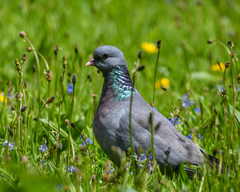
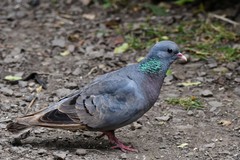

Stock Dove

Stock Dove

Columba oenas

Silhouette: Bengt Nyman · PhyloPic

LCLeast ConcernNTVUENCR
Daily sighting probability ~30% · Possible
at Liverpool

In 3 days ~60% in a week ~90%

944 Verified sightings at Liverpool
1,604 In all 14 parks From 2019 to 2026
August Best month
☀️ Diurnal When it's spotted

About the Stock Dove

The stock dove (Columba oenas) is a species of bird in the family Columbidae, the doves and pigeons. It is widely distributed in the western Palearctic, north to central Scandinavia and south to northwest Africa. Western and southern populations are resident, while northeastern populations are migratory to avoid the colder winters there. It is the type species of the genus Columba.

The stock dove was first formally described by the Swedish naturalist Carl Linnaeus in 1758 in the tenth edition of his Systema Naturae. He placed it with all the other pigeons in the genus Columba and coined the binomial name Columba oenas. The specific name oenas is from the Ancient Greek οἰνάς oinás meaning "pigeon".

Two subspecies are recognised: The stock dove is 28–34 cm (11–13 in) long, with a wingspan of 60–66 cm (24–26 in) and a weight of 303–365 g in males, 286–290 g in females. The plumage is a blue-toned... Wikipedia →

Sounds

Call0:44

Poland · 2025

© Romuald Mikusek · XC1092367 · CC BY-NC-SA 4.0

Song0:59

Poland · 2024

© Jarek Matusiak · XC961402 · CC BY-NC-ND 4.0

Begging call1:30

United Kingdom · 2022

© Simon Elliott · XC747099 · CC BY-NC-ND 4.0

Global Distribution

Parks Where Found

# Park Country Daily sighting probability
1 Wadden Sea National Park 🇩🇪 Germany
~10%
2 Białowieża National Park 🇵🇱 Poland
~10%
3 Fertő-Hanság National Park 🇭🇺 Hungary
~10%
4 Kiskunság National Park 🇭🇺 Hungary
~10%
5 Bavarian Forest National Park 🇩🇪 Germany
~10%
6 Biebrza National Park 🇵🇱 Poland
<5%
7 Cévennes National Park 🇫🇷 France
<5%
8 Snowdonia National Park 🇬🇧 United Kingdom
<5%
9 Hortobágy National Park 🇭🇺 Hungary
<5%
10 Cairngorms National Park 🇬🇧 United Kingdom
<5%
11 Monfragüe National Park 🇪🇸 Spain
<5%
12 Pyrénées National Park 🇫🇷 France
<5%
13 Camargue 🇫🇷 France
<5%
14 Sierra de Guadarrama National Park 🇪🇸 Spain
<5%

Cities Where Found

# City Country Daily sighting probability
1 London 🇬🇧 United Kingdom
~30%
2 Liverpool 🇬🇧 United Kingdom
~30%
3 Madrid 🇪🇸 Spain
~30%
4 Birmingham 🇬🇧 United Kingdom
~20%
5 Leeds 🇬🇧 United Kingdom
~20%
6 Paris 🇫🇷 France
~20%
7 Lyon 🇫🇷 France
~20%
8 Manchester 🇬🇧 United Kingdom
~20%
9 Helsinki 🇫🇮 Finland
~20%
10 Brussels 🇧🇪 Belgium
~20%

Zoos & Centres Where Found

# Zoo / Centre Country
1 Prague Zoo 🇨🇿 Czechia In captivity
2 Natura Artis Magistra 🇳🇱 Netherlands In captivity
3 Kyiv Zoo 🇺🇦 Ukraine In captivity
4 Rákosův pavilon 🇨🇿 Czechia In captivity
5 Velemlokárium 🇨🇿 Czechia In captivity

Before you go

What are the chances of seeing a Stock Dove in Liverpool?

Possible

About 30% of wildlife watchers report a Stock Dove sighting in Liverpool on a given day, based on 944 verified sightings from GBIF citizen-science data. It is the 49th most-seen of the 168 birds we can rate there. Over three days the chance rises to about 60%, and over a week to about 90%, if each day is a fresh chance.

When is the best time to see a Stock Dove in Liverpool?

March to August

In those months about 40% of wildlife watchers report a Stock Dove in Liverpool on a given day, against about 10% in October to December, the lowest months.

What time of day is best to see a Stock Dove?

Between 11 am and 2 pm

Across all the parks we cover, that three-hour window holds the most Stock Dove sightings with a recorded time, and about 8 in 10 of them come between 6 am and 6 pm: it is a daytime animal.

Is Liverpool the best place to see a Stock Dove?

Among the best

Of the 30 cities where we can rate Stock Dove sightings, Liverpool ranks 2nd at about 30%, level with the leaders once rounded. The best odds are in London (United Kingdom, about 30%).

Which relatives of the Stock Dove live in Liverpool?

Same genus: Columba

The closest relatives of the Stock Dove that you can see in Liverpool (genus Columba, Typical Old World Pigeons) are Wood Pigeon (about 90%) and Rock Pigeon (about 90%), with each one's daily chance of a sighting.

Where does the Stock Dove sighting chance come from?

GBIF citizen-science records

It is estimated from how often the Stock Dove is recorded against all the birds logged in Liverpool (944 verified sightings), calibrated against known sighting rates. Figures are rounded to the nearest 10% because citizen-science data supports honest approximations, not decimals, and months with records from fewer than five people show "—". How it works.

← Back to Liverpool