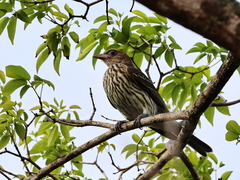
Australasian Figbird

Australasian Figbird

Sphecotheres vieilloti

Silhouette: Sheatherius · PhyloPic

LCLeast ConcernNTVUENCR
Daily sighting probability <5% · Rare
at Melbourne

In 3 days <5%

53 Verified sightings at Melbourne
2,343 In all 10 parks From 2019 to 2026
October Best month
☀️ Diurnal When it's spotted

About the Australasian Figbird

The Australasian figbird (Sphecotheres vieilloti), also known as the green figbird (not to be confused with the Timor figbird), is a conspicuous, medium-sized passerine bird native to a wide range of wooded habitats in northern and eastern Australia, southern New Guinea, and the Kai Islands. It is common in large parts of its range, and occurs in numerous protected areas. Consequently, it is rated as least concern by BirdLife International and the IUCN.

Formerly, the Australasian figbird was considered as a subspecies of the green figbird and referred to as simply the figbird, a name still commonly used in Australia, where the Australasian figbird is the only figbird present. The Australasian figbird was split from the green figbird primarily based on differences in measurements, plumage, and biogeography. Additionally, the Australasian figbird has sometimes been split into two separate species, the more northern, yellow figbird (S. flaviventris) and the green or southern figbird (S. vieilloti), but the two intergrade widely where they come into contact, supporting the view that they are part of a single biological species.

Five subspecies... Wikipedia →

Sounds

Call0:22

Australia · 2025

© Étienne Leroy · XC1070858 · CC BY-NC-SA 4.0

Song1:10

Australia · 2025

© Peter Boesman · XC1066975 · CC BY-NC-ND 4.0

Dawn song0:34

Australia · 2023

© James Lambert · XC839745 · CC BY-NC-ND 4.0

Global Distribution

Parks Where Found

# Park Country Daily sighting probability
1 Daintree National Park 🇦🇺 Australia
~60%
2 Noosa National Park 🇦🇺 Australia
~50%
3 Springbrook National Park 🇦🇺 Australia
~30%
4 Litchfield National Park 🇦🇺 Australia
~20%
5 Nitmiluk National Park 🇦🇺 Australia
~10%
6 Kakadu National Park 🇦🇺 Australia
~10%
7 Royal National Park 🇦🇺 Australia
~10%
8 Lamington National Park 🇦🇺 Australia
<5%
9 Booderee National Park 🇦🇺 Australia
<5%
10 Blue Mountains National Park 🇦🇺 Australia
<5%

Cities Where Found

# City Country Daily sighting probability
1 Brisbane 🇦🇺 Australia
~50%
2 Sydney 🇦🇺 Australia
~20%
3 Melbourne 🇦🇺 Australia
<5%

Zoos & Centres Where Found

# Zoo / Centre Country
1 Taronga Zoo 🇦🇺 Australia In captivity
2 Adelaide Zoo 🇦🇺 Australia In captivity
3 Featherdale Sydney Wildlife Park 🇦🇺 Australia In captivity
4 Bali Bird Park 🇮🇩 Indonesia In captivity
5 Birdworld Kuranda 🇦🇺 Australia In captivity
6 Kuranda Koala Gardens 🇦🇺 Australia In captivity

Before you go

What are the chances of seeing an Australasian Figbird in Melbourne?

Rare

Under 5% of wildlife watchers report an Australasian Figbird sighting in Melbourne on a given day, based on 53 verified sightings from GBIF citizen-science data. It is the 202nd most-seen of the 236 birds we can rate there. Over three days the chance rises to under 5%, if each day is a fresh chance.

When is the best time to see an Australasian Figbird in Melbourne?

Any time of year

In every month with enough records, under 5% of wildlife watchers report an Australasian Figbird in Melbourne on a given day, so our monthly data shows no clear season.

What time of day is best to see an Australasian Figbird?

Between 3 and 6 pm

Across all the parks we cover, that three-hour window holds the most Australasian Figbird sightings with a recorded time, and nearly all of them come between 6 am and 6 pm: it is a daytime animal.

Is Melbourne the best place to see an Australasian Figbird?

3rd of 3

Of the 3 cities where we can rate Australasian Figbird sightings, Melbourne ranks 3rd at under 5%. The best odds are in Brisbane (Australia, about 50%) and Sydney (Australia, about 20%).

Where does the Australasian Figbird sighting chance come from?

GBIF citizen-science records

It is estimated from how often the Australasian Figbird is recorded against all the birds logged in Melbourne (53 verified sightings), calibrated against known sighting rates. Figures are rounded to the nearest 10% because citizen-science data supports honest approximations, not decimals, and months with records from fewer than five people show "—". How it works.

← Back to Melbourne