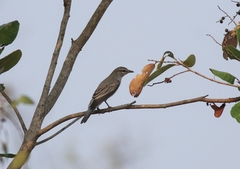
Black-headed Cuckooshrike

Black-headed Cuckooshrike

Coracina melanoptera

Silhouette: PhyloPic

Daily sighting probability <5% · Rare
at Nashik

In 3 days <5% in a week ~10%

5 Verified sightings at Nashik
1,587 In all 16 parks From 2019 to 2026
September Best month
☀️ Diurnal When it's spotted

About the Black-headed Cuckooshrike

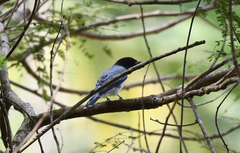
The black-headed cuckooshrike (Lalage melanoptera) is a species of cuckooshrike found in the Indian subcontinent and Southeast Asia. The Black-headed Cuckooshrike is a 18-20 cm slender bird found in the Indian subcontinent with distinct sexual dimorphism. Males feature a dark slaty-grey hood, neck, and upper breast, contrasting with a pale grey back and white belly. They have blackish wings with grey edges and white-tipped tail feathers. The females are duller, with brownish-grey upperparts, a whitish supercilium (eyebrow), and heavily barred underparts with a dark grey bill.

This is a resident and partially bird migratory that is found across the Indian subcontinent, including India, Bangladesh, Sri Lanka, Nepal, and Bhutan, extending to Myanmar. It inhabits open, dry-deciduous, or semi-evergreen forests, secondary growth, bamboo patches, and, frequently, urban gardens, orchards, and agricultural plantations up to 2,100 meters, typically preferring lower altitudes. Primarily distributed across India (from the Himalayan foothills in the north to the peninsula, including Rajasthan, Gujarat, Maharashtra, and Kerala), with breeding populations... Wikipedia →

Global Distribution

Parks Where Found

# Park Country Daily sighting probability
1 Mudumalai National Park 🇮🇳 India
~20%
2 Sinharaja Forest Reserve 🇱🇰 Sri Lanka
~20%
3 Udawalawe National Park 🇱🇰 Sri Lanka
~20%
4 Minneriya National Park 🇱🇰 Sri Lanka
~20%
5 Sundarbans National Park 🇮🇳 India
~10%
6 Yala National Park 🇱🇰 Sri Lanka
~10%
7 Wilpattu National Park 🇱🇰 Sri Lanka
~10%
8 Bandipur National Park 🇮🇳 India
~10%
9 Nagarhole National Park 🇮🇳 India
~10%
10 Bandhavgarh National Park 🇮🇳 India
<5%
11 Gir National Park 🇮🇳 India
<5%
12 Kanha National Park 🇮🇳 India
<5%
13 Satpura National Park 🇮🇳 India
<5%
14 Ranthambore National Park 🇮🇳 India
<5%
15 Periyar National Park 🇮🇳 India
<5%
16 Jim Corbett National Park 🇮🇳 India
<5%

Cities Where Found

# City Country Daily sighting probability
1 Thrissur 🇮🇳 India
~10%
2 Jabalpur 🇮🇳 India
~10%
3 Rajkot 🇮🇳 India
<5%
4 Tamluk 🇮🇳 India
<5%
5 Kozhikode 🇮🇳 India
<5%
6 Bengaluru 🇮🇳 India
<5%
7 Pune 🇮🇳 India
<5%
8 Kochi 🇮🇳 India
<5%
9 Dhaka 🇧🇩 Bangladesh
<5%
10 Bhubaneshwar 🇮🇳 India
<5%

Before you go

What are the chances of seeing a Black-headed Cuckooshrike in Nashik?

Rare

Under 5% of wildlife watchers report a Black-headed Cuckooshrike sighting in Nashik on a given day, based on 5 verified sightings from GBIF citizen-science data. It is the 136th most-seen of the 141 birds we can rate there. Over three days the chance rises to under 5%, and over a week to about 10%, if each day is a fresh chance.

When is the best time to see a Black-headed Cuckooshrike in Nashik?

September

In that month about 10% of wildlife watchers report a Black-headed Cuckooshrike in Nashik on a given day, against under 5% in October to August, the lowest months. That is one of Nashik's wettest months, with about 280 mm of rain against almost none in January.

What time of day is best to see a Black-headed Cuckooshrike?

Between 7 and 10 am

Across all the parks we cover, that three-hour window holds the most Black-headed Cuckooshrike sightings with a recorded time, and about 9 in 10 of them come between 6 am and 6 pm: it is a daytime animal.

Is Nashik the best place to see a Black-headed Cuckooshrike?

15th of 22

Of the 22 cities where we can rate Black-headed Cuckooshrike sightings, Nashik ranks 15th at under 5%. The best odds are in Thrissur (India, about 10%), Jabalpur (India, about 10%) and Rajkot (India, under 5%).

Where does the Black-headed Cuckooshrike sighting chance come from?

GBIF citizen-science records

It is estimated from how often the Black-headed Cuckooshrike is recorded against all the birds logged in Nashik (5 verified sightings), calibrated against known sighting rates. Figures are rounded to the nearest 10% because citizen-science data supports honest approximations, not decimals, and months with records from fewer than five people show "—". How it works.

← Back to Nashik