Blackish Rail

Blackish Rail

Pardirallus nigricans

Silhouette: Sheatherius · PhyloPic

LCLeast ConcernNTVUENCR
Daily sighting probability <5% · Rare
at Rio de Janeiro

In 3 days <5% in a week ~10%

76 Verified sightings at Rio de Janeiro
1,269 In all 8 parks From 2019 to 2026
December Best month
☀️ Diurnal When it's spotted

About the Blackish Rail

The blackish rail (Pardirallus nigricans) is a species of bird in the subfamily Rallinae of the rail, crake, and coot family Rallidae. It is found in Argentina, Brazil, Colombia, Ecuador, Paraguay, Peru, Venezuela, and possibly Bolivia.

The blackish rail has previously been placed in the large genus Rallus, and also in genus Orygonax with the plumbeous rail (Pardirallus sanguinolentus). Some authors propose that the blackish and plumbeous rails are conspecific, and they do form a superspecies.

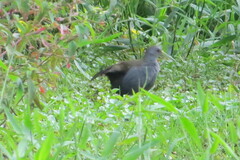
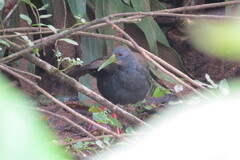
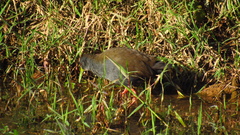
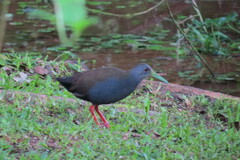
The blackish rail is 27 to 29 cm (11 to 11 in) long; one male weighed 217 g (7.7 oz). The sexes are alike. They have a long yellow-green bill and pinkish legs. The nominate subspecies has unmarked dark brown upperparts, a white chin and throat, and dark gray face and underparts. P. n. caucae is larger than the nominate and has a larger and whiter throat patch and paler underparts especially at the vent.

The blackish rail has a disjunct distribution. The nominate subspecies has two populations. One is found from northeastern Brazil... Wikipedia →

Sounds

Call0:06

Argentina · 2025

© Marcos E. Sosa · XC1065682 · CC BY-NC-SA 4.0

Duet0:31

Brazil · 2025

© rafarrinho · XC1064763 · CC BY-NC-SA 4.0

Song1:30

Brazil · 2025

© Marcelo J Feliti · XC1033127 · CC BY-NC-SA 4.0

Global Distribution

Parks Where Found

# Park Country Daily sighting probability
1 Iguazú National Park 🇦🇷 Argentina
~10%
2 Iguaçu National Park 🇧🇷 Brazil
~10%
3 Serra da Canastra National Park 🇧🇷 Brazil
<5%
4 Serra dos Órgãos National Park 🇧🇷 Brazil
<5%
5 Chapada Diamantina National Park 🇧🇷 Brazil
<5%
6 Manu National Park 🇵🇪 Peru
<5%
7 Farallones de Cali National Natural Park 🇨🇴 Colombia
<5%
8 Los Nevados National Natural Park 🇨🇴 Colombia
<5%

Cities Where Found

# City Country Daily sighting probability
1 Curitiba 🇧🇷 Brazil
~10%
2 São Paulo 🇧🇷 Brazil
~10%
3 Porto Alegre 🇧🇷 Brazil
~10%
4 Campinas 🇧🇷 Brazil
<5%
5 Belo Horizonte 🇧🇷 Brazil
<5%
6 Santos 🇧🇷 Brazil
<5%
7 Goiânia 🇧🇷 Brazil
<5%
8 Rio de Janeiro 🇧🇷 Brazil
<5%
9 Brasilia 🇧🇷 Brazil
<5%
10 Maceió 🇧🇷 Brazil
<5%

Before you go

What are the chances of seeing a Blackish Rail in Rio de Janeiro?

Rare

Under 5% of wildlife watchers report a Blackish Rail sighting in Rio de Janeiro on a given day, based on 76 verified sightings from GBIF citizen-science data. It is the 157th most-seen of the 278 birds we can rate there. Over three days the chance rises to under 5%, and over a week to about 10%, if each day is a fresh chance.

When is the best time to see a Blackish Rail in Rio de Janeiro?

Any time of year

In every month with enough records, under 5% of wildlife watchers report a Blackish Rail in Rio de Janeiro on a given day, so our monthly data shows no clear season.

What time of day is best to see a Blackish Rail?

Between 7 and 10 am

Across all the parks we cover, that three-hour window holds the most Blackish Rail sightings with a recorded time, and about 8 in 10 of them come between 6 am and 6 pm: it is a daytime animal.

Is Rio de Janeiro the best place to see a Blackish Rail?

8th of 10

Of the 10 cities where we can rate Blackish Rail sightings, Rio de Janeiro ranks 8th at under 5%. The best odds are in Curitiba (Brazil, about 10%), São Paulo (Brazil, about 10%) and Porto Alegre (Brazil, about 10%).

Which relatives of the Blackish Rail live in Rio de Janeiro?

Same family: Rallidae

The closest relatives of the Blackish Rail that you can see in Rio de Janeiro (family Rallidae, Rails, Gallinules, and Coots) are Gray-cowled Wood-Rail (about 10%), Slaty-breasted Wood-Rail (about 10%) and Common Moorhen (about 10%), with each one's daily chance of a sighting.

Where does the Blackish Rail sighting chance come from?

GBIF citizen-science records

It is estimated from how often the Blackish Rail is recorded against all the birds logged in Rio de Janeiro (76 verified sightings), calibrated against known sighting rates. Figures are rounded to the nearest 10% because citizen-science data supports honest approximations, not decimals, and months with records from fewer than five people show "—". How it works.

← Back to Rio de Janeiro