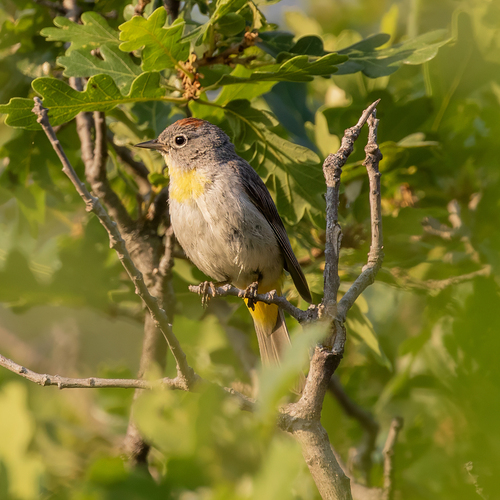
Audubon's Warbler

Audubon's Warbler

Setophaga auduboni

Silhouette: Richard Rich · PhyloPic

Daily sighting probability ~10% · With luck
at Salt Lake City

In 3 days ~20% in a week ~40%

21 Verified sightings at Salt Lake City
393 In all 17 parks From 2019 to 2026
April Best month
☀️ Diurnal When it's spotted

About the Audubon's Warbler

The yellow-rumped warbler (Setophaga coronata) is a North American bird species that can be commonly observed all across the continent. Its extensive range connects both the Pacific and Atlantic coasts of the U.S. as well as Canada and Central America, with the population concentrated in the continent's northern reaches during the breeding season and migrating southwards to southern North and Central America in the winter. It generally prefers coniferous forests or mixed coniferous-deciduous forests as its breeding habitat, while during the winter it can be found inhabiting more open areas such as shrublands that offer food resources. The yellow-rumped warbler is primarily insectivorous, though the species eats fruit such as juniper berries, especially in winter.

The species combines four closely related forms: the eastern myrtle warbler (spp. coronata); its western counterpart, Audubon's warbler (spp. group auduboni); the northwest Mexican black-fronted warbler (spp. nigrifrons); and the Guatemalan Goldman's warbler (spp. goldmani). All subspecies of the yellow-rumped warbler are characterized by the yellow rump as its name implies, while intra-group and inter-group variations in appearance exist in spite of many similarities. The myrtle and Audubon's groups, as two major subspecies, are distinguished by noticeable features such as differing throat colorations. Wikipedia →

Sounds

Song0:18

United States · 2026

© Ed Pandolfino · XC1153736 · CC BY-NC-SA 4.0

Call0:35

United States · 2025

© Greg Irving · XC1028825 · CC BY-NC-SA 4.0

Call0:30

Guatemala · 2024

© Peter Boesman · XC880296 · CC BY-NC-ND 4.0

Global Distribution

Parks Where Found

# Park Country Daily sighting probability
1 Reserva de la Biosfera Mariposa Monarca 🇲🇽 Mexico
~30%
2 Big Bend National Park 🇺🇸 United States
~20%
3 Guadalupe Mountains National Park 🇺🇸 United States
~20%
4 Grand Teton National Park 🇺🇸 United States
~20%
5 Rocky Mountain National Park 🇺🇸 United States
~10%
6 Sequoia and Kings Canyon National Parks 🇺🇸 United States
~10%
7 Yellowstone National Park 🇺🇸 United States
~10%
8 Yosemite National Park 🇺🇸 United States
~10%
9 Glacier National Park 🇺🇸 United States
~10%
10 Cumbres de Monterrey National Park 🇲🇽 Mexico
~10%
11 Channel Islands National Park 🇺🇸 United States
~10%
12 Banff National Park 🇨🇦 Canada
~10%
13 Great Bear Rainforest 🇨🇦 Canada
~10%
14 Joshua Tree National Park 🇺🇸 United States
~10%
15 Grand Canyon National Park 🇺🇸 United States
~10%
16 Olympic National Park 🇺🇸 United States
~10%
17 Saguaro National Park 🇺🇸 United States
<5%

Cities Where Found

# City Country Daily sighting probability
1 Torreón 🇲🇽 México
~40%
2 Guadalajara 🇲🇽 México
~30%
3 Sacramento 🇺🇸 United States
~20%
4 Mexico City 🇲🇽 México
~20%
5 Toluca 🇲🇽 México
~20%
6 Tijuana 🇲🇽 México
~20%
7 San Luis Potosí 🇲🇽 México
~20%
8 León 🇲🇽 México
~20%
9 Puebla 🇲🇽 México
~20%
10 Mesa 🇺🇸 United States
~20%

Before you go

What are the chances of seeing an Audubon's Warbler in Salt Lake City?

With luck

About 10% of wildlife watchers report an Audubon's Warbler sighting in Salt Lake City on a given day, based on 21 verified sightings from GBIF citizen-science data. It is the 55th most-seen of the 216 birds we can rate there. Over three days the chance rises to about 20%, and over a week to about 40%, if each day is a fresh chance.

When is the best time to see an Audubon's Warbler in Salt Lake City?

April and October–February

In those months about 10% of wildlife watchers report an Audubon's Warbler in Salt Lake City on a given day, against under 5% in March and May–September, the lowest months.

What time of day is best to see an Audubon's Warbler?

Between noon and 3 pm

Across all the parks we cover, that three-hour window holds the most Audubon's Warbler sightings with a recorded time, and about 9 in 10 of them come between 6 am and 6 pm: it is a daytime animal.

Is Salt Lake City the best place to see an Audubon's Warbler?

18th of 23

Of the 23 cities where we can rate Audubon's Warbler sightings, Salt Lake City ranks 18th at about 10%. The best odds are in Torreón (México, about 40%), Guadalajara (México, about 30%) and Sacramento (United States, about 20%).

Which relatives of the Audubon's Warbler live in Salt Lake City?

Same genus: Setophaga

The closest relatives of the Audubon's Warbler that you can see in Salt Lake City (genus Setophaga, Setophaga Warblers) are Yellow-rumped Warbler (about 30%), Yellow Warbler (about 20%) and Northern Yellow Warbler (about 10%), with each one's daily chance of a sighting.

Where does the Audubon's Warbler sighting chance come from?

GBIF citizen-science records

It is estimated from how often the Audubon's Warbler is recorded against all the birds logged in Salt Lake City (21 verified sightings), calibrated against known sighting rates. Figures are rounded to the nearest 10% because citizen-science data supports honest approximations, not decimals, and months with records from fewer than five people show "—". How it works.

← Back to Salt Lake City