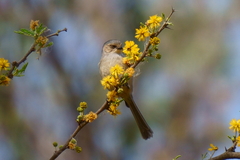
Bushtit

Bushtit

Psaltriparus minimus

Silhouette: Sheatherius · PhyloPic

LCLeast ConcernNTVUENCR
Daily sighting probability <5% · Rare
at Salt Lake City

In 3 days <5%

20 Verified sightings at Salt Lake City
6,141 In all 17 parks From 2019 to 2026
September Best month
☀️ Diurnal When it's spotted

About the Bushtit

The American bushtit, or simply bushtit (Psaltriparus minimus), is a social songbird belonging to the monotypic genus Psaltriparus. It is one of the smallest passerines in North America and it is the only species in the family Aegithalidae found in the Americas; the other eleven species occur in Eurasia.

The American bushtit's distinguishing characteristics are its tiny size, its plump and large head, and its long tail. Its range stretches from Vancouver in Canada, south through the Western United States, via the Great Basin, the lowlands and foothills of California, the highlands of Mexico, to Guatemala. Bushtits usually inhabit mixed open woodlands, which contains oaks and a scrubby chaparral understory. They can also be found residing in gardens and parks. Their food source is small insects, primarily, and spiders in mixed-species feeding flocks.

The sharp-shinned hawk and other raptors prey upon American bushtits. Bushtits live in flocks of 10 to 40 birds and family members sleep together in their large, hanging nest during breeding season. Once the offspring develop wings that are strong enough to fly, they leave the nest and sleep on branches. Bushtits display a unique behavior as adult males are typically the helpers that assist and raise the nestlings; hence it has intrigued many naturalists for its interesting breeding and mating patterns. Wikipedia →

Sounds

Call0:47

United States · 2025

© Greg Irving · XC1024967 · CC BY-NC-SA 4.0

Alarm call0:11

United States · 2022

© Paul Marvin · XC697596 · CC BY-NC-SA 4.0

Song0:51

Canada · 1983

© Peter Ward · XC511287 · CC BY-NC-SA 4.0

Global Distribution

Parks Where Found

# Park Country Daily sighting probability
1 Channel Islands National Park 🇺🇸 United States
~40%
2 Guadalupe Mountains National Park 🇺🇸 United States
~30%
3 Grand Canyon National Park 🇺🇸 United States
~30%
4 Reserva de la Biosfera Mariposa Monarca 🇲🇽 Mexico
~20%
5 Zion National Park 🇺🇸 United States
~20%
6 Sequoia and Kings Canyon National Parks 🇺🇸 United States
~10%
7 Big Bend National Park 🇺🇸 United States
~10%
8 Olympic National Park 🇺🇸 United States
~10%
9 Joshua Tree National Park 🇺🇸 United States
~10%
10 Cumbres de Monterrey National Park 🇲🇽 Mexico
~10%
11 Yosemite National Park 🇺🇸 United States
~10%
12 Death Valley National Park 🇺🇸 United States
<5%
13 Redwood National Park 🇺🇸 United States
<5%
14 Great Bear Rainforest 🇨🇦 Canada
<5%
15 Rocky Mountain National Park 🇺🇸 United States
<5%
16 Saguaro National Park 🇺🇸 United States
<5%
17 Pacific Rim National Park Reserve 🇨🇦 Canada
<5%

Cities Where Found

# City Country Daily sighting probability
1 Toluca 🇲🇽 México
~70%
2 Tijuana 🇲🇽 México
~70%
3 Los Angeles 🇺🇸 United States
~50%
4 Mexico City 🇲🇽 México
~50%
5 Sacramento 🇺🇸 United States
~50%
6 Puebla 🇲🇽 México
~50%
7 León 🇲🇽 México
~40%
8 San Francisco 🇺🇸 United States
~40%
9 San Diego 🇺🇸 United States
~40%
10 Portland 🇺🇸 United States
~40%

Before you go

What are the chances of seeing a Bushtit in Salt Lake City?

Rare

Under 5% of wildlife watchers report a Bushtit sighting in Salt Lake City on a given day, based on 20 verified sightings from GBIF citizen-science data. It is the 172nd most-seen of the 216 birds we can rate there. Over three days the chance rises to under 5%, if each day is a fresh chance.

When is the best time to see a Bushtit in Salt Lake City?

Any time of year

In every month with enough records, under 5% of wildlife watchers report a Bushtit in Salt Lake City on a given day, so our monthly data shows no clear season.

What time of day is best to see a Bushtit?

Between 7 and 10 am

Across all the parks we cover, that three-hour window holds the most Bushtit sightings with a recorded time, and about 8 in 10 of them come between 6 am and 6 pm: it is a daytime animal.

Is Salt Lake City the best place to see a Bushtit?

18th of 18

Of the 18 cities where we can rate Bushtit sightings, Salt Lake City ranks 18th at under 5%. The best odds are in Toluca (México, about 70%), Tijuana (México, about 70%) and Los Angeles (United States, about 50%).

Which relatives of the Bushtit live in Salt Lake City?

Same order: Passeriformes

The closest relatives of the Bushtit that you can see in Salt Lake City (order Passeriformes, Perching Birds) are House Finch (about 80%), American Robin (about 80%) and Black-capped Chickadee (about 70%), with each one's daily chance of a sighting.

Where does the Bushtit sighting chance come from?

GBIF citizen-science records

It is estimated from how often the Bushtit is recorded against all the birds logged in Salt Lake City (20 verified sightings), calibrated against known sighting rates. Figures are rounded to the nearest 10% because citizen-science data supports honest approximations, not decimals, and months with records from fewer than five people show "—". How it works.

← Back to Salt Lake City