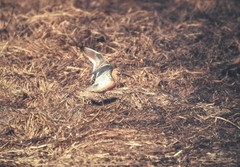
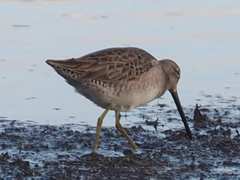
Long-billed Dowitcher

Long-billed Dowitcher

Limnodromus scolopaceus

Silhouette: Sheatherius · PhyloPic

LCNTNear ThreatenedVUENCR
Daily sighting probability ~10% · With luck
at San Luis Potosí

In 3 days ~40% in a week ~60%

10 Verified sightings at San Luis Potosí
2,441 In all 23 parks From 2019 to 2026
December Best month
☀️ Diurnal When it's spotted

About the Long-billed Dowitcher

The long-billed dowitcher (Limnodromus scolopaceus) is a medium-sized shorebird with a relatively long bill belonging to the sandpiper family, Scolopacidae. In breeding plumage, adults are characterized by a rufous head and underparts with a darker mottled back and a large white upper rump only seen in flight. They feed in various freshwater habitats with their bill underwater in a "sewing machine" motion and have a mating display where males chase females in flight. The genus, Limnodromus is Ancient Greek from limne, "marsh" and dromos, "racer". The specific scolopaceus is Neo-Latin for "snipe-like", from Latin scolopax, scolopacis, a snipe or woodcock. The English name is from Iroquois and was first recorded in 1841.

The long-billed dowitcher is similar in appearance to the short-billed dowitcher and was only recognized as a separate species in 1950. Between the two, the best distinguishing field mark is their flight call, especially in winter, when the two species' plumage can be nearly identical. However, the two species differ ecologically in their habitat preferences and breeding locations. Long-billed dowitchers generally prefer freshwater habitats, and breed in northern Alaska and Siberia; their short-billed counterparts favor saltwater habitats and breed farther east, from southern Alaska across Canada to the maritime provinces. Wikipedia →

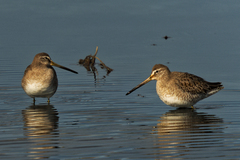
Sounds

Song0:07

United States · 2022

© AUDEVARD Aurélien · XC1046346 · CC BY-NC-SA 4.0

Alarm call0:32

France · 2024

© Frédéric Cazaban · XC948873 · CC BY-NC-SA 4.0

Call0:13

United Kingdom · 2022

© Tom Gale · XC761084 · CC BY-NC-SA 4.0

Global Distribution

Parks Where Found

# Park Country Daily sighting probability
1 Merritt Island National Wildlife Refuge 🇺🇸 United States
~10%
2 El Vizcaíno Biosphere Reserve 🇲🇽 Mexico
~10%
3 Kluane National Park 🇨🇦 Canada
~10%
4 Pacific Rim National Park Reserve 🇨🇦 Canada
<5%
5 Bahía de Loreto National Park 🇲🇽 Mexico
<5%
6 Padre Island National Seashore 🇺🇸 United States
<5%
7 Ría Lagartos Biosphere Reserve 🇲🇽 Mexico
<5%
8 Death Valley National Park 🇺🇸 United States
<5%
9 Everglades National Park 🇺🇸 United States
<5%
10 Channel Islands National Park 🇺🇸 United States
<5%
11 Big Cypress National Preserve 🇺🇸 United States
<5%
12 Elk Island National Park 🇨🇦 Canada
<5%
13 Great Bear Rainforest 🇨🇦 Canada
<5%
14 Yellowstone National Park 🇺🇸 United States
<5%
15 Wadden Sea National Park 🇩🇪 Germany
<5%
16 Palo Verde National Park 🇨🇷 Costa Rica
<5%
17 Kaziranga National Park 🇮🇳 India
<5%
18 Olympic National Park 🇺🇸 United States
<5%
19 Celestún Biosphere Reserve 🇲🇽 Mexico
<5%
20 Grand Teton National Park 🇺🇸 United States
<5%
21 Doñana National Park 🇪🇸 Spain
<5%
22 Point Pelee National Park 🇨🇦 Canada
<5%
23 Saguaro National Park 🇺🇸 United States
<5%

Cities Where Found

# City Country Daily sighting probability
1 Mesa 🇺🇸 United States
~30%
2 León 🇲🇽 México
~20%
3 San Luis Potosí 🇲🇽 México
~10%
4 Los Angeles 🇺🇸 United States
~10%
5 San Francisco 🇺🇸 United States
~10%
6 Vancouver 🇨🇦 Canada
<5%
7 San Diego 🇺🇸 United States
<5%
8 Mexico City 🇲🇽 México
<5%
9 Portland 🇺🇸 United States
<5%
10 Havana 🇨🇺 Cuba
<5%

Zoos & Centres Where Found

# Zoo / Centre Country
1 National Zoological Park 🇺🇸 United States In captivity
2 California Academy of Sciences 🇺🇸 United States In captivity

Before you go

What are the chances of seeing a Long-billed Dowitcher in San Luis Potosí?

With luck

About 10% of wildlife watchers report a Long-billed Dowitcher sighting in San Luis Potosí on a given day, based on 10 verified sightings from GBIF citizen-science data. It is the 28th most-seen of the 62 birds we can rate there. Over three days the chance rises to about 40%, and over a week to about 60%, if each day is a fresh chance.

When is the best time to see a Long-billed Dowitcher in San Luis Potosí?

February–March and December

In those months about 30% of wildlife watchers report a Long-billed Dowitcher in San Luis Potosí on a given day, against under 5% in January and April–November, the lowest months. Those are among San Luis Potosí's driest months, with about 10 mm of rain a month against 110 mm in July.

What time of day is best to see a Long-billed Dowitcher?

Between 10 am and 1 pm

Across all the parks we cover, that three-hour window holds the most Long-billed Dowitcher sightings with a recorded time, and about 9 in 10 of them come between 6 am and 6 pm: it is a daytime animal.

Is San Luis Potosí the best place to see a Long-billed Dowitcher?

3rd of 28

Of the 28 cities where we can rate Long-billed Dowitcher sightings, San Luis Potosí ranks 3rd at about 10%. The best odds are in Mesa (United States, about 30%) and León (México, about 20%).

Where does the Long-billed Dowitcher sighting chance come from?

GBIF citizen-science records

It is estimated from how often the Long-billed Dowitcher is recorded against all the birds logged in San Luis Potosí (10 verified sightings), calibrated against known sighting rates. Figures are rounded to the nearest 10% because citizen-science data supports honest approximations, not decimals, and months with records from fewer than five people show "—". How it works.

← Back to San Luis Potosí