Cave Swallow

Cave Swallow

Petrochelidon fulva

Silhouette: Andy Wilson · PhyloPic

LCLeast ConcernNTVUENCR
Daily sighting probability <5% · Rare
at Santo Domingo

In 3 days ~10%

28 Verified sightings at Santo Domingo
790 In all 15 parks From 2019 to 2026
April Best month
☀️ Diurnal When it's spotted

About the Cave Swallow

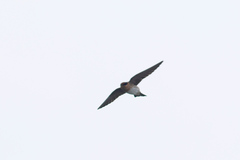
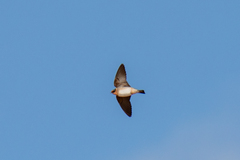
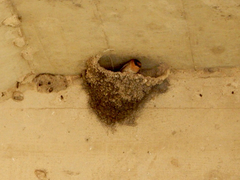
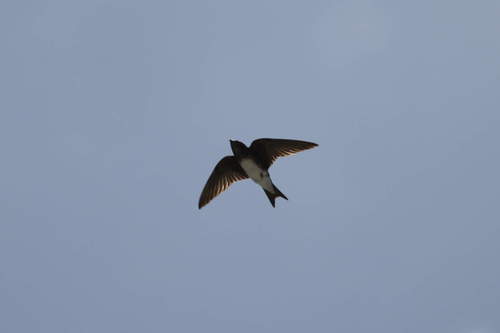
The cave swallow (Petrochelidon fulva) is a medium-sized, squarish-tailed swallow belonging to the same genus as the more familiar and widespread cliff swallow of North America. The cave swallow, also native to the Americas, nests and roosts primarily in caves and sinkholes.

Cave swallows are found in Mexico and the Greater Antilles, with fall and winter vagrants reaching the east and Gulf Coasts of the U.S. Breeding colonies occur in south-eastern New Mexico, Texas, Florida, the Greater Antilles, portions of southern Mexico, and along the west coast of South America. Five subspecies are currently recognized according to Birds of North America, three occurring in North America and two in South America.

The cave swallow measures 12 to 14 cm in length and weighs 19 g on average. Differences between the sexes are minimal, both are similar in size and weight and are difficult to distinguish from their plumage. It has grey-blue upperparts and brown-tangerine forefront... Wikipedia →

Sounds

Call0:27

Mexico · 2026

© Richard E. Webster · XC1183805 · CC BY-NC-SA 4.0

Song0:51

United States · 2009

© Andrew Spencer · XC34112 · CC BY-NC-ND 2.5

Alarm call0:10

United States · 2015

© Jane Tillman · XC252093 · CC BY-NC-SA 4.0

Global Distribution

Parks Where Found

# Park Country Daily sighting probability
1 Los Haitises National Park 🇩🇴 Dominican Republic
~20%
2 Ciénaga de Zapata 🇨🇺 Cuba
~20%
3 Jaragua National Park 🇩🇴 Dominican Republic
~10%
4 Big Bend National Park 🇺🇸 United States
<5%
5 Everglades National Park 🇺🇸 United States
<5%
6 Padre Island National Seashore 🇺🇸 United States
<5%
7 Cumbres de Monterrey National Park 🇲🇽 Mexico
<5%
8 Ría Lagartos Biosphere Reserve 🇲🇽 Mexico
<5%
9 Blue and John Crow Mountains National Park 🇯🇲 Jamaica
<5%
10 Arrecifes de Cozumel National Park 🇲🇽 Mexico
<5%
11 Sian Ka'an Biosphere Reserve 🇲🇽 Mexico
<5%
12 Celestún Biosphere Reserve 🇲🇽 Mexico
<5%
13 Big Cypress National Preserve 🇺🇸 United States
<5%
14 Acadia National Park 🇺🇸 United States
<5%
15 Merritt Island National Wildlife Refuge 🇺🇸 United States
<5%

Cities Where Found

# City Country Daily sighting probability
1 Torreón 🇲🇽 México
~20%
2 Havana 🇨🇺 Cuba
~10%
3 Monterrey 🇲🇽 México
~10%
4 San Antonio 🇺🇸 United States
<5%
5 Austin 🇺🇸 United States
<5%
6 Santo Domingo 🇩🇴 Dominican Republic
<5%
7 Houston 🇺🇸 United States
<5%
8 Miami 🇺🇸 United States
<5%
9 Toronto 🇨🇦 Canada
<5%
10 Philadelphia 🇺🇸 United States
<5%

Before you go

What are the chances of seeing a Cave Swallow in Santo Domingo?

Rare

Under 5% of wildlife watchers report a Cave Swallow sighting in Santo Domingo on a given day, based on 28 verified sightings from GBIF citizen-science data. It is the 73rd most-seen of the 110 birds we can rate there. Over three days the chance rises to about 10%, if each day is a fresh chance.

When is the best time to see a Cave Swallow in Santo Domingo?

April and October

In those months about 10% of wildlife watchers report a Cave Swallow in Santo Domingo on a given day, against under 5% in May–September and November–March, the lowest months.

What time of day is best to see a Cave Swallow?

Between 8 and 11 am

Across all the parks we cover, that three-hour window holds the most Cave Swallow sightings with a recorded time, and about 9 in 10 of them come between 6 am and 6 pm: it is a daytime animal.

Is Santo Domingo the best place to see a Cave Swallow?

6th of 11

Of the 11 cities where we can rate Cave Swallow sightings, Santo Domingo ranks 6th at under 5%. The best odds are in Torreón (México, about 20%), Havana (Cuba, about 10%) and Monterrey (México, about 10%).

Where does the Cave Swallow sighting chance come from?

GBIF citizen-science records

It is estimated from how often the Cave Swallow is recorded against all the birds logged in Santo Domingo (28 verified sightings), calibrated against known sighting rates. Figures are rounded to the nearest 10% because citizen-science data supports honest approximations, not decimals, and months with records from fewer than five people show "—". How it works.

← Back to Santo Domingo