Garden Carpet

Garden Carpet

Xanthorhoe fluctuata

Daily sighting probability ~10% · With luck
at Tel Aviv

In 3 days ~20% in a week ~40%

8 Verified sightings at Tel Aviv
147 In all 9 parks From 2019 to 2026
April Best month
🌅 Crepuscular When it's spotted

About the Garden Carpet

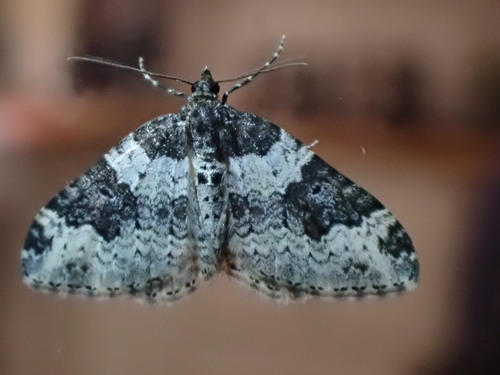
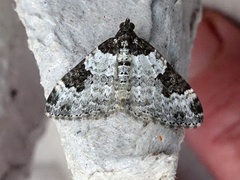
The garden carpet (Xanthorhoe fluctuata) is a moth of the family Geometridae. It is an abundant and familiar species across its huge range which covers the whole Palearctic region from Ireland to Japan and including the Near East and North Africa. It was first described by Carl Linnaeus in his 1758 10th edition of Systema Naturae.

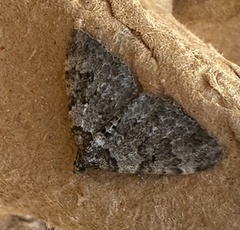
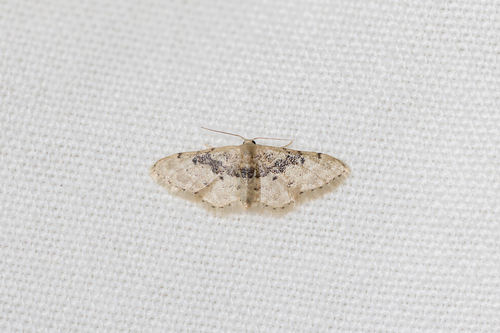
It has a wingspan of 27–31 mm (1.1–1.2 in). The wings are greyish white with three irregular black blotches along the costa of the forewing, the largest in the middle. Occasionally, much darker (melanic) forms occur. "Easy to recognize, in spite of its variability. In the typical form the ground colour is dirty whitish and the median band is almost or altogether obsolete in its posterior half.

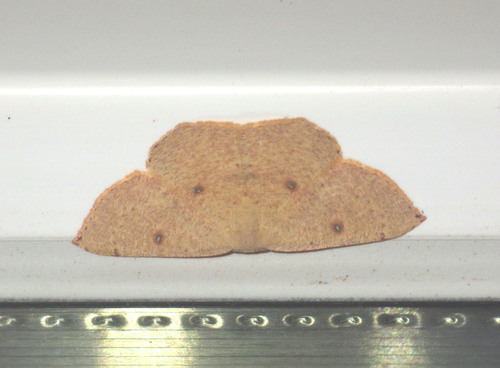
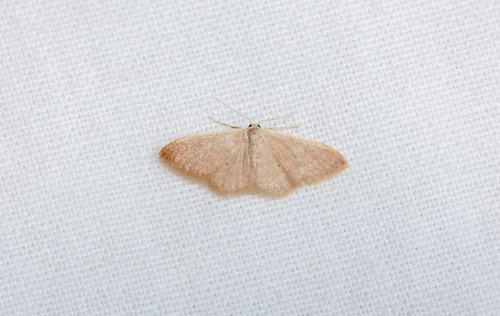
– ab. ochreata Prout has the ground colour ochreous. – In ab. neapolisata Mill, the ground colour is much darkened with brown-grey. – ab. costovata Haw. has the median band much narrowed and somewhat shortened, – deleta Ckll. is merely a rather extreme development of this and need not be separated.

– ab.immaculata Tutt is a much rarer aberration with the median band entirely wanting. – ab. abstersata H.-Sch. shows the opposite extreme of development... Wikipedia →
Global Distribution

Parks Where Found

# Park Country Daily sighting probability
1 Cairngorms National Park 🇬🇧 United Kingdom
~10%
2 Mercantour National Park 🇫🇷 France
~10%
3 Sierra Nevada National Park 🇪🇸 Spain
~10%
4 Bavarian Forest National Park 🇩🇪 Germany
~10%
5 Pyrénées National Park 🇫🇷 France
~10%
6 Snowdonia National Park 🇬🇧 United Kingdom
~10%
7 Wadden Sea National Park 🇩🇪 Germany
~10%
8 Cévennes National Park 🇫🇷 France
~10%
9 Sierra de Guadarrama National Park 🇪🇸 Spain
~10%

Cities Where Found

# City Country Daily sighting probability
1 Liverpool 🇬🇧 United Kingdom
~30%
2 Birmingham 🇬🇧 United Kingdom
~10%
3 London 🇬🇧 United Kingdom
~10%
4 Manchester 🇬🇧 United Kingdom
~10%
5 Kharkiv 🇺🇦 Ukraine
~10%
6 Porto 🇵🇹 Portugal
~10%
7 Dublin 🇮🇪 Ireland
~10%
8 Lyon 🇫🇷 France
~10%
9 Leeds 🇬🇧 United Kingdom
~10%
10 Essen 🇩🇪 Germany
~10%

Before you go

What are the chances of seeing a Garden Carpet in Tel Aviv?

With luck

About 10% of wildlife watchers report a Garden Carpet sighting in Tel Aviv on a given day, based on 8 verified sightings from GBIF citizen-science data. It is the 172nd most-seen of the 264 insects we can rate there. Over three days the chance rises to about 20%, and over a week to about 40%, if each day is a fresh chance.

When is the best time to see a Garden Carpet in Tel Aviv?

February–April and November

In those months about 10% of wildlife watchers report a Garden Carpet in Tel Aviv on a given day, against under 5% in May–October and December–January, the lowest months.

What time of day is best to see a Garden Carpet?

Between 6 and 9 am

Across all the parks we cover, that three-hour window holds the most Garden Carpet sightings with a recorded time, and about half of them come between 6 am and 6 pm: it is most active around dawn and dusk.

Is Tel Aviv the best place to see a Garden Carpet?

15th of 32

Of the 32 cities where we can rate Garden Carpet sightings, Tel Aviv ranks 15th at about 10%. The best odds are in Liverpool (United Kingdom, about 30%), Birmingham (United Kingdom, about 10%) and London (United Kingdom, about 10%).

Which relatives of the Garden Carpet live in Tel Aviv?

Same family: Geometridae

The closest relatives of the Garden Carpet that you can see in Tel Aviv (family Geometridae, Geometer Moths) are Vestal (about 10%), Laned Wave (about 10%) and Blair's Mocha (about 10%), with each one's daily chance of a sighting.

Where does the Garden Carpet sighting chance come from?

GBIF citizen-science records

It is estimated from how often the Garden Carpet is recorded against all the insects logged in Tel Aviv (8 verified sightings), calibrated against known sighting rates. Figures are rounded to the nearest 10% because citizen-science data supports honest approximations, not decimals, and months with records from fewer than five people show "—". How it works.

← Back to Tel Aviv