Richard's Pipit

Richard's Pipit

Anthus richardi

Silhouette: Susan Murphy (original photograph), T. Michael Keesey (vectorization) · PhyloPic

LCLeast ConcernNTVUENCR
Daily sighting probability ~10% · With luck
at Vasai-Virar

In 3 days ~10% in a week ~30%

82 Verified sightings at Vasai-Virar
187 In all 9 parks From 2019 to 2026
March Best month
☀️ Diurnal When it's spotted

About the Richard's Pipit

Richard's pipit (Anthus richardi) is a medium-sized passerine bird which breeds in open grasslands in the East Palearctic. It is a long-distance migrant moving to open lowlands in the Indian subcontinent and Southeast Asia. It is a rare but regular vagrant to western Europe.

The genus name Anthus is the Latin name for a small bird of grasslands. The English name and richardi are for the French naturalist Charles Richard (1745–1835), director of postal services at Lunéville and friend of Francois Levaillant.

It belongs to the pipit genus Anthus in the family Motacillidae. It was formerly lumped together with the Australasian, African, mountain and paddyfield pipits in a single species: Richard's pipit, Anthus novaeseelandiae. These pipits are now commonly considered to be separate species although the African and paddyfield pipits are sometimes treated as part of A. richardi.

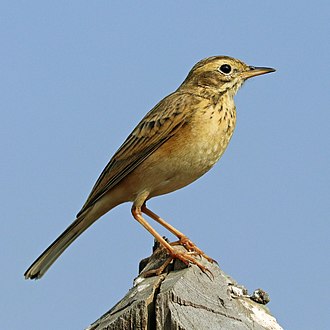
This is a large pipit, 17–20 cm in length, with a weight of 25–36 g and a wingspan of 29 to 33 cm. It is a slender bird which often stands very upright. It has long yellow-brown legs, a long tail with white outer-feathers and a long dark bill with a yellowish base to the lower mandible. The hindclaw... Wikipedia →


Sounds

Call0:14

France · 2026

© Thierry THOMAS · XC1186022 · CC BY-NC-SA 4.0

Flight call0:20

Netherlands · 2026

© Ezra Mandemaker · XC1182451 · CC BY-NC-SA 4.0

Alarm call0:22

China · 2026

© He Wenjin · XC1177836 · CC BY-NC-SA 4.0

Global Distribution

Parks Where Found

# Park Country Daily sighting probability
1 Gobi Gurvansaikhan National Park 🇲🇳 Mongolia
~10%
2 Royal Bardia National Park 🇳🇵 Nepal
<5%
3 Chitwan National Park 🇳🇵 Nepal
<5%
4 Kaziranga National Park 🇮🇳 India
<5%
5 Yala National Park 🇱🇰 Sri Lanka
<5%
6 Khao Yai National Park 🇹🇭 Thailand
<5%
7 Manas National Park 🇮🇳 India
<5%
8 Jim Corbett National Park 🇮🇳 India
<5%
9 Wadden Sea National Park 🇩🇪 Germany
<5%

Cities Where Found

# City Country Daily sighting probability
1 Quanzhou 🇨🇳 China
~10%
2 Suzhou 🇨🇳 China
~10%
3 Vasai-Virar 🇮🇳 India
~10%
4 Hangzhou 🇨🇳 China
<5%
5 Kaohsiung 🇹🇼 Taiwan
<5%
6 Kolkata 🇮🇳 India
<5%
7 Guangzhou 🇨🇳 China
<5%
8 Beijing 🇨🇳 China
<5%
9 Tuen Mun 🇨🇳 China
<5%
10 Bangkok 🇹🇭 Thailand
<5%

Before you go

What are the chances of seeing a Richard's Pipit in Vasai-Virar?

With luck

About 10% of wildlife watchers report a Richard's Pipit sighting in Vasai-Virar on a given day, based on 82 verified sightings from GBIF citizen-science data. It is the 112th most-seen of the 217 birds we can rate there. Over three days the chance rises to about 10%, and over a week to about 30%, if each day is a fresh chance.

When is the best time to see a Richard's Pipit in Vasai-Virar?

December to March

In those months about 10% of wildlife watchers report a Richard's Pipit in Vasai-Virar on a given day, against under 5% in April to November, the lowest months. Those are among Vasai-Virar's driest months, with almost no rain against 840 mm in July.

What time of day is best to see a Richard's Pipit?

Between 9 am and noon

Across all the parks we cover, that three-hour window holds the most Richard's Pipit sightings with a recorded time, and about 9 in 10 of them come between 6 am and 6 pm: it is a daytime animal.

Is Vasai-Virar the best place to see a Richard's Pipit?

Among the best

Of the 14 cities where we can rate Richard's Pipit sightings, Vasai-Virar ranks 3rd at about 10%, level with the leaders once rounded. The best odds are in Quanzhou (China, about 10%) and Suzhou (China, about 10%).

Which relatives of the Richard's Pipit live in Vasai-Virar?

Same genus: Anthus

The closest relatives of the Richard's Pipit that you can see in Vasai-Virar (genus Anthus, Pipits) are Oriental Pipit (about 40%), Tawny Pipit (about 10%) and Tree Pipit (about 10%), with each one's daily chance of a sighting.

Where does the Richard's Pipit sighting chance come from?

GBIF citizen-science records

It is estimated from how often the Richard's Pipit is recorded against all the birds logged in Vasai-Virar (82 verified sightings), calibrated against known sighting rates. Figures are rounded to the nearest 10% because citizen-science data supports honest approximations, not decimals, and months with records from fewer than five people show "—". How it works.

← Back to Vasai-Virar