Citrine Wagtail

Citrine Wagtail

Motacilla citreola

Silhouette: Martin Bulla, based on Ren Hathway's illustration · PhyloPic

LCLeast ConcernNTVUENCR
Daily sighting probability <5% · Rare
at Vasai-Virar

In 3 days ~10% in a week ~20%

32 Verified sightings at Vasai-Virar
2,889 In all 17 parks From 2019 to 2026
February Best month
☀️ Diurnal When it's spotted

About the Citrine Wagtail

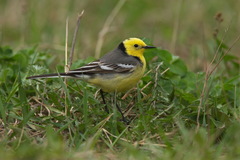
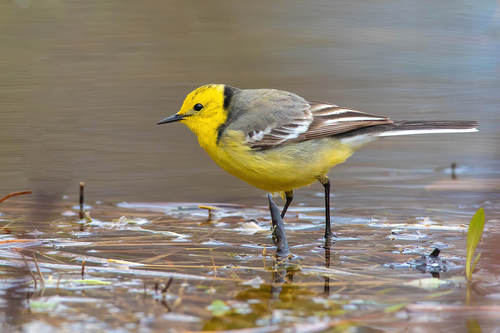
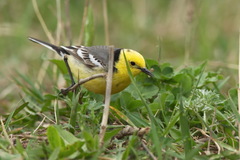
The citrine wagtail (Motacilla citreola) is a small songbird in the family Motacillidae. The term citrine, and the specific name citreola, refer to its yellowish colouration. Its systematics, phylogeny and taxonomy are subject of considerable debate in the early 21st century. This is because this bird forms a cryptic species complex with the eastern (M. tschutschensis ) and western yellow wagtail (M. flava). Which of the many taxa in this group should properly refer to which population is unlikely to be resolved in the immediate future.

Motacilla is the Latin name for the pied wagtail; although actually a diminutive of motare, " to move about", from medieval times it led to the misunderstanding of cilla as "tail". The specific citreola is Latin for "lemon yellow".

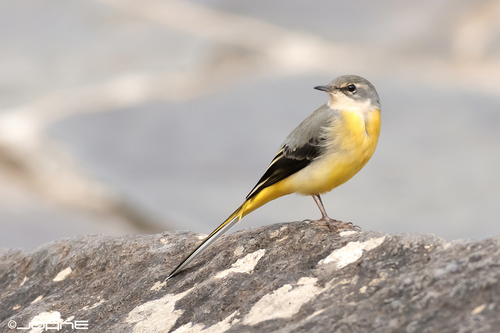
It is a slender, 15.5–17 cm long bird, with the long, constantly wagging tail characteristic of the genus Motacilla. The adult male in breeding plumage is basically grey or black above, with white on the remiges, and bright yellow below and on the entire head except for the black nape. In winter plumage, its yellow underparts may be diluted by white, and the head is brownish... Wikipedia →
Sounds

Call0:11

Poland · 2026

© Daan van der Hoeven · XC1165304 · CC BY-NC-SA 4.0

Song1:30

Sweden · 2023

© Lars Edenius · XC805680 · CC BY-NC-SA 4.0

Flight call0:26

Ireland · 2022

© Irish Wildlife Sounds · XC748865 · CC BY-NC-ND 4.0

Global Distribution

Parks Where Found

# Park Country Daily sighting probability
1 Kaziranga National Park 🇮🇳 India
~50%
2 Keoladeo National Park 🇮🇳 India
~30%
3 Gobi Gurvansaikhan National Park 🇲🇳 Mongolia
~20%
4 Biebrza National Park 🇵🇱 Poland
~20%
5 Manas National Park 🇮🇳 India
~10%
6 Hemis National Park 🇮🇳 India
~10%
7 Chitwan National Park 🇳🇵 Nepal
~10%
8 Ranthambore National Park 🇮🇳 India
~10%
9 Białowieża National Park 🇵🇱 Poland
~10%
10 Royal Bardia National Park 🇳🇵 Nepal
<5%
11 Satpura National Park 🇮🇳 India
<5%
12 Sundarbans National Park 🇮🇳 India
<5%
13 Udawalawe National Park 🇱🇰 Sri Lanka
<5%
14 Jim Corbett National Park 🇮🇳 India
<5%
15 Namdapha National Park 🇮🇳 India
<5%
16 Bandhavgarh National Park 🇮🇳 India
<5%
17 Kanha National Park 🇮🇳 India
<5%

Cities Where Found

# City Country Daily sighting probability
1 Kunming 🇨🇳 China
~20%
2 Chattogram 🇧🇩 Bangladesh
~20%
3 Karachi 🇵🇰 Pakistan
~20%
4 Savar 🇧🇩 Bangladesh
~20%
5 Kolkata 🇮🇳 India
~10%
6 Srinagar 🇮🇳 India
~10%
7 Novosibirsk 🇷🇺 Russia
~10%
8 Vijayawada 🇮🇳 India
~10%
9 Kota 🇮🇳 India
~10%
10 Asansol 🇮🇳 India
~10%

Before you go

What are the chances of seeing a Citrine Wagtail in Vasai-Virar?

Rare

Under 5% of wildlife watchers report a Citrine Wagtail sighting in Vasai-Virar on a given day, based on 32 verified sightings from GBIF citizen-science data. It is the 143rd most-seen of the 217 birds we can rate there. Over three days the chance rises to about 10%, and over a week to about 20%, if each day is a fresh chance.

When is the best time to see a Citrine Wagtail in Vasai-Virar?

February

In that month about 10% of wildlife watchers report a Citrine Wagtail in Vasai-Virar on a given day, against under 5% in March to January, the lowest months. That is one of Vasai-Virar's driest months, with almost no rain against 840 mm in July.

What time of day is best to see a Citrine Wagtail?

Between 7 and 10 am

Across all the parks we cover, that three-hour window holds the most Citrine Wagtail sightings with a recorded time, and about 9 in 10 of them come between 6 am and 6 pm: it is a daytime animal.

Is Vasai-Virar the best place to see a Citrine Wagtail?

31st of 56

Of the 56 cities where we can rate Citrine Wagtail sightings, Vasai-Virar ranks 31st at under 5%. The best odds are in Kunming (China, about 20%), Chattogram (Bangladesh, about 20%) and Karachi (Pakistan, about 20%).

Where does the Citrine Wagtail sighting chance come from?

GBIF citizen-science records

It is estimated from how often the Citrine Wagtail is recorded against all the birds logged in Vasai-Virar (32 verified sightings), calibrated against known sighting rates. Figures are rounded to the nearest 10% because citizen-science data supports honest approximations, not decimals, and months with records from fewer than five people show "—". How it works.

← Back to Vasai-Virar