
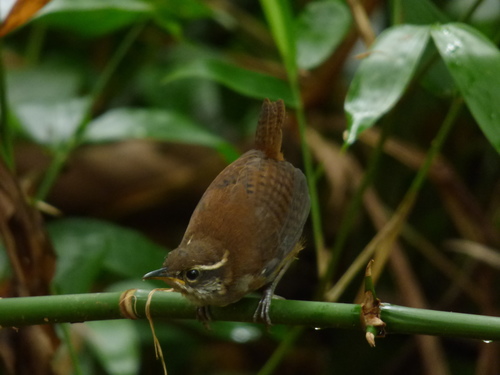
Ruddy Crake

Ruddy Crake

Laterallus ruber

Silhouette: Sheatherius · PhyloPic

LCLeast ConcernNTVUENCR
Daily sighting probability <5% · Rare
at Cockscomb Basin Wildlife Sanctuary

In 3 days ~10%

20 Verified sightings at Cockscomb Basin Wildlife Sanctuary From 2019 to 2026
548 In all 11 parks
July Best month
☀️ Diurnal When it's spotted

About the Ruddy Crake

The ruddy crake (Laterallus ruber) is a bird in the rail family, Rallidae. Other names the ruddy crake is known by are "red rail", "ruddy rail" and "red crake". The ruddy crake can be identified by its ruddy plumage that can vary in shade and gray head with dark brown wings and tail. It is mostly bright chestnut in colour with a paler chin and belly, blackish crown and dark grey ear-coverts. Ruddy crakes are about the size of a sparrow. It is a small crake, 14–16.5 cm in length. Immature ruddy crakes tend to show discoloration on their midline or nape, such as a pale midline or chestnut colored nape. The bill is black, the iris is red and the legs and feet are olive-green. This distinct characteristic of yellow green legs, differentiating it from other small birds. The ruddy crake has a short black conical bill, and it has wide spread feet specifically adapted for wet habitats. Female ruddy crakes are more drab than males, and the males have rusty red plumage on the breast.

The ruddy crake, similar to others in the Rallidae family, prefers wet pastures and marshes, especially the tall grasses. The ruddy crake populates the lowlands of... Wikipedia →

Sounds

Song1:16

El Salvador · 2019

© Mario Trejo · XC455083 · CC BY-NC-SA 4.0

Alarm call0:45

Mexico · 2015

© Manuel Grosselet · XC265055 · CC BY-NC-SA 4.0

Call0:35

Honduras · 2014

© Mayron McKewy Mejía · XC183750 · CC BY-NC-SA 4.0

Global Distribution

Parks Where Found

# Park Country Daily sighting probability
1 Lago de Yojoa 🇭🇳 Honduras
~20%
2 Cerro Azul Meámbar National Park 🇭🇳 Honduras
~10%
3 Biotopo Cerro Cahuí 🇬🇹 Guatemala
~10%
4 Montes Azules Biosphere Reserve 🇲🇽 Mexico
~10%
5 Sian Ka'an Biosphere Reserve 🇲🇽 Mexico
<5%
6 Cusuco National Park 🇭🇳 Honduras
<5%
7 Cockscomb Basin Wildlife Sanctuary 🇧🇿 Belize
<5%
8 Calakmul Biosphere Reserve 🇲🇽 Mexico
<5%
9 Celestún Biosphere Reserve 🇲🇽 Mexico
<5%
10 Ría Lagartos Biosphere Reserve 🇲🇽 Mexico
<5%
11 Tikal National Park 🇬🇹 Guatemala
<5%

Cities Where Found

# City Country Daily sighting probability
1 San Pedro Sula 🇭🇳 Honduras
~10%

Before you go

What are the chances of seeing a Ruddy Crake in Cockscomb Basin Wildlife Sanctuary?

Rare

Under 5% of wildlife watchers report a Ruddy Crake sighting in Cockscomb Basin Wildlife Sanctuary on a given day, based on 20 verified sightings from GBIF citizen-science data from 2019 to 2026. It is the 215th most-seen of the 277 birds we can rate there. Over three days the chance rises to about 10%, if each day is a fresh chance.

When is the best time to see a Ruddy Crake in Cockscomb Basin Wildlife Sanctuary?

May and July

In those months about 10% of wildlife watchers report a Ruddy Crake in Cockscomb Basin Wildlife Sanctuary on a given day, against under 5% in June and August–April, the lowest months.

What time of day is best to see a Ruddy Crake?

Between 7 and 10 am

Across all the parks we cover, that three-hour window holds the most Ruddy Crake sightings with a recorded time, and about 9 in 10 of them come between 6 am and 6 pm: it is a daytime animal.

Is Cockscomb Basin Wildlife Sanctuary the best place to see a Ruddy Crake?

7th of 11

Of the 11 parks where we can rate Ruddy Crake sightings, Cockscomb Basin Wildlife Sanctuary ranks 7th at under 5%. The best odds are in Lago de Yojoa (Honduras, about 20%), Cerro Azul Meámbar National Park (Honduras, about 10%) and Biotopo Cerro Cahuí (Guatemala, about 10%).

Where does the Ruddy Crake sighting chance come from?

GBIF citizen-science records

It is estimated from how often the Ruddy Crake is recorded against all the birds logged in Cockscomb Basin Wildlife Sanctuary (20 verified sightings from 2019 to 2026), calibrated against known sighting rates. Figures are rounded to the nearest 10% because citizen-science data supports honest approximations, not decimals, and months with records from fewer than five people show "—". How it works.

← Back to Cockscomb Basin Wildlife Sanctuary