Black-throated Gray Warbler

Black-throated Gray Warbler

Setophaga nigrescens

Silhouette: Dylan GE Gomes · PhyloPic

LCLeast ConcernNTVUENCR
Daily sighting probability <5% · Rare
at Cumbres de Monterrey National Park

In 3 days ~10% in a week ~20%

72 Verified sightings at Cumbres de Monterrey National Park From 2019 to 2026
4,142 In all 18 parks
November Best month
☀️ Diurnal When it's spotted

About the Black-throated Gray Warbler

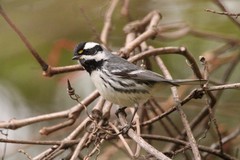
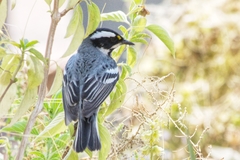
The black-throated gray warbler or black-throated grey warbler (Setophaga nigrescens) is a passerine bird of the New World warbler family Parulidae. It is 13 cm (5.1 in) long and has gray and white plumage with black markings. The male has the bold black throat of its name, and black stripes on its head, as well as black streaks on its flanks; the female is a paler version of the male, with a white throat and less distinct black markings on the flanks and wings. It breeds in western North America from British Columbia to New Mexico, and winters in Mexico and the southwestern United States. The habitats it prefers are coniferous and mixed forests and scrubland, especially those with pinyon pines, junipers, sagebrush, and oaks. Its nest is an open cup of plant fibers lined with feathers, built a few metres from the ground in the branches of a tree or shrub. Three to five eggs are laid, and young are fed by both parents. Common in its breeding range, it does not seem to be seriously threatened by human activities, unlike many migratory warblers.

The black-throated gray warbler was first described by John Kirk Townsend in 1837 from a specimen collected near today's Portland... Wikipedia →

Sounds

Song0:40

United States · 2026

© Ed Pandolfino · XC1139588 · CC BY-NC-SA 4.0

Call1:11

United States · 2022

© Paul Marvin · XC715990 · CC BY-NC-SA 4.0

Song0:43

United States · 2025

© Sue Riffe · XC1083461 · CC BY-NC-SA 4.0

Global Distribution

Parks Where Found

# Park Country Daily sighting probability
1 Grand Canyon National Park 🇺🇸 United States
~30%
2 Zion National Park 🇺🇸 United States
~20%
3 Yosemite National Park 🇺🇸 United States
~20%
4 Sequoia and Kings Canyon National Parks 🇺🇸 United States
~10%
5 Guadalupe Mountains National Park 🇺🇸 United States
~10%
6 Olympic National Park 🇺🇸 United States
~10%
7 Death Valley National Park 🇺🇸 United States
~10%
8 Saguaro National Park 🇺🇸 United States
~10%
9 Redwood National Park 🇺🇸 United States
<5%
10 Cumbres de Monterrey National Park 🇲🇽 Mexico
<5%
11 Reserva de la Biosfera Mariposa Monarca 🇲🇽 Mexico
<5%
12 Joshua Tree National Park 🇺🇸 United States
<5%
13 El Vizcaíno Biosphere Reserve 🇲🇽 Mexico
<5%
14 Great Bear Rainforest 🇨🇦 Canada
<5%
15 Pacific Rim National Park Reserve 🇨🇦 Canada
<5%
16 Big Bend National Park 🇺🇸 United States
<5%
17 Channel Islands National Park 🇺🇸 United States
<5%
18 Bahía de Loreto National Park 🇲🇽 Mexico
<5%

Cities Where Found

# City Country Daily sighting probability
1 Mexico City 🇲🇽 México
~10%
2 Guadalajara 🇲🇽 México
~10%
3 Vancouver 🇨🇦 Canada
~10%
4 Tijuana 🇲🇽 México
~10%
5 Puebla 🇲🇽 México
~10%
6 Monterrey 🇲🇽 México
~10%
7 Portland 🇺🇸 United States
~10%
8 Los Angeles 🇺🇸 United States
~10%
9 Sacramento 🇺🇸 United States
~10%
10 Mesa 🇺🇸 United States
<5%

Before you go

What are the chances of seeing a Black-throated Gray Warbler in Cumbres de Monterrey National Park?

Rare

Under 5% of wildlife watchers report a Black-throated Gray Warbler sighting in Cumbres de Monterrey National Park on a given day, based on 72 verified sightings from GBIF citizen-science data from 2019 to 2026. It is the 139th most-seen of the 275 birds we can rate there. Over three days the chance rises to about 10%, and over a week to about 20%, if each day is a fresh chance.

When is the best time to see a Black-throated Gray Warbler in Cumbres de Monterrey National Park?

October to December

In those months about 10% of wildlife watchers report a Black-throated Gray Warbler in Cumbres de Monterrey National Park on a given day, against under 5% in January to September, the lowest months. Those are among Cumbres de Monterrey National Park's driest months, with about 55 mm of rain a month against 180 mm in September.

What time of day is best to see a Black-throated Gray Warbler?

Between 8 and 11 am

Across all the parks we cover, that three-hour window holds the most Black-throated Gray Warbler sightings with a recorded time, and nearly all of them come between 6 am and 6 pm: it is a daytime animal.

Is Cumbres de Monterrey National Park the best place to see a Black-throated Gray Warbler?

10th of 18

Of the 18 parks where we can rate Black-throated Gray Warbler sightings, Cumbres de Monterrey National Park ranks 10th at under 5%. The best odds are in Grand Canyon National Park (United States, about 30%), Zion National Park (United States, about 20%) and Yosemite National Park (United States, about 20%).

Which relatives of the Black-throated Gray Warbler live in Cumbres de Monterrey National Park?

Same genus: Setophaga

The closest relatives of the Black-throated Gray Warbler that you can see in Cumbres de Monterrey National Park (genus Setophaga, Setophaga Warblers) are Tropical Parula (about 30%), Yellow-rumped Warbler (about 30%) and Black-throated Green Warbler (about 10%), with each one's daily chance of a sighting.

Where does the Black-throated Gray Warbler sighting chance come from?

GBIF citizen-science records

It is estimated from how often the Black-throated Gray Warbler is recorded against all the birds logged in Cumbres de Monterrey National Park (72 verified sightings from 2019 to 2026), calibrated against known sighting rates. Figures are rounded to the nearest 10% because citizen-science data supports honest approximations, not decimals, and months with records from fewer than five people show "—". How it works.

← Back to Cumbres de Monterrey National Park