Spotted Wood Quail

Spotted Wood Quail

Odontophorus guttatus

Silhouette: Sheatherius · PhyloPic

LCLeast ConcernNTVUENCR
Daily sighting probability <5% · Rare
at Cusuco National Park

In 3 days ~10% in a week ~20%

17 Verified sightings at Cusuco National Park From 2019 to 2026
5,331 In all 10 parks
June Best month
☀️ Diurnal When it's spotted

About the Spotted Wood Quail

The spotted wood quail (Odontophorus guttatus) is a small ground-dwelling bird in the New World quail family. It is a resident breeder in the mountains of Central America from southern Mexico to western Panama. It occurs in highlands from 1000 m or higher up to the timberline, usually in dense understory thickets or bamboos. The nest, as with several other wood-quails remains undescribed, but the eggs are known to be creamy-white with brown spots.

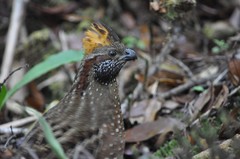
The spotted wood quail is 25 cm long and weighs 300 g. It has an orange crest which is raised when it is excited. The upperparts are dark brown with black and rufous flecking. The underparts are normally olive brown, but there is a colour morph with rufous underparts. In both cases, the underparts are boldly spotted with white. The forehead is dark brown and the cheeks and throat are black streaked with white.

The sexes are similar, but the male averages slightly larger and the female has a duller crest. Immature birds have smaller, more buff-tinted spotting, and the throat is dusky rather than black. There are no subspecies. The advertising call of the spotted wood quail, actually a duet, is a clear whistled coowit CAWwit coowit COO, and the contact calls are clear chirps and peeps.

Spotted wood quails are found in groups of 4 to 10; they forage on the ground, scratching at the soil for seeds, fallen fruit and insects. This is a shy and wary species, which will normally make its escape on foot, but if startled it will explode into a short fast flight into cover. The best chance of seeing this species is at dawn, when it may feed at the side of a road or on a forest track.

This species is reported as locally common in suitable habitat in Costa Rica and Panama, but has been adversely impacted in much of its range by rampant deforestation. Wikipedia →

Sounds

Song1:23

Costa Rica · 2022

© Brendan Sloan · XC729941 · CC BY-NC-ND 4.0

Duet0:21

Panama · 2015

© Peter Boesman · XC271463 · CC BY-NC-ND 4.0

Call0:14

Costa Rica · 2013

© Pritam Baruah · XC119778 · CC BY-NC-SA 3.0

Global Distribution

Parks Where Found

# Park Country Daily sighting probability
1 Los Quetzales National Park 🇨🇷 Costa Rica
~20%
2 Chirripó National Park 🇨🇷 Costa Rica
~20%
3 Volcán Barú National Park 🇵🇦 Panama
~10%
4 Tapantí-Macizo de la Muerte National Park 🇨🇷 Costa Rica
~10%
5 La Amistad International Park (Panama) 🇵🇦 Panama
~10%
6 Cusuco National Park 🇭🇳 Honduras
<5%
7 Tikal National Park 🇬🇹 Guatemala
<5%
8 Cockscomb Basin Wildlife Sanctuary 🇧🇿 Belize
<5%
9 Poás Volcano National Park 🇨🇷 Costa Rica
<5%
10 Braulio Carrillo National Park 🇨🇷 Costa Rica
<5%

Before you go

What are the chances of seeing a Spotted Wood Quail in Cusuco National Park?

Rare

Under 5% of wildlife watchers report a Spotted Wood Quail sighting in Cusuco National Park on a given day, based on 17 verified sightings from GBIF citizen-science data from 2019 to 2026. It is the 182nd most-seen of the 250 birds we can rate there. Over three days the chance rises to about 10%, and over a week to about 20%, if each day is a fresh chance.

When is the best time to see a Spotted Wood Quail in Cusuco National Park?

June and October

In those months about 10% of wildlife watchers report a Spotted Wood Quail in Cusuco National Park on a given day, against under 5% in July–September and November–May, the lowest months.

What time of day is best to see a Spotted Wood Quail?

Between 7 and 10 am

Across all the parks we cover, that three-hour window holds the most Spotted Wood Quail sightings with a recorded time, and about 9 in 10 of them come between 6 am and 6 pm: it is a daytime animal.

Where does the Spotted Wood Quail sighting chance come from?

GBIF citizen-science records

It is estimated from how often the Spotted Wood Quail is recorded against all the birds logged in Cusuco National Park (17 verified sightings from 2019 to 2026), calibrated against known sighting rates. Figures are rounded to the nearest 10% because citizen-science data supports honest approximations, not decimals, and months with records from fewer than five people show "—". How it works.

← Back to Cusuco National Park

