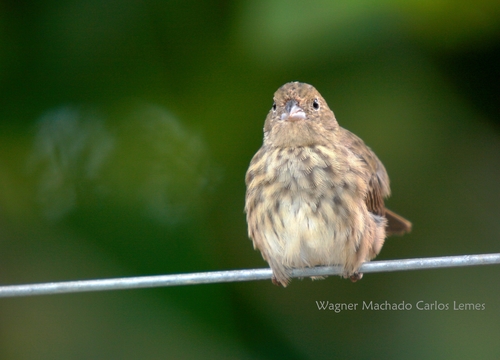
Burnished-buff Tanager

Burnished-buff Tanager

Stilpnia cayana

Silhouette: Sheatherius · PhyloPic

Daily sighting probability ~40% · Likely
at Emas National Park

In 3 days ~80% in a week >90%

80 Verified sightings at Emas National Park From 2019 to 2026
2,554 In all 10 parks
August Best month
☀️ Diurnal When it's spotted

About the Burnished-buff Tanager

The burnished-buff tanager (Stilpnia cayana), also known as the rufous-crowned tanager, is a common South American species of bird in the family Thraupidae. It is found in the northern Guianas, most of Venezuela, and east-central Colombia; also near the Amazon River outlet in Brazil, as well as most of the east of that country, Paraguay, and northeast Argentina. It also occurs very locally in Bolivia and Peru. It can be seen in virtually any semi-open habitat with trees, including human-altered habitats such as gardens, plantations, and parks.

There are several subspecies of the burnished-buff tanager, falling into two main groups: the northern and western cayana group, and the southern and eastern flava group. The subspecies huberi from Marajó Island is intermediate between the two main groups. Males of the cayana group have an orange-rufous crown, black mask, and cream underparts distinctly tinged blue on the throat and chest. Males of the flava group have an orange-buff crown and buff underparts with a black patch extending from the mask, over the throat and central chest, to the mid-belly. Males of both groups have turquoise wings... Wikipedia →

Sounds

Call0:14

Brazil · 2026

© JAYRSON ARAUJO DE OLIVEIRA · XC1162251 · CC BY-NC-SA 4.0

Song0:08

Brazil · 2024

© Robson Silva e Silva · XC1018694 · CC BY-NC-SA 4.0

Call0:29

Colombia · 2022

© Frank Lambert · XC1036459 · CC BY-NC-ND 4.0

Global Distribution

Parks Where Found

# Park Country Daily sighting probability
1 Serra da Canastra National Park 🇧🇷 Brazil
~60%
2 Serra dos Órgãos National Park 🇧🇷 Brazil
~50%
3 Chapada Diamantina National Park 🇧🇷 Brazil
~50%
4 Emas National Park 🇧🇷 Brazil
~40%
5 Chapada dos Guimarães National Park 🇧🇷 Brazil
~40%
6 Sierra de la Macarena National Park 🇨🇴 Colombia
~30%
7 Itatiaia National Park 🇧🇷 Brazil
~30%
8 Henri Pittier National Park 🇻🇪 Venezuela
~10%
9 Tijuca National Park 🇧🇷 Brazil
~10%
10 Chingaza National Natural Park 🇨🇴 Colombia
<5%

Cities Where Found

# City Country Daily sighting probability
1 Recife 🇧🇷 Brazil
~50%
2 João Pessoa 🇧🇷 Brazil
~40%
3 Maceió 🇧🇷 Brazil
~30%
4 Campo Grande 🇧🇷 Brazil
~20%
5 Salvador 🇧🇷 Brazil
~20%
6 Campinas 🇧🇷 Brazil
~20%
7 Natal 🇧🇷 Brazil
~10%
8 Maracaibo 🇻🇪 Venezuela
~10%
9 Valencia 🇻🇪 Venezuela
~10%
10 Belo Horizonte 🇧🇷 Brazil
~10%

Zoos & Centres Where Found

# Zoo / Centre Country
1 Basel Zoo 🇨🇭 Switzerland In captivity
2 California Academy of Sciences 🇺🇸 United States In captivity
3 Aviario Nacional de Colombia 🇨🇴 Colombia In captivity
4 The Living Planet Aquarium 🇺🇸 United States In captivity
5 Dallas World Aquarium 🇺🇸 United States In captivity
6 Butterfly World 🇺🇸 United States In captivity

Before you go

What are the chances of seeing a Burnished-buff Tanager in Emas National Park?

Likely

About 40% of wildlife watchers report a Burnished-buff Tanager sighting in Emas National Park on a given day, based on 80 verified sightings from GBIF citizen-science data from 2019 to 2026. It is the 49th most-seen of the 187 birds we can rate there. Over three days the chance rises to about 80%, and over a week to over 90%, if each day is a fresh chance.

When is the best time to see a Burnished-buff Tanager in Emas National Park?

August

In that month about 60% of wildlife watchers report a Burnished-buff Tanager in Emas National Park on a given day, against about 20% in July and November, the lowest months. That is one of Emas National Park's driest months, with about 15 mm of rain against 190 mm in January. April and December–February have too few records to rate.

What time of day is best to see a Burnished-buff Tanager?

Between 9 am and noon

Across all the parks we cover, that three-hour window holds the most Burnished-buff Tanager sightings with a recorded time, and about 9 in 10 of them come between 6 am and 6 pm: it is a daytime animal.

Which relatives of the Burnished-buff Tanager live in Emas National Park?

Same family: Thraupidae

The closest relatives of the Burnished-buff Tanager that you can see in Emas National Park (family Thraupidae, Tanagers and Allies) are Black-throated Saltator (about 70%), Blue-black Grassquit (about 70%) and Saffron Finch (about 70%), with each one's daily chance of a sighting.

Where does the Burnished-buff Tanager sighting chance come from?

GBIF citizen-science records

It is estimated from how often the Burnished-buff Tanager is recorded against all the birds logged in Emas National Park (80 verified sightings from 2019 to 2026), calibrated against known sighting rates. Figures are rounded to the nearest 10% because citizen-science data supports honest approximations, not decimals, and months with records from fewer than five people show "—". How it works.

← Back to Emas National Park