Red-footed Falcon

Red-footed Falcon

Falco vespertinus

Silhouette: Shyamal · PhyloPic

LCNTVUVulnerableENCR
Daily sighting probability <5% · Rare
at Etosha National Park

In 3 days <5%

12 Verified sightings at Etosha National Park From 2019 to 2026
824 In all 10 parks
February Best month
☀️ Diurnal When it's spotted

About the Red-footed Falcon

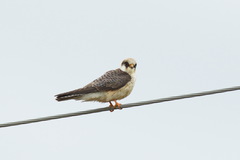
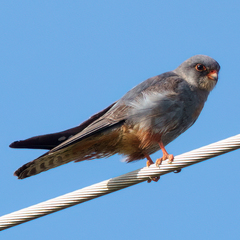
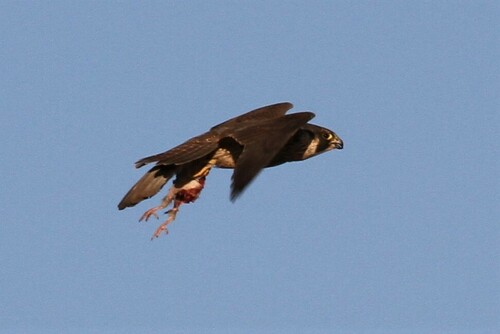
The red-footed falcon (Falco vespertinus), formerly the western red-footed falcon, is a bird of prey. It belongs to the family Falconidae, the falcons. This bird is found in eastern Europe and Asia although its numbers are dwindling rapidly due to habitat loss and hunting. It is migratory, wintering in Africa. It is a regular wanderer to western Europe, and in August 2004 a red-footed falcon was found in North America for the first time on the island of Martha's Vineyard, Massachusetts.

The Amur falcon was formerly included herein as a subspecies but it is nowadays considered distinct. Nonetheless, it is the present species' closest relative; their relationship to other falcons is more enigmatic. They appear morphologically somewhat intermediate between kestrels and hobbies and DNA sequence data has been unable to further resolve this question, mainly due to lack of comprehensive sampling. They might be closer to the merlin than to most other living falcons, or more generally related to this species and American falcons such as the American kestrel and the aplomado falcon.

The genus name Falco is from Late Latin falx, falcis, a sickle, referencing the claws of the bird... Wikipedia →

Sounds

Flight call0:27

Kazakhstan · 2025

© Frank Lambert · XC1030392 · CC BY-NC-ND 4.0

Call1:17

Kazakhstan · 2023

© Peter Boesman · XC813405 · CC BY-NC-ND 4.0

Begging call1:25

Hungary · 2021

© Michel Veldt · XC770208 · CC BY-NC-SA 4.0

Global Distribution

Parks Where Found

# Park Country Daily sighting probability
1 Hortobágy National Park 🇭🇺 Hungary
~20%
2 Kiskunság National Park 🇭🇺 Hungary
~20%
3 Fertő-Hanság National Park 🇭🇺 Hungary
~10%
4 Biebrza National Park 🇵🇱 Poland
<5%
5 Camargue 🇫🇷 France
<5%
6 Chobe National Park 🇧🇼 Botswana
<5%
7 Etosha National Park 🇳🇦 Namibia
<5%
8 Białowieża National Park 🇵🇱 Poland
<5%
9 Pyrénées National Park 🇫🇷 France
<5%
10 Kruger National Park 🇿🇦 South Africa
<5%

Cities Where Found

# City Country Daily sighting probability
1 Istanbul 🇹🇷 Turkey
<5%
2 Berlin 🇩🇪 Germany
<5%
3 Tel Aviv 🇮🇱 Israel
<5%
4 Jerusalem 🇮🇱 Israel
<5%

Before you go

What are the chances of seeing a Red-footed Falcon in Etosha National Park?

Rare

Under 5% of wildlife watchers report a Red-footed Falcon sighting in Etosha National Park on a given day, based on 12 verified sightings from GBIF citizen-science data from 2019 to 2026. It is the 236th most-seen of the 260 birds we can rate there. Over three days the chance rises to under 5%, if each day is a fresh chance.

When is the best time to see a Red-footed Falcon in Etosha National Park?

February and March

In those months about 10% of wildlife watchers report a Red-footed Falcon in Etosha National Park on a given day, against under 5% in April to January, the lowest months. Those are among Etosha National Park's wettest months, with about 65 mm of rain a month against almost none in June.

What time of day is best to see a Red-footed Falcon?

Between 6 and 9 am

Across all the parks we cover, that three-hour window holds the most Red-footed Falcon sightings with a recorded time, and about 8 in 10 of them come between 6 am and 6 pm: it is a daytime animal.

Which relatives of the Red-footed Falcon live in Etosha National Park?

Same genus: Falco

The closest relatives of the Red-footed Falcon that you can see in Etosha National Park (genus Falco, Typical Falcons) are Greater Kestrel (about 30%), Red-necked Falcon (about 20%) and Lanner Falcon (about 10%), with each one's daily chance of a sighting.

Where does the Red-footed Falcon sighting chance come from?

GBIF citizen-science records

It is estimated from how often the Red-footed Falcon is recorded against all the birds logged in Etosha National Park (12 verified sightings from 2019 to 2026), calibrated against known sighting rates. Figures are rounded to the nearest 10% because citizen-science data supports honest approximations, not decimals, and months with records from fewer than five people show "—". How it works.

← Back to Etosha National Park