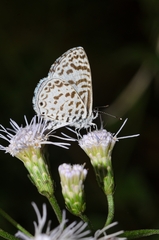
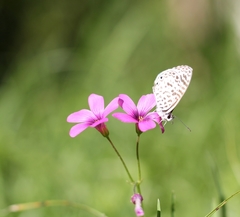
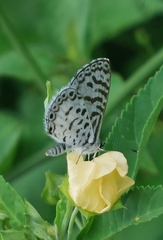
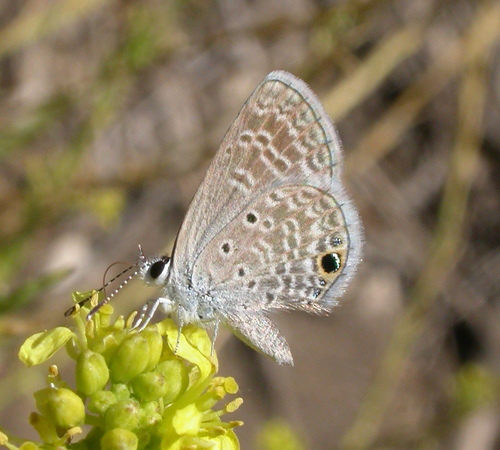
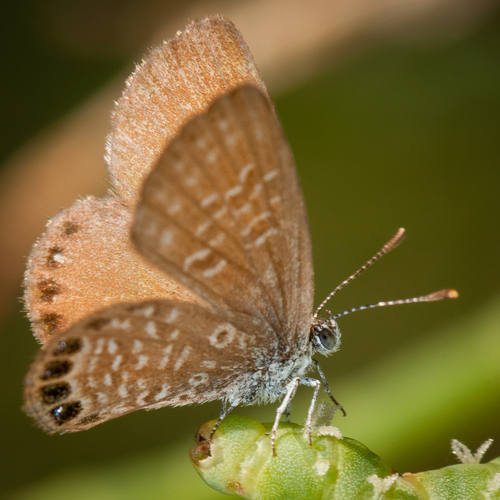
Cassius Blue

Cassius Blue

Leptotes cassius

Daily sighting probability ~20% · Possible
at Everglades National Park

In 3 days ~50% in a week ~80%

164 Verified sightings at Everglades National Park From 2019 to 2026
269 In all 8 parks
June Best month
☀️ Diurnal When it's spotted

About the Cassius Blue

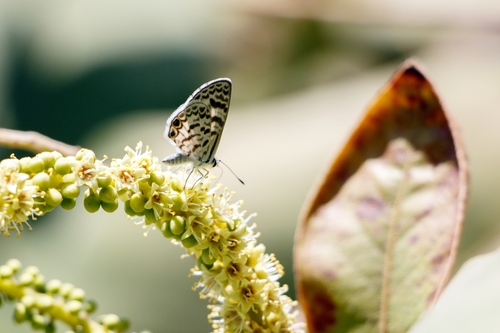
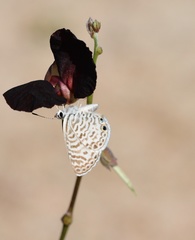
Leptotes cassius, the Cassius blue or tropical striped blue, is a butterfly of the family Lycaenidae. It is found in North America in Florida including the Keys, Texas south through the Caribbean, Mexico, and Central America to South America. Strays have been found in New Mexico, Kansas, Missouri, South Carolina, North Carolina and Virginia.

The wingspan is 20–35 mm. The butterfly species has an important role in Marisha Pessl's 2006 novel Special Topics in Calamity Physics. The protagonist, Blue van Meer, is named in honor of the Cassius blue. The caterpillars feed natively on Fabaceae. Food plants on record are Amorpha crenulata, woolly rattlepod (Crotalaria incana), Galactia regularis and lima bean (Phaseolus lunatus). It can also successfully develop feeding on Cape leadwort (Plumbago auriculata) or doctorbush (P. scandens), which (among the eudicots) are not closely related to its usual food plants. Wikipedia →
Global Distribution

Parks Where Found

# Park Country Daily sighting probability
1 Blue and John Crow Mountains National Park 🇯🇲 Jamaica
~40%
2 Everglades National Park 🇺🇸 United States
~20%
3 Iguazú National Park 🇦🇷 Argentina
~10%
4 Big Cypress National Preserve 🇺🇸 United States
~10%
5 Ría Lagartos Biosphere Reserve 🇲🇽 Mexico
~10%
6 Iguaçu National Park 🇧🇷 Brazil
~10%
7 Merritt Island National Wildlife Refuge 🇺🇸 United States
~10%
8 Cumbres de Monterrey National Park 🇲🇽 Mexico
<5%

Cities Where Found

# City Country Daily sighting probability
1 Mendoza 🇦🇷 Argentina
~20%
2 Porto Alegre 🇧🇷 Brazil
~20%
3 São Paulo 🇧🇷 Brazil
~20%
4 Buenos Aires 🇦🇷 Argentina
~20%
5 Curitiba 🇧🇷 Brazil
~20%
6 Rosario 🇦🇷 Argentina
~10%
7 Caracas 🇻🇪 Venezuela
~10%
8 Miami 🇺🇸 United States
~10%
9 Cordoba 🇦🇷 Argentina
~10%
10 Vitória 🇧🇷 Brazil
~10%

Before you go

What are the chances of seeing a Cassius Blue in Everglades National Park?

Possible

About 20% of wildlife watchers report a Cassius Blue sighting in Everglades National Park on a given day, based on 164 verified sightings from GBIF citizen-science data from 2019 to 2026. It is the 22nd most-seen of the 496 insects we can rate there. Over three days the chance rises to about 50%, and over a week to about 80%, if each day is a fresh chance.

When is the best time to see a Cassius Blue in Everglades National Park?

April to July

In those months about 30% of wildlife watchers report a Cassius Blue in Everglades National Park on a given day, against about 10% in September, the lowest month.

What time of day is best to see a Cassius Blue?

Between 10 am and 1 pm

Across all the parks we cover, that three-hour window holds the most Cassius Blue sightings with a recorded time, and nearly all of them come between 6 am and 6 pm: it is a daytime animal.

Is Everglades National Park the best place to see a Cassius Blue?

2nd of 8

Of the 8 parks where we can rate Cassius Blue sightings, Everglades National Park ranks 2nd at about 20%. The best odds are in Blue and John Crow Mountains National Park (Jamaica, about 40%).

Which relatives of the Cassius Blue live in Everglades National Park?

Same family: Lycaenidae

The closest relatives of the Cassius Blue that you can see in Everglades National Park (family Lycaenidae, Gossamer-winged Butterflies) are Ceraunus Blue (about 20%), Atala (about 20%) and Eastern Pygmy-Blue (about 10%), with each one's daily chance of a sighting.

Where does the Cassius Blue sighting chance come from?

GBIF citizen-science records

It is estimated from how often the Cassius Blue is recorded against all the insects logged in Everglades National Park (164 verified sightings from 2019 to 2026), calibrated against known sighting rates. Figures are rounded to the nearest 10% because citizen-science data supports honest approximations, not decimals, and months with records from fewer than five people show "—". How it works.

← Back to Everglades National Park