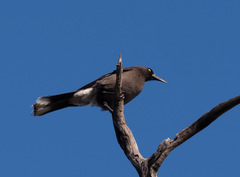
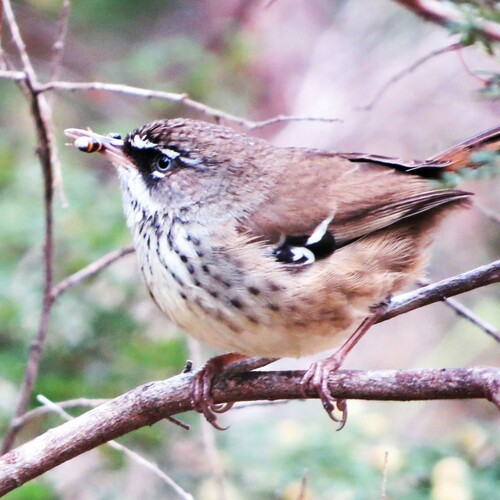
Grey Currawong

Grey Currawong

Strepera versicolor

Silhouette: Michael Scroggie · PhyloPic

LCLeast ConcernNTVUENCR Endemic
Daily sighting probability ~40% · Likely
at Flinders Chase

In 3 days ~80% in a week >90%

54 Verified sightings at Flinders Chase From 2019 to 2026
1,969 In all 10 parks
September Best month
☀️ Diurnal When it's spotted

About the Grey Currawong

The grey currawong (Strepera versicolor) is a large passerine bird native to southern Australia, including Tasmania. One of three currawong species in the genus Strepera, it is closely related to the butcherbirds and Australian magpie of the family Artamidae. It is a large crow-like bird, around 48 cm (19 in) long on average; with yellow irises, a heavy bill, dark plumage with white undertail and wing patches. The male and female are similar in appearance. Six subspecies are recognised and are distinguished by overall plumage colour, which ranges from slate-grey for the nominate from New South Wales and eastern Victoria and subspecies plumbea from Western Australia, to sooty black for the clinking currawong of Tasmania and subspecies halmaturina from Kangaroo Island. All grey currawongs have a loud distinctive ringing or clinking call.

Within its range, the grey currawong is generally sedentary, although it is a winter visitor in the southeastern corner of Australia. Comparatively little studied, much of its behaviour and habits is poorly known. Omnivorous, it has a diet that includes a variety of berries, invertebrates, and small vertebrates. The habitat includes all kinds of forested areas as well as scrubland in drier parts of the country. It is less arboreal than the pied currawong, spending more time foraging on the ground. It builds nests high in trees, which has limited the study of its breeding habits. Unlike its more common relative, it has adapted poorly to human impact and has declined in much of its range, although not considered endangered. Wikipedia →

Sounds

Alarm call0:34

Australia · 2026

© Khristos Nizamis · XC1181676 · CC BY-NC-ND 4.0

Call0:27

Australia · 2023

© Romuald Mikusek · XC1169113 · CC BY-NC-SA 4.0

Flight call0:27

Australia · 2022

© nick talbot · XC739286 · CC BY-NC-SA 4.0

Global Distribution

Parks Where Found

# Park Country Daily sighting probability
1 Flinders Chase 🇦🇺 Australia
~40%
2 Wilsons Promontory National Park 🇦🇺 Australia
~40%
3 Hattah-Kulkyne National Park 🇦🇺 Australia
~30%
4 Great Otway National Park 🇦🇺 Australia
~30%
5 Grampians National Park 🇦🇺 Australia
~20%
6 Kosciuszko National Park 🇦🇺 Australia
~20%
7 Freycinet National Park 🇦🇺 Australia
~10%
8 Maria Island National Park 🇦🇺 Australia
~10%
9 Cradle Mountain-Lake St Clair National Park 🇦🇺 Australia
<5%
10 Blue Mountains National Park 🇦🇺 Australia
<5%

Cities Where Found

# City Country Daily sighting probability
1 Hobart 🇦🇺 Australia
~30%
2 Melbourne 🇦🇺 Australia
~10%
3 Perth 🇦🇺 Australia
<5%

Before you go

What are the chances of seeing a Grey Currawong in Flinders Chase?

Likely

About 40% of wildlife watchers report a Grey Currawong sighting in Flinders Chase on a given day, based on 54 verified sightings from GBIF citizen-science data from 2019 to 2026. It is the 19th most-seen of the 68 birds we can rate there. Over three days the chance rises to about 80%, and over a week to over 90%, if each day is a fresh chance.

When is the best time to see a Grey Currawong in Flinders Chase?

January, March–April, July and September

In those months about 50% of wildlife watchers report a Grey Currawong in Flinders Chase on a given day, against about 20% in February, the lowest month. August has too few records to rate.

What time of day is best to see a Grey Currawong?

Between noon and 3 pm

Across all the parks we cover, that three-hour window holds the most Grey Currawong sightings with a recorded time, and nearly all of them come between 6 am and 6 pm: it is a daytime animal.

Where does the Grey Currawong sighting chance come from?

GBIF citizen-science records

It is estimated from how often the Grey Currawong is recorded against all the birds logged in Flinders Chase (54 verified sightings from 2019 to 2026), calibrated against known sighting rates. Figures are rounded to the nearest 10% because citizen-science data supports honest approximations, not decimals, and months with records from fewer than five people show "—". How it works.

← Back to Flinders Chase