


Completed



Whale Shark
Rhincodon typus
Silhouette: Scarlet23 (vectorized by T. Michael Keesey) · PhyloPic
- KingdomAnimalia (Animals)
- PhylumChordata (Chordates)
- ClassElasmobranchii
- OrderOrectolobiformes (Carpet Sharks)
- FamilyRhincodontidae (Whale Sharks)
- GenusRhincodon (Whale sharks)
- SpeciesRhincodon typus (Whale Shark)
In 3 days ~30% in a week ~60%
13 Verified sightings at Galápagos Islands From 2019 to 2026
111 In all 3 parks
August Best month
☀️ Diurnal When it's spotted







About the Whale Shark
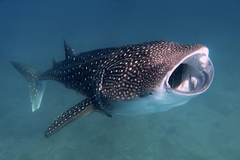
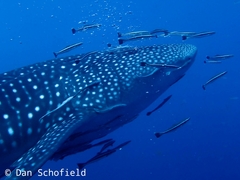
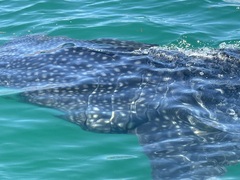
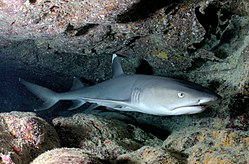
The whale shark (Rhincodon typus) is a slow-moving, filter-feeding carpet shark and the largest known extant fish species. An individual with a length of 18.8 m (61.7 ft) has been considered the largest reliably recorded. The whale shark holds many records for size in the animal kingdom, most notably being by far the largest living non-cetacean animal. It is the only living species of the genus Rhincodon and the only extant member of the family Rhincodontidae, which belongs to the subclass Elasmobranchii in the class Chondrichthyes. Before 1984, it was classified as Rhiniodon into Rhinodontidae. An extinct species, Rhincodon ferriolensis, was described in Europe (probably in Spain), in the Late Burdigalian stage.
The whale shark is an active filter feeder, primarily consuming plankton, krill, fish eggs, and small schooling fish such as sardines and anchovies. The shark can process over 6,000 liters of water per hour through its specialized sieve-like gill pads. Highly migratory, the whale shark travels thousands of miles across tropical oceans to exploit seasonal food sources, with large, predictable feeding aggregations occurring at coastal sites such as Ningaloo Reef in Western Australia, the Yucatan Peninsula in Mexico, and off the coast of Gujarat and Kerala in India. Despite its immense size, the whale shark is docile and poses no significant threat to humans. It is currently listed as an Endangered species on the IUCN Red List owing to a population decline of more than 50% over the last 75 years, primarily as a result of targeted fishing, bycatch in other fisheries, and collisions with large ships.
Whale sharks inhabit the open waters of all tropical oceans. They are rarely found in water below 21 °C (70 °F). The lifespan of a whale shark is estimated to be between 80 and 130 years, based on studies of their vertebral growth bands and the growth rates of free-swimming sharks.
The species was distinguished in April 1828 after the harpooning of a 4.6 m (15 ft) specimen in Table Bay, South Africa. Andrew Smith, a military doctor associated with British troops stationed in Cape Town, described it the following year. The name "whale shark" refers to the animal's appearance and large size; it is a fish, not a mammal, and, like all sharks, is not closely related to whales. Wikipedia →
Recent sightings of Whale Shark in Galápagos Islands
LIVEiNaturalistGlobal Distribution
Parks Where Found
| # | Park | Country | Daily sighting probability |
|---|---|---|---|
| 1 | Ningaloo Marine Park | 🇦🇺 Australia | |
| 2 | Coiba National Park | 🇵🇦 Panama | |
| 3 | Galápagos Islands | 🇪🇨 Ecuador |
Zoos & Centres Where Found
| # | Zoo / Centre | Country | |
|---|---|---|---|
| 1 | Zhuhai Chimelong Ocean Kingdom | 🇨🇳 China | |
| 2 | Chimelong Spaceship | 🇨🇳 China | |
| 3 | Jacksonville Zoo and Gardens | 🇺🇸 United States | |
| 4 | Ukumarí Biopark | 🇨🇴 Colombia | |
| 5 | Neo Park Okinawa | 🇯🇵 Japan | |
| 6 | Kagoshima City Hirakawa Zoo | 🇯🇵 Japan | |
| 7 | Zoo Atlanta | 🇺🇸 United States | |
| 8 | Tennōji Zoo | 🇯🇵 Japan | |
| 9 | Notojima Aquarium | 🇯🇵 Japan | |
| 10 | Georgia Aquarium | 🇺🇸 United States | |
| 11 | Macau Zoo | 🇲🇴 Macao SAR China | |
| 12 | Agroflori Parque de las Aves | 🇧🇴 Bolivia | |
| 13 | Okinawa Churaumi Aquarium | 🇯🇵 Japan | |
| 14 | Osaka Aquarium Kaiyukan | 🇯🇵 Japan | |
| 15 | 海昌鲸鲨馆 | 🇨🇳 China | |
| 16 | Birch Aquarium | 🇺🇸 United States | |
| 17 | Osaka Water Museum | 🇯🇵 Japan | |
| 18 | Bangsaen Aquarium | 🇹🇭 Thailand | |
| 19 | National Museum of Marine Biology and Aquarium | 🇹🇼 Taiwan |
Closest Relatives at Galápagos Islands
No species of the same family or order lives in Galápagos Islands, so these are its closest relatives here: other sharks & rays.


Before you go
What are the chances of seeing a Whale Shark in Galápagos Islands?
With luck
About 10% of wildlife watchers report a Whale Shark sighting in Galápagos Islands on a given day, based on 13 verified sightings from GBIF citizen-science data from 2019 to 2026. It is the 12th most-seen of the 16 sharks and rays we can rate there. Over three days the chance rises to about 30%, and over a week to about 60%, if each day is a fresh chance.
When is the best time to see a Whale Shark in Galápagos Islands?
August
In that month about 30% of wildlife watchers report a Whale Shark in Galápagos Islands on a given day, against under 5% in October and December, the lowest months. That is one of Galápagos Islands's driest months, with almost no rain against 50 mm in March.
What time of day is best to see a Whale Shark?
Between 9 am and noon
Across all the parks we cover, that three-hour window holds the most Whale Shark sightings with a recorded time, and about 8 in 10 of them come between 6 am and 6 pm: it is a daytime animal.
Is Galápagos Islands the best place to see a Whale Shark?
3rd of 3
Of the 3 parks where we can rate Whale Shark sightings, Galápagos Islands ranks 3rd at about 10%. The best odds are in Ningaloo Marine Park (Australia, about 60%) and Coiba National Park (Panama, about 40%).
Where does the Whale Shark sighting chance come from?
GBIF citizen-science records
It is estimated from how often the Whale Shark is recorded against all the sharks and rays logged in Galápagos Islands (13 verified sightings from 2019 to 2026), calibrated against known sighting rates. Figures are rounded to the nearest 10% because citizen-science data supports honest approximations, not decimals, and months with records from fewer than five people show "—". How it works.
