


Completed

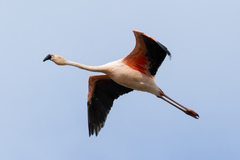


Chilean Flamingo
Phoenicopterus chilensis
Silhouette: Lee Harding (photo), John E. McCormack, Michael G. Harvey, Brant C. Faircloth, Nicholas G. Crawford, Travis C. Glenn, Robb T. Brumfield & T. Michael Keesey · PhyloPic
- KingdomAnimalia (Animals)
- PhylumChordata (Chordates)
- ClassAves (Birds)
- OrderPhoenicopteriformes (Flamingos)
- FamilyPhoenicopteridae (Flamingos)
- GenusPhoenicopterus (Large Flamingos)
- SpeciesPhoenicopterus chilensis (Chilean Flamingo)
In 3 days <5% in a week ~10%
98 Verified sightings at Galápagos Islands From 2019 to 2026
1,179 In all 5 parks
June Best month
☀️ Diurnal When it's spotted
About the Chilean Flamingo
The Chilean flamingo (Phoenicopterus chilensis) is a species of large flamingo at a height of 110–130 cm (43–51 in) closely related to the American flamingo and the greater flamingo, with which it was previously considered a subspecies before being classified as its own species as a result of their lighter color, smaller size and behavioral differences. The species is listed as Near Threatened on the IUCN Red List.
The species breeds in South America from Ecuador and Peru to Chile and Argentina and east to Brazil. Like all flamingos, it lays a single chalky-white egg on a mud mound. These flamingos are mainly restricted to salt lagoons and soda lakes that are vulnerable to habitat loss and water pollution, especially from mining and irrigation which can cause rapid habitat degradation.
The Chilean flamingo's plumage is pinker than the slightly larger greater flamingo, but less so than the American flamingo. It can be differentiated from these species by its grayish legs with pink joints, by the larger amount of black on the bill (more than half), and also by being a foot shorter than the American flamingo. Young chicks may have no sign of pink coloring whatsoever... Wikipedia →
Recent sightings of Chilean Flamingo in Galápagos Islands
LIVEiNaturalistGlobal Distribution
Parks Where Found
| # | Park | Country | Daily sighting probability |
|---|---|---|---|
| 1 | Lauca National Park | 🇨🇱 Chile | |
| 2 | Torres del Paine National Park | 🇨🇱 Chile | |
| 3 | Península Valdés | 🇦🇷 Argentina | |
| 4 | Galápagos Islands | 🇪🇨 Ecuador | |
| 5 | Camargue | 🇫🇷 France |
Cities Where Found
| # | City | Country | Daily sighting probability |
|---|---|---|---|
| 1 | Cochabamba | 🇧🇴 Bolivia | |
| 2 | León | 🇲🇽 México | |
| 3 | Lima | 🇵🇪 Peru | |
| 4 | Montevideo | 🇺🇾 Uruguay | |
| 5 | São Paulo | 🇧🇷 Brazil | |
| 6 | Rio de Janeiro | 🇧🇷 Brazil | |
| 7 | Buenos Aires | 🇦🇷 Argentina |
Zoos & Centres Where Found
| # | Zoo / Centre | Country | |
|---|---|---|---|
| 1 | SeaWorld Orlando | 🇺🇸 United States | |
| 2 | San Diego Zoo | 🇺🇸 United States | |
| 3 | Prague Zoo | 🇨🇿 Czechia | |
| 4 | Leipzig Zoological Garden | 🇩🇪 Germany | |
| 5 | Denver Zoo | 🇺🇸 United States | |
| 6 | Tierpark Berlin | 🇩🇪 Germany | |
| 7 | Natura Artis Magistra | 🇳🇱 Netherlands | |
| 8 | Dublin Zoo | 🇮🇪 Ireland | |
| 9 | Cleveland Metroparks Zoo | 🇺🇸 United States | |
| 10 | Zürich Zoo | 🇨🇭 Switzerland | |
| 11 | Planckendael Zoo | 🇧🇪 Belgium | |
| 12 | Antwerp Zoo | 🇧🇪 Belgium | |
| 13 | Parque das Aves | 🇧🇷 Brazil | |
| 14 | Barcelona Zoo | 🇪🇸 Spain | |
| 15 | Bellewaerde | 🇧🇪 Belgium | |
| 16 | North Carolina Zoo | 🇺🇸 United States | |
| 17 | Fota Wildlife Park | 🇮🇪 Ireland | |
| 18 | Réserve africaine de Sigean | 🇫🇷 France | |
| 19 | Parc des oiseaux | 🇫🇷 France | |
| 20 | Zoo de Doué | 🇫🇷 France | |
| 21 | Espace zoologique de La Boissière-du-Doré | 🇫🇷 France | |
| 22 | Harewood House | 🇬🇧 United Kingdom | |
| 23 | Bioparque Estrella | 🇲🇽 Mexico | |
| 24 | San Diego Zoo Safari Park | 🇺🇸 United States | |
| 25 | Al Ain Zoo | 🇦🇪 United Arab Emirates | |
| 26 | Taipei Zoo | 🇹🇼 Taiwan | |
| 27 | Parque Zoológico | 🇧🇷 Brazil | |
| 28 | Columbus Zoo and Aquarium | 🇺🇸 United States | |
| 29 | Bronx Zoo | 🇺🇸 United States | |
| 30 | Wildlife Safari | 🇺🇸 United States | |
| 31 | SeaWorld San Antonio | 🇺🇸 United States | |
| 32 | Planète Sauvage | 🇫🇷 France | |
| 33 | Givskud Zoo | 🇩🇰 Denmark | |
| 34 | Curitiba Zoo | 🇧🇷 Brazil | |
| 35 | Beijing Zoo | 🇨🇳 China | |
| 36 | Saitama Children's Zoo | 🇯🇵 Japan | |
| 37 | Reserva de Flora y Fauna Dr. Rodolfo Tálice | 🇺🇾 Uruguay | |
| 38 | Banham Zoo | 🇬🇧 United Kingdom | |
| 39 | Cotswold Wildlife Park | 🇬🇧 United Kingdom | |
| 40 | Los Angeles Zoo | 🇺🇸 United States | |
| 41 | Nuremberg Zoo | 🇩🇪 Germany | |
| 42 | Slimbridge Wetland Centre | 🇬🇧 United Kingdom | |
| 43 | Mundo Marino | 🇦🇷 Argentina | |
| 44 | Phoenix Zoo | 🇺🇸 United States | |
| 45 | Detroit Zoo | 🇺🇸 United States | |
| 46 | Greater Vancouver Zoo | 🇨🇦 Canada | |
| 47 | São Paulo Zoo | 🇧🇷 Brazil | |
| 48 | Folly Farm Adventure Park and Zoo | 🇬🇧 United Kingdom | |
| 49 | Parco Natura Viva | 🇮🇹 Italy | |
| 50 | Louisville Zoo | 🇺🇸 United States |
Closest Relatives at Galápagos Islands


Before you go
What are the chances of seeing a Chilean Flamingo in Galápagos Islands?
Rare
Under 5% of wildlife watchers report a Chilean Flamingo sighting in Galápagos Islands on a given day, based on 98 verified sightings from GBIF citizen-science data from 2019 to 2026. It is the 78th most-seen of the 114 birds we can rate there. Over three days the chance rises to under 5%, and over a week to about 10%, if each day is a fresh chance.
When is the best time to see a Chilean Flamingo in Galápagos Islands?
Any time of year
In every month with enough records, under 5% of wildlife watchers report a Chilean Flamingo in Galápagos Islands on a given day, so our monthly data shows no clear season.
What time of day is best to see a Chilean Flamingo?
Between 10 am and 1 pm
Across all the parks we cover, that three-hour window holds the most Chilean Flamingo sightings with a recorded time, and about 9 in 10 of them come between 6 am and 6 pm: it is a daytime animal.
Is Galápagos Islands the best place to see a Chilean Flamingo?
4th of 5
Of the 5 parks where we can rate Chilean Flamingo sightings, Galápagos Islands ranks 4th at under 5%. The best odds are in Lauca National Park (Chile, about 50%), Torres del Paine National Park (Chile, about 20%) and Península Valdés (Argentina, about 10%).
Where does the Chilean Flamingo sighting chance come from?
GBIF citizen-science records
It is estimated from how often the Chilean Flamingo is recorded against all the birds logged in Galápagos Islands (98 verified sightings from 2019 to 2026), calibrated against known sighting rates. Figures are rounded to the nearest 10% because citizen-science data supports honest approximations, not decimals, and months with records from fewer than five people show "—". How it works.
