Jungle Nightjar

Jungle Nightjar

Caprimulgus indicus

Silhouette: Ferran Sayol · PhyloPic

LCLeast ConcernNTVUENCR
Daily sighting probability ~10% · With luck
at Gir National Park

In 3 days ~30% in a week ~50%

23 Verified sightings at Gir National Park From 2019 to 2026
1,288 In all 12 parks
May Best month
☀️🌙 Day & Night When it's spotted

About the Jungle Nightjar

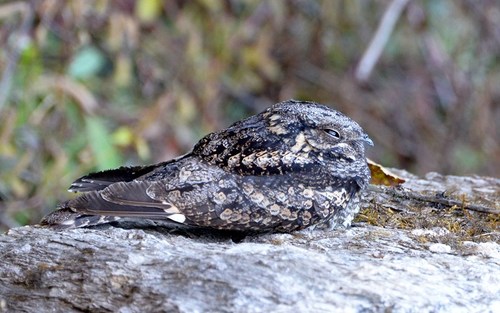
The jungle nightjar (Caprimulgus indicus) is a species of nightjar found in the Indian subcontinent. It is found mainly on the edge of forests where it is seen or heard at dusk. The taxonomy of this and related nightjars is complex and a range of treatments have been followed that cover this and several other nightjars in the Asian region. It was formerly called the grey nightjar or Indian jungle nightjar and sometimes included the East Asian grey nightjar (C. jotaka) as a subspecies.

The jungle nightjar is about 21–24 cm long with the Sri Lankan population (ssp. kelaarti) being smaller. Mostly grey with black streaks on the crown, it lacks a conspicuous wing patch which is rufous. The tail is greyish with well separated narrow black bars. The male has a white throat patch that is broken at the middle. The female has a rufous throat patch and submoustachial streaks. The usual call is a series of thacoo or chuck notes (at the rate of 5 every 2 seconds) like a distant engine. The song is a slow and regular, series of FWik-m notes, repeated for as long as 10 seconds. This sometimes ends in quick whistling foo-foo with the quality of sounds obtained when air is blown... Wikipedia →

Sounds

Song0:05

India · 2023

© Sandeep Chakraborty · XC777393 · CC BY-NC-SA 4.0

Call0:56

India · 2009

© Pankaj Lad · XC214014 · CC BY-NC-SA 4.0

Flight call1:20

India · 2011

© Andrew Mascarenhas · XC196661 · CC BY-NC-SA 4.0

Global Distribution

Parks Where Found

# Park Country Daily sighting probability
1 Mudumalai National Park 🇮🇳 India
~20%
2 Keoladeo National Park 🇮🇳 India
~10%
3 Gir National Park 🇮🇳 India
~10%
4 Bandhavgarh National Park 🇮🇳 India
~10%
5 Satpura National Park 🇮🇳 India
~10%
6 Yala National Park 🇱🇰 Sri Lanka
~10%
7 Kanha National Park 🇮🇳 India
<5%
8 Periyar National Park 🇮🇳 India
<5%
9 Ranthambore National Park 🇮🇳 India
<5%
10 Bandipur National Park 🇮🇳 India
<5%
11 Minneriya National Park 🇱🇰 Sri Lanka
<5%
12 Nagarhole National Park 🇮🇳 India
<5%

Cities Where Found

# City Country Daily sighting probability
1 Jaipur 🇮🇳 India
~10%
2 Thrissur 🇮🇳 India
<5%
3 Pune 🇮🇳 India
<5%
4 Kochi 🇮🇳 India
<5%
5 Bengaluru 🇮🇳 India
<5%

Before you go

What are the chances of seeing a Jungle Nightjar in Gir National Park?

With luck

About 10% of wildlife watchers report a Jungle Nightjar sighting in Gir National Park on a given day, based on 23 verified sightings from GBIF citizen-science data from 2019 to 2026. It is the 83rd most-seen of the 135 birds we can rate there. Over three days the chance rises to about 30%, and over a week to about 50%, if each day is a fresh chance.

When is the best time to see a Jungle Nightjar in Gir National Park?

February and May–June

In those months about 20% of wildlife watchers report a Jungle Nightjar in Gir National Park on a given day, against under 5% in January, the lowest month. July and August have too few records to rate.

What time of day is best to see a Jungle Nightjar?

Between 8 and 11 am

Across all the parks we cover, that three-hour window holds the most Jungle Nightjar sightings with a recorded time, and about 7 in 10 of them come between 6 am and 6 pm: it is seen both by day and at night.

Is Gir National Park the best place to see a Jungle Nightjar?

3rd of 12

Of the 12 parks where we can rate Jungle Nightjar sightings, Gir National Park ranks 3rd at about 10%. The best odds are in Mudumalai National Park (India, about 20%) and Keoladeo National Park (India, about 10%).

Which relatives of the Jungle Nightjar live in Gir National Park?

Same genus: Caprimulgus

The closest relatives of the Jungle Nightjar that you can see in Gir National Park (genus Caprimulgus, Old World Nightjars) are Indian Nightjar (about 10%) and Savanna Nightjar (about 10%), with each one's daily chance of a sighting.

Where does the Jungle Nightjar sighting chance come from?

GBIF citizen-science records

It is estimated from how often the Jungle Nightjar is recorded against all the birds logged in Gir National Park (23 verified sightings from 2019 to 2026), calibrated against known sighting rates. Figures are rounded to the nearest 10% because citizen-science data supports honest approximations, not decimals, and months with records from fewer than five people show "—". How it works.
← Back to Gir National Park