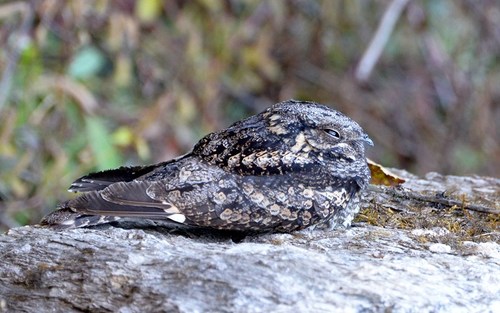
Indian Nightjar

Indian Nightjar

Caprimulgus asiaticus

Silhouette: Ferran Sayol · PhyloPic

LCLeast ConcernNTVUENCR
Daily sighting probability ~10% · With luck
at Gir National Park

In 3 days ~40% in a week ~60%

25 Verified sightings at Gir National Park From 2019 to 2026
1,111 In all 15 parks
May Best month
🌅 Crepuscular When it's spotted

About the Indian Nightjar

The Indian nightjar (Caprimulgus asiaticus) is a small nightjar which is a resident breeder in open lands across South Asia and Southeast Asia. Like most nightjars it is crepuscular and is best detected from its characteristic calls at dawn and dusk that have been likened to a stone skipping on a frozen lake - a series of clicks that become shorter and more rapid. They are sometimes spotted on roads when their eyes gleam red in the spotlight of a vehicle. There is considerable plumage variation across its range and can be hard to differentiate from other nightjars in the region especially in the field.

This nightjar is small and short-tailed with white corners to the tail, a golden nape and collar, dark cheeks and white patches on the sides of the throat. The crown is grey and the breast is finely barred in brown. The males have more white on the tail while the female is more heavily streaked on the crown. It is differentiated from Sykes's nightjar by the dark undertail and from Jerdon's nightjar by the shorter tail and white patches on the sides of the throat.

The call is distinctive and has been likened to a stone skipped on a frozen lake (due to which it was also... Wikipedia →

Sounds

Song1:00

Thailand · 2025

© Ding Li Yong · XC961729 · CC BY-NC-ND 4.0

Call0:13

India · 2021

© Sandip das · XC642141 · CC BY-NC-SA 4.0

Song0:35

Thailand · 2020

© Peter Ericsson · XC611999 · CC BY-NC-SA 4.0

Global Distribution

Parks Where Found

# Park Country Daily sighting probability
1 Yala National Park 🇱🇰 Sri Lanka
~20%
2 Gir National Park 🇮🇳 India
~10%
3 Udawalawe National Park 🇱🇰 Sri Lanka
~10%
4 Bandhavgarh National Park 🇮🇳 India
~10%
5 Satpura National Park 🇮🇳 India
~10%
6 Wilpattu National Park 🇱🇰 Sri Lanka
~10%
7 Keoladeo National Park 🇮🇳 India
~10%
8 Minneriya National Park 🇱🇰 Sri Lanka
<5%
9 Kanha National Park 🇮🇳 India
<5%
10 Doi Inthanon National Park 🇹🇭 Thailand
<5%
11 Ranthambore National Park 🇮🇳 India
<5%
12 Mudumalai National Park 🇮🇳 India
<5%
13 Kaeng Krachan National Park 🇹🇭 Thailand
<5%
14 Bandipur National Park 🇮🇳 India
<5%
15 Khao Yai National Park 🇹🇭 Thailand
<5%

Cities Where Found

# City Country Daily sighting probability
1 Solapur 🇮🇳 India
<5%
2 Chhatrapati Sambhajinagar 🇮🇳 India
<5%
3 Raipur 🇮🇳 India
<5%
4 Jaipur 🇮🇳 India
<5%
5 Pune 🇮🇳 India
<5%
6 Nagpur 🇮🇳 India
<5%
7 Thrissur 🇮🇳 India
<5%
8 Bhopal 🇮🇳 India
<5%
9 Hyderabad 🇮🇳 India
<5%
10 Jabalpur 🇮🇳 India
<5%

Before you go

What are the chances of seeing an Indian Nightjar in Gir National Park?

With luck

About 10% of wildlife watchers report an Indian Nightjar sighting in Gir National Park on a given day, based on 25 verified sightings from GBIF citizen-science data from 2019 to 2026. It is the 71st most-seen of the 135 birds we can rate there. Over three days the chance rises to about 40%, and over a week to about 60%, if each day is a fresh chance.

When is the best time to see an Indian Nightjar in Gir National Park?

March and May

In those months about 30% of wildlife watchers report an Indian Nightjar in Gir National Park on a given day, against about 10% in April, June and September–January, the lowest months. Those are among Gir National Park's driest months, with about 10 mm of rain a month against 330 mm in July. July and August have too few records to rate.

What time of day is best to see an Indian Nightjar?

Between 4 and 7 pm

Across all the parks we cover, that three-hour window holds the most Indian Nightjar sightings with a recorded time, and about 6 in 10 of them come between 6 am and 6 pm: it is most active around dawn and dusk.

Is Gir National Park the best place to see an Indian Nightjar?

2nd of 15

Of the 15 parks where we can rate Indian Nightjar sightings, Gir National Park ranks 2nd at about 10%. The best odds are in Yala National Park (Sri Lanka, about 20%).

Which relatives of the Indian Nightjar live in Gir National Park?

Same genus: Caprimulgus

The closest relatives of the Indian Nightjar that you can see in Gir National Park (genus Caprimulgus, Old World Nightjars) are Jungle Nightjar (about 10%) and Savanna Nightjar (about 10%), with each one's daily chance of a sighting.

Where does the Indian Nightjar sighting chance come from?

GBIF citizen-science records

It is estimated from how often the Indian Nightjar is recorded against all the birds logged in Gir National Park (25 verified sightings from 2019 to 2026), calibrated against known sighting rates. Figures are rounded to the nearest 10% because citizen-science data supports honest approximations, not decimals, and months with records from fewer than five people show "—". How it works.

← Back to Gir National Park