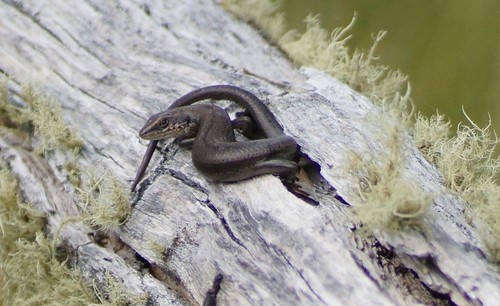
White's Rock-skink

White's Rock-skink

Liopholis whitii

Silhouette: David Orr · PhyloPic

LCLeast ConcernNTVUENCR
Daily sighting probability ~40% · Likely
at Grampians National Park

In 3 days ~80% in a week >90%

98 Verified sightings at Grampians National Park From 2019 to 2026
373 In all 6 parks
February Best month
☀️ Diurnal When it's spotted

About the White's Rock-skink

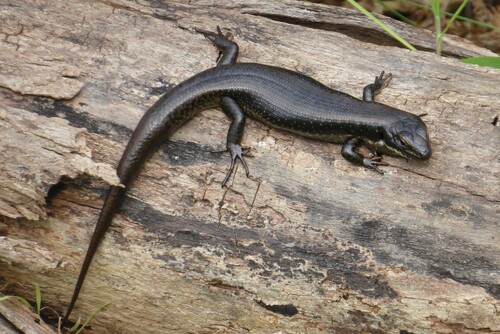
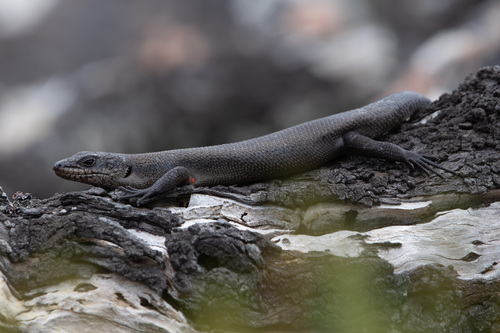
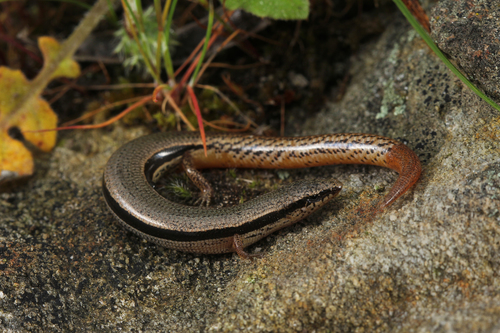
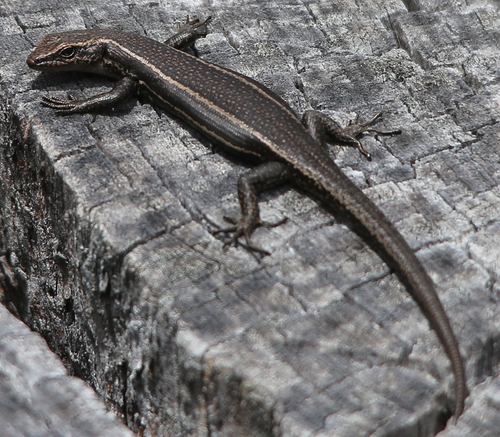
White's skink (Liopholis whitii), also known commonly as White's rock skink, is a species of lizard in the skink family. It was first described in 1804 by French naturalist Bernard Germain de Lacépède. It is endemic to Australia.

L. whitii is highly variable and may be a complex of closely related species The specific name, whitii, honours Irish surgeon and naturalist John White. Two subspecies are recognized as being valid, including the nominotypical subspecies.

Liopholis whitii moniligera (A.M.C. Duméril & Bibron, 1839) Liopholis whitii whitii (Lacèpėde, 1804) L. whitii is widespread in south-eastern Australia, including Tasmania and many Bass Strait islands. Natural habitats of the species include forest, shrubland, and rocky areas, at altitudes from sea level to 1,200 m (3,900 ft). The preferred habitat has rocks and shrubby heathland with minimal environmental disturbance.

White's skink is a stocky, slow-growing, medium-sized species, reaching a maximum snout-to-vent length (SVL) of about 90 mm (3.5 in). Both sexes are mature at ~75 mm (3.0 in) (SVL), a size typically achieved... Wikipedia →

Global Distribution

Parks Where Found

# Park Country Daily sighting probability
1 Freycinet National Park 🇦🇺 Australia
~70%
2 Maria Island National Park 🇦🇺 Australia
~50%
3 Wilsons Promontory National Park 🇦🇺 Australia
~50%
4 Grampians National Park 🇦🇺 Australia
~40%
5 Flinders Chase 🇦🇺 Australia
~20%
6 Great Otway National Park 🇦🇺 Australia
~10%

Cities Where Found

# City Country Daily sighting probability
1 Hobart 🇦🇺 Australia
~10%
2 Melbourne 🇦🇺 Australia
<5%

Closest Relatives at Grampians National Park

Before you go

What are the chances of seeing a White's Rock-skink in Grampians National Park?

Likely

About 40% of wildlife watchers report a White's Rock-skink sighting in Grampians National Park on a given day, based on 98 verified sightings from GBIF citizen-science data from 2019 to 2026. It is the 6th most-seen of the 25 reptiles we can rate there. Over three days the chance rises to about 80%, and over a week to over 90%, if each day is a fresh chance.

When is the best time to see a White's Rock-skink in Grampians National Park?

February

In that month about 70% of wildlife watchers report a White's Rock-skink in Grampians National Park on a given day, against under 5% in May to August, the lowest months. That is one of Grampians National Park's driest months, with about 20 mm of rain against 85 mm in October.

What time of day is best to see a White's Rock-skink?

Between 11 am and 2 pm

Across all the parks we cover, that three-hour window holds the most White's Rock-skink sightings with a recorded time, and about 9 in 10 of them come between 6 am and 6 pm: it is a daytime animal.

Which relatives of the White's Rock-skink live in Grampians National Park?

Same family: Scincidae

The closest relatives of the White's Rock-skink that you can see in Grampians National Park (family Scincidae, Skinks) are Shingleback Lizard (about 70%), Cool-temperate Water Skink (about 70%) and Black Crevice-skink (about 60%), with each one's daily chance of a sighting.

Where does the White's Rock-skink sighting chance come from?

GBIF citizen-science records

It is estimated from how often the White's Rock-skink is recorded against all the reptiles logged in Grampians National Park (98 verified sightings from 2019 to 2026), calibrated against known sighting rates. Figures are rounded to the nearest 10% because citizen-science data supports honest approximations, not decimals, and months with records from fewer than five people show "—". How it works.

← Back to Grampians National Park