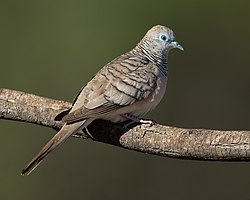
Peaceful Dove

Peaceful Dove

Geopelia placida

Silhouette: Sheatherius · PhyloPic

LCLeast ConcernNTVUENCR
Daily sighting probability ~10% · With luck
at Hattah-Kulkyne National Park

In 3 days ~30% in a week ~60%

159 Verified sightings at Hattah-Kulkyne National Park From 2019 to 2026
2,688 In all 10 parks
November Best month
☀️ Diurnal When it's spotted

About the Peaceful Dove

The peaceful dove (Geopelia placida) is a pigeon native to Australia and New Guinea. The peaceful dove is closely related to the zebra dove of south-east Asia and the barred dove of eastern Indonesia. Until recently, the three were classed as a single species, Geopelia striata, known as peaceful dove or zebra dove.

The bird is a relatively small pigeon and varies in length from 19 to 21 centimetres (7.6 to 8.4 inches). The peaceful dove has a pink-grey breast with chequered grey-brown wings. Thin striations of black appear around the neck and nape area and descend down the back. The eye is greyish-white and a blue-grey ring surrounds the eye that tapers off and joins the beak/cere. The juveniles are paler and less striated. They also have a duller eye ring. The nape is similar to that of the bar-shouldered dove in that the nape feathers are striated but differs in that the bar-shouldered dove does not have striated throat feathers like the peaceful dove. Furthermore, the nape feathers are grey-brown in colour compared to the vivid copper colour seen with bar-shouldered doves.

Calls of the peaceful dove are high-pitched "doodle-doo", "co-co-coo" and "croorrr!".... Wikipedia →

Sounds

Song0:24

Australia · 2025

© Peter Boesman · XC1066574 · CC BY-NC-ND 4.0

Call0:30

Australia · 2020

© Toby Esplin · XC580368 · CC BY-NC-ND 4.0

Song0:32

Australia · 2021

© Eddy Smith · XC747824 · CC BY-NC-SA 4.0

Global Distribution

Parks Where Found

# Park Country Daily sighting probability
1 Kakadu National Park 🇦🇺 Australia
~70%
2 Nitmiluk National Park 🇦🇺 Australia
~60%
3 Litchfield National Park 🇦🇺 Australia
~50%
4 Flinders Ranges National Park 🇦🇺 Australia
~30%
5 Hattah-Kulkyne National Park 🇦🇺 Australia
~10%
6 Daintree National Park 🇦🇺 Australia
~10%
7 Blue Mountains National Park 🇦🇺 Australia
<5%
8 Springbrook National Park 🇦🇺 Australia
<5%
9 Noosa National Park 🇦🇺 Australia
<5%
10 Lamington National Park 🇦🇺 Australia
<5%

Cities Where Found

# City Country Daily sighting probability
1 Brisbane 🇦🇺 Australia
~10%

Zoos & Centres Where Found

# Zoo / Centre Country
1 Alice Springs Desert Park 🇦🇺 Australia In captivity
2 Healesville Sanctuary 🇦🇺 Australia In captivity
3 Taronga Zoo 🇦🇺 Australia In captivity
4 Featherdale Sydney Wildlife Park 🇦🇺 Australia In captivity
5 Cairns Aquarium 🇦🇺 Australia In captivity
6 Fauna Reserve 🇦🇺 Australia In captivity
7 Birdworld Kuranda 🇦🇺 Australia In captivity
8 Kuranda Koala Gardens 🇦🇺 Australia In captivity
9 Ranger Red’s Zoo & Conservation Park 🇦🇺 Australia In captivity

Before you go

What are the chances of seeing a Peaceful Dove in Hattah-Kulkyne National Park?

With luck

About 10% of wildlife watchers report a Peaceful Dove sighting in Hattah-Kulkyne National Park on a given day, based on 159 verified sightings from GBIF citizen-science data from 2019 to 2026. It is the 76th most-seen of the 170 birds we can rate there. Over three days the chance rises to about 30%, and over a week to about 60%, if each day is a fresh chance.

When is the best time to see a Peaceful Dove in Hattah-Kulkyne National Park?

September and November

In those months about 20% of wildlife watchers report a Peaceful Dove in Hattah-Kulkyne National Park on a given day, against under 5% in August, the lowest month. Those are among Hattah-Kulkyne National Park's wettest months, with about 35 mm of rain a month against 5 mm in February.

What time of day is best to see a Peaceful Dove?

Between 7 and 10 am

Across all the parks we cover, that three-hour window holds the most Peaceful Dove sightings with a recorded time, and about 9 in 10 of them come between 6 am and 6 pm: it is a daytime animal.

Where does the Peaceful Dove sighting chance come from?

GBIF citizen-science records

It is estimated from how often the Peaceful Dove is recorded against all the birds logged in Hattah-Kulkyne National Park (159 verified sightings from 2019 to 2026), calibrated against known sighting rates. Figures are rounded to the nearest 10% because citizen-science data supports honest approximations, not decimals, and months with records from fewer than five people show "—". How it works.

← Back to Hattah-Kulkyne National Park