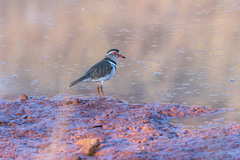
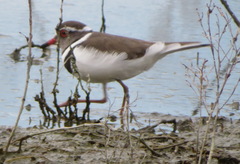
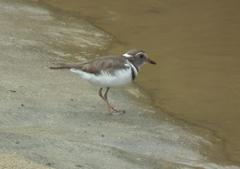
Three-Banded Plover

Three-Banded Plover

Charadrius tricollaris

LCLeast ConcernNTVUENCR
Daily sighting probability ~40% · Likely
at Hluhluwe-Imfolozi Park

In 3 days ~80% in a week >90%

155 Verified sightings at Hluhluwe-Imfolozi Park From 2019 to 2026
12,475 In all 31 parks
January Best month
☀️ Diurnal When it's spotted

About the Three-Banded Plover

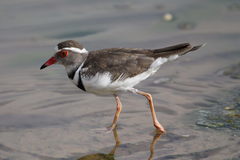
The three-banded plover, or three-banded sandplover (Charadrius tricollaris, syn.: Thinornis tricollaris), is a small wader. This plover is resident and generally sedentary in much of East Africa, southern Africa and Madagascar. It occurs mainly on inland rivers, pools, lakes and pans, frequenting their exposed shores. This species is often seen as single individuals, but it will form small flocks. It hunts by sight for insects, worms and other invertebrates. Three-banded plovers have a sharp whistled weeet-weet call. Its larger and darker-plumaged sister species, Forbes's plover, replaces it in West Africa and in the moist tropics. The two species have largely allopatric breeding ranges. Both species present a distinctively elongated profile, due to their proportionally long tail and wings.

The adult three-banded plover is 18 cm in length. It has long wings and a very long tail, and therefore looks different from most other small plovers in flight, the exception being the closely related Forbes's plover. The adult three-banded plover has medium brown upperparts, and the underparts are white except for the two black breast bands, separated by a white band, which...

Wikipedia →

Sounds

Call0:05

Ethiopia · 2024

© Marcin Sołowiej · XC960411 · CC BY-NC-SA 4.0

Song0:16

South Africa · 2020

© Nature Sounds by Simply Birding · XC576252 · CC BY-NC-ND 4.0

Call0:04

Zambia · 2023

© Dries Van de Loock · XC854368 · CC BY-NC-ND 4.0

Global Distribution

Parks Where Found

# Park Country Daily sighting probability
1 uMkhuze Game Reserve 🇿🇦 South Africa
~60%
2 Semuliki National Park 🇺🇬 Uganda
~60%
3 Nairobi National Park 🇰🇪 Kenya
~50%
4 Arusha National Park 🇹🇿 Tanzania
~40%
5 West Coast National Park 🇿🇦 South Africa
~40%
6 Hluhluwe-Imfolozi Park 🇿🇦 South Africa
~40%
7 Gonarezhou National Park 🇿🇼 Zimbabwe
~40%
8 Kruger National Park 🇿🇦 South Africa
~40%
9 South Luangwa National Park 🇿🇲 Zambia
~40%
10 Hwange National Park 🇿🇼 Zimbabwe
~40%
11 Pilanesberg National Park 🇿🇦 South Africa
~30%
12 Lake Nakuru National Park 🇰🇪 Kenya
~30%
13 Serengeti National Park 🇹🇿 Tanzania
~30%
14 Tarangire National Park 🇹🇿 Tanzania
~30%
15 Amboseli National Park 🇰🇪 Kenya
~30%
16 Masai Mara National Reserve 🇰🇪 Kenya
~30%
17 De Hoop Nature Reserve 🇿🇦 South Africa
~20%
18 Tsavo East National Park 🇰🇪 Kenya
~20%
19 Samburu National Reserve 🇰🇪 Kenya
~20%
20 Tsavo West National Park 🇰🇪 Kenya
~20%
21 Liwonde National Park 🇲🇼 Malawi
~20%
22 Addo Elephant National Park 🇿🇦 South Africa
~20%
23 Ngorongoro Conservation Area 🇹🇿 Tanzania
~20%
24 Lake Manyara National Park 🇹🇿 Tanzania
~20%
25 Moremi Game Reserve 🇧🇼 Botswana
~20%
26 Queen Elizabeth National Park 🇺🇬 Uganda
~20%
27 iSimangaliso Wetland Park 🇿🇦 South Africa
~20%
28 Garden Route National Park 🇿🇦 South Africa
~10%
29 Chobe National Park 🇧🇼 Botswana
~10%
30 Etosha National Park 🇳🇦 Namibia
~10%
31 Table Mountain National Park 🇿🇦 South Africa
~10%

Cities Where Found

# City Country Daily sighting probability
1 Mombasa 🇰🇪 Kenya
~30%
2 Dar es-Salaam 🇹🇿 Tanzania
~10%
3 Cape Town 🇿🇦 South Africa
~10%
4 Kigali 🇷🇼 Rwanda
<5%
5 Durban 🇿🇦 South Africa
<5%
6 Harare 🇿🇼 Zimbabwe
<5%
7 Antananarivo 🇲🇬 Madagascar
<5%
8 Pretoria 🇿🇦 South Africa
<5%
9 Johannesburg 🇿🇦 South Africa
<5%
10 Nairobi 🇰🇪 Kenya
<5%

Zoos & Centres Where Found

# Zoo / Centre Country
1 Tierpark Hagenbeck 🇩🇪 Germany In captivity

Before you go

What are the chances of seeing a Three-Banded Plover in Hluhluwe-Imfolozi Park?

Likely

About 40% of wildlife watchers report a Three-Banded Plover sighting in Hluhluwe-Imfolozi Park on a given day, based on 155 verified sightings from GBIF citizen-science data from 2019 to 2026. It is the 19th most-seen of the 223 birds we can rate there. Over three days the chance rises to about 80%, and over a week to over 90%, if each day is a fresh chance.

When is the best time to see a Three-Banded Plover in Hluhluwe-Imfolozi Park?

January

In that month about 50% of wildlife watchers report a Three-Banded Plover in Hluhluwe-Imfolozi Park on a given day, against about 20% in August, the lowest month. That is one of Hluhluwe-Imfolozi Park's wettest months, with about 110 mm of rain against 15 mm in June.

What time of day is best to see a Three-Banded Plover?

Between 7 and 10 am

Across all the parks we cover, that three-hour window holds the most Three-Banded Plover sightings with a recorded time, and about 9 in 10 of them come between 6 am and 6 pm: it is a daytime animal.

Which relatives of the Three-Banded Plover live in Hluhluwe-Imfolozi Park?

Same family: Charadriidae

The closest relatives of the Three-Banded Plover that you can see in Hluhluwe-Imfolozi Park (family Charadriidae, Plovers and Lapwings) are African Wattled Lapwing (about 20%), Crowned Lapwing (about 10%) and Blacksmith Lapwing (about 10%), with each one's daily chance of a sighting.

Where does the Three-Banded Plover sighting chance come from?

GBIF citizen-science records

It is estimated from how often the Three-Banded Plover is recorded against all the birds logged in Hluhluwe-Imfolozi Park (155 verified sightings from 2019 to 2026), calibrated against known sighting rates. Figures are rounded to the nearest 10% because citizen-science data supports honest approximations, not decimals, and months with records from fewer than five people show "—". How it works.

← Back to Hluhluwe-Imfolozi Park