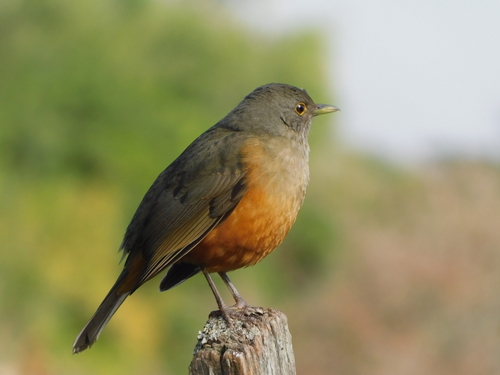
Grassland Sparrow

Grassland Sparrow

Ammodramus humeralis

Silhouette: Andy Wilson · PhyloPic

LCLeast ConcernNTVUENCR
Daily sighting probability ~30% · Possible
at Iberá National Park

In 3 days ~70% in a week ~90%

626 Verified sightings at Iberá National Park From 2019 to 2026
1,320 In all 11 parks
January Best month
☀️ Diurnal When it's spotted

About the Grassland Sparrow

The grassland sparrow (Ammodramus humeralis) is a species of bird in the family Passerellidae. It is found in Argentina, Bolivia, Brazil, Colombia, French Guiana, Guyana, Paraguay, Peru, Suriname, Uruguay, and Venezuela. Its natural habitats are dry savannah, subtropical or tropical seasonally wet or flooded lowland grassland, and pastureland.

The grassland sparrow is a robust species with a large head and a short tail, with a total length of about 13 cm (5 in). The wings are short and the legs fairly long. The upper parts are brownish-grey streaked with black. The breast and flanks are greyish-buff or pinkish-buff and the underparts are dull white. There is a narrow white eye-ring, and a spot of yellow on the lores and another on the bend of the wing. The song is a high-pitched but thin series of plaintive phrases, "eee, telee, teeeee". This bird is similar in appearance to the yellow-browed sparrow, but that has more yellow on the face and the voice is quite distinct.

This sparrow is native to the western half of South America. Its range includes Argentina, Bolivia, Brazil, Colombia, French Guiana, Guyana, Paraguay, Peru, Suriname... Wikipedia →

Sounds

Song0:58

Brazil · 2025

© JAYRSON ARAUJO DE OLIVEIRA · XC1019659 · CC BY-NC-SA 4.0

Alarm call0:07

Colombia · 2023

© David Monroy Rengifo · XC816677 · CC BY-NC-SA 4.0

Call0:32

Brazil · 2019

© Marcelo J Feliti · XC502083 · CC BY-NC-SA 4.0

Global Distribution

Parks Where Found

# Park Country Daily sighting probability
1 Emas National Park 🇧🇷 Brazil
~60%
2 Serra da Canastra National Park 🇧🇷 Brazil
~40%
3 Iberá National Park 🇦🇷 Argentina
~30%
4 El Palmar National Park 🇦🇷 Argentina
~20%
5 Chapada Diamantina National Park 🇧🇷 Brazil
~10%
6 El Impenetrable National Park 🇦🇷 Argentina
~10%
7 Serra dos Órgãos National Park 🇧🇷 Brazil
<5%
8 Iguaçu National Park 🇧🇷 Brazil
<5%
9 Chapada dos Guimarães National Park 🇧🇷 Brazil
<5%
10 Iguazú National Park 🇦🇷 Argentina
<5%
11 Manu National Park 🇵🇪 Peru
<5%

Cities Where Found

# City Country Daily sighting probability
1 Brasilia 🇧🇷 Brazil
<5%
2 Curitiba 🇧🇷 Brazil
<5%
3 Santa Cruz de la Sierra 🇧🇴 Bolivia
<5%
4 Campinas 🇧🇷 Brazil
<5%
5 Campo Grande 🇧🇷 Brazil
<5%
6 São Paulo 🇧🇷 Brazil
<5%
7 Asuncion 🇵🇾 Paraguay
<5%
8 Buenos Aires 🇦🇷 Argentina
<5%

Before you go

What are the chances of seeing a Grassland Sparrow in Iberá National Park?

Possible

About 30% of wildlife watchers report a Grassland Sparrow sighting in Iberá National Park on a given day, based on 626 verified sightings from GBIF citizen-science data from 2019 to 2026. It is the 62nd most-seen of the 284 birds we can rate there. Over three days the chance rises to about 70%, and over a week to about 90%, if each day is a fresh chance.

When is the best time to see a Grassland Sparrow in Iberá National Park?

January

In that month about 60% of wildlife watchers report a Grassland Sparrow in Iberá National Park on a given day, against about 10% in August, the lowest month.

What time of day is best to see a Grassland Sparrow?

Between 8 and 11 am

Across all the parks we cover, that three-hour window holds the most Grassland Sparrow sightings with a recorded time, and about 8 in 10 of them come between 6 am and 6 pm: it is a daytime animal.

Where does the Grassland Sparrow sighting chance come from?

GBIF citizen-science records

It is estimated from how often the Grassland Sparrow is recorded against all the birds logged in Iberá National Park (626 verified sightings from 2019 to 2026), calibrated against known sighting rates. Figures are rounded to the nearest 10% because citizen-science data supports honest approximations, not decimals, and months with records from fewer than five people show "—". How it works.

← Back to Iberá National Park