

Lesser Racket-tailed Drongo

Lesser Racket-tailed Drongo

Dicrurus remifer

Silhouette: Ferran Sayol · PhyloPic

LCLeast ConcernNTVUENCR
Daily sighting probability ~10% · With luck
at Jim Corbett National Park

In 3 days ~20% in a week ~40%

167 Verified sightings at Jim Corbett National Park From 2019 to 2026
2,403 In all 13 parks
January Best month
🌅 Crepuscular When it's spotted

About the Lesser Racket-tailed Drongo

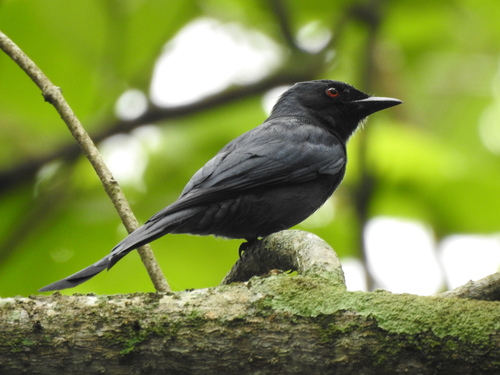
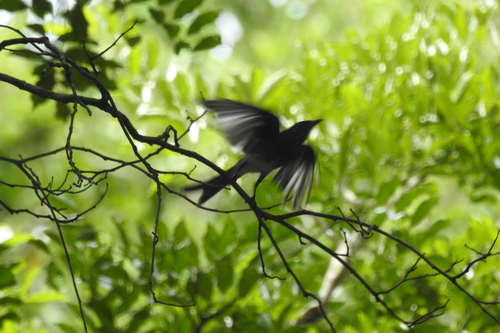
The lesser racket-tailed drongo (Dicrurus remifer) is a species of bird in the family Dicruridae. It is found in the Indian subcontinent and Southeast Asia. It is found in the Indian subcontinent and Southeast Asia, ranging across Bangladesh, Bhutan, Cambodia, India, Indonesia, Laos, Malaysia, Myanmar, Nepal, Thailand, and Vietnam. Its natural habitat is near the edge or inside of subtropical or tropical moist montane forests.

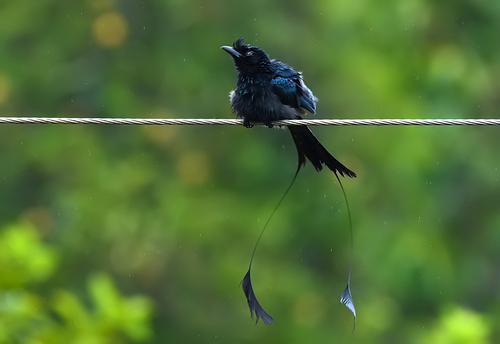
The drongo is about 25–27.5 cm long, excluding outermost tail feathers (c. 30–40 cm to end of tail); average weight of males is between 39–49 grams while females are between 35.5–44 grams. Its feathers are black with a bluish metallic gloss. The ends of its tail have long shafts more than 50 centimetres (20 in).

It can be confused with the greater racket-tailed drongo, but the former doesn't have a crest on its head and its tail is square cut. Wikipedia →

Sounds

Song0:42

Cambodia · 2025

© Ding Li Yong · XC982168 · CC BY-NC-ND 4.0

Call0:45

Laos · 2020

© Bram Piot · XC607439 · CC BY-NC-SA 4.0

Subsong0:42

Malaysia · 2019

© Marc Anderson · XC531350 · CC BY-NC-ND 4.0

Global Distribution

Parks Where Found

# Park Country Daily sighting probability
1 Namdapha National Park 🇮🇳 India
~40%
2 Doi Inthanon National Park 🇹🇭 Thailand
~30%
3 Kerinci Seblat National Park 🇮🇩 Indonesia
~20%
4 Royal Manas National Park 🇧🇹 Bhutan
~20%
5 Manas National Park 🇮🇳 India
~10%
6 Jim Corbett National Park 🇮🇳 India
~10%
7 Kaeng Krachan National Park 🇹🇭 Thailand
~10%
8 Cat Tien National Park 🇻🇳 Vietnam
~10%
9 Kaziranga National Park 🇮🇳 India
<5%
10 Royal Bardia National Park 🇳🇵 Nepal
<5%
11 Cuc Phuong National Park 🇻🇳 Vietnam
<5%
12 Chitwan National Park 🇳🇵 Nepal
<5%
13 Taman Negara National Park 🇲🇾 Malaysia
<5%

Cities Where Found

# City Country Daily sighting probability
1 Tamluk 🇮🇳 India
<5%
2 Guwahati 🇮🇳 India
<5%
3 Kolkata 🇮🇳 India
<5%
4 Bangkok 🇹🇭 Thailand
<5%
5 Kuala Lumpur 🇲🇾 Malaysia
<5%
6 Kathmandu 🇳🇵 Nepal
<5%
7 Dehradun 🇮🇳 India
<5%

Before you go

What are the chances of seeing a Lesser Racket-tailed Drongo in Jim Corbett National Park?

With luck

About 10% of wildlife watchers report a Lesser Racket-tailed Drongo sighting in Jim Corbett National Park on a given day, based on 167 verified sightings from GBIF citizen-science data from 2019 to 2026. It is the 150th most-seen of the 368 birds we can rate there. Over three days the chance rises to about 20%, and over a week to about 40%, if each day is a fresh chance.

When is the best time to see a Lesser Racket-tailed Drongo in Jim Corbett National Park?

January

In that month about 20% of wildlife watchers report a Lesser Racket-tailed Drongo in Jim Corbett National Park on a given day, against under 5% in March to September, the lowest months. That is one of Jim Corbett National Park's driest months, with about 45 mm of rain against 360 mm in July.

What time of day is best to see a Lesser Racket-tailed Drongo?

Between 2 and 5 am

Across all the parks we cover, that three-hour window holds the most Lesser Racket-tailed Drongo sightings with a recorded time, and about 6 in 10 of them come between 6 pm and 6 am: it is most active around dawn and dusk.

Is Jim Corbett National Park the best place to see a Lesser Racket-tailed Drongo?

6th of 13

Of the 13 parks where we can rate Lesser Racket-tailed Drongo sightings, Jim Corbett National Park ranks 6th at about 10%. The best odds are in Namdapha National Park (India, about 40%), Doi Inthanon National Park (Thailand, about 30%) and Kerinci Seblat National Park (Indonesia, about 20%).

Which relatives of the Lesser Racket-tailed Drongo live in Jim Corbett National Park?

Same genus: Dicrurus

The closest relatives of the Lesser Racket-tailed Drongo that you can see in Jim Corbett National Park (genus Dicrurus, Drongos) are Hair-crested Drongo (about 20%), Black Drongo (about 20%) and Ashy Drongo (about 10%), with each one's daily chance of a sighting.

Where does the Lesser Racket-tailed Drongo sighting chance come from?

GBIF citizen-science records

It is estimated from how often the Lesser Racket-tailed Drongo is recorded against all the birds logged in Jim Corbett National Park (167 verified sightings from 2019 to 2026), calibrated against known sighting rates. Figures are rounded to the nearest 10% because citizen-science data supports honest approximations, not decimals, and months with records from fewer than five people show "—". How it works.

← Back to Jim Corbett National Park