Black Drongo

Black Drongo

Dicrurus macrocercus

Silhouette: Ferran Sayol · PhyloPic

LCLeast ConcernNTVUENCR
Daily sighting probability ~20% · Possible
at Jim Corbett National Park

In 3 days ~50% in a week ~80%

569 Verified sightings at Jim Corbett National Park From 2019 to 2026
22,680 In all 31 parks
June Best month
☀️ Diurnal When it's spotted

About the Black Drongo

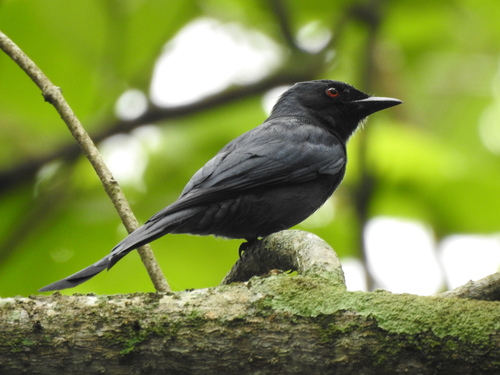
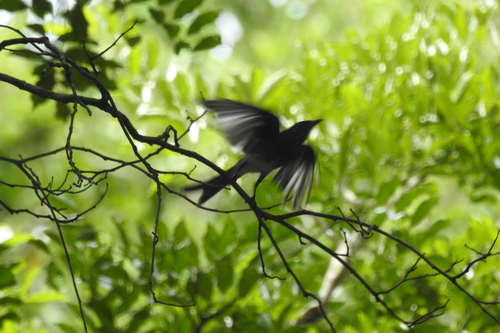
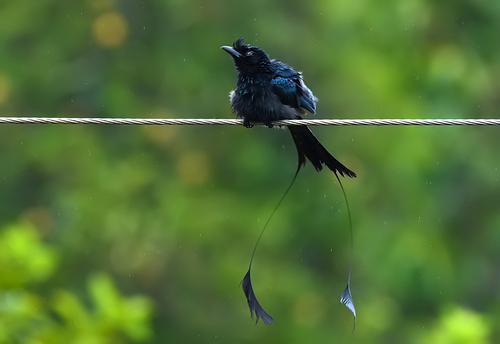
The black drongo (Dicrurus macrocercus) is a small Asian passerine bird of the drongo family Dicruridae. It is a common resident breeder in much of tropical southern Asia from southwest Iran through Pakistan, India, Bangladesh and Sri Lanka east to southern China and Indonesia and accidental visitor of Japan. It is an all black bird with a distinctive forked tail and measures 28 cm (11 in) in length. It feeds on insects, and is common in open agricultural areas and light forest throughout its range, perching conspicuously on a bare perch or along power or telephone lines.

The species is known for its aggressive behaviour towards much larger birds, such as crows, never hesitating to dive-bomb any bird of prey that invades its territory. This behaviour earns it the informal name of king crow. Smaller birds often nest in the well-guarded vicinity of a nesting black drongo. Previously grouped along with the African fork-tailed drongo (Dicrurus adsimilis), the Asian forms are now treated as a separate species with several distinct populations.

The black drongo is listed as least concern by the International Union for Conservation of Nature (IUCN) on the IUCN Red List, due to its large range and relative commonness. It has been introduced to some Pacific islands, where it has thrived and become abundant to the point of threatening and causing the extinction of native and endemic bird species there. Wikipedia →

Sounds

Song0:39

India · 2026

© Ding Li Yong · XC1088310 · CC BY-NC-ND 4.0

Call0:32

Thailand · 2025

© Peter Ericsson · XC1044773 · CC BY-NC-SA 4.0

Alarm call1:24

China · 2018

© Bo Shunqi 薄顺奇 · XC840786 · CC BY-NC-SA 4.0

Global Distribution

Parks Where Found

# Park Country Daily sighting probability
1 Kanha National Park 🇮🇳 India
~70%
2 Keoladeo National Park 🇮🇳 India
~70%
3 Chitwan National Park 🇳🇵 Nepal
~70%
4 Bandhavgarh National Park 🇮🇳 India
~60%
5 Satpura National Park 🇮🇳 India
~60%
6 Ranthambore National Park 🇮🇳 India
~60%
7 Kaziranga National Park 🇮🇳 India
~60%
8 Royal Bardia National Park 🇳🇵 Nepal
~50%
9 Manas National Park 🇮🇳 India
~50%
10 Gir National Park 🇮🇳 India
~50%
11 Sundarbans National Park 🇮🇳 India
~50%
12 Nagarhole National Park 🇮🇳 India
~50%
13 Bandipur National Park 🇮🇳 India
~30%
14 Bali Barat National Park 🇮🇩 Indonesia
~30%
15 Jim Corbett National Park 🇮🇳 India
~20%
16 Mudumalai National Park 🇮🇳 India
~20%
17 Wilpattu National Park 🇱🇰 Sri Lanka
~20%
18 Cat Tien National Park 🇻🇳 Vietnam
~20%
19 Kaeng Krachan National Park 🇹🇭 Thailand
~10%
20 Periyar National Park 🇮🇳 India
~10%
21 Royal Manas National Park 🇧🇹 Bhutan
~10%
22 Doi Inthanon National Park 🇹🇭 Thailand
~10%
23 Namdapha National Park 🇮🇳 India
~10%
24 Khao Yai National Park 🇹🇭 Thailand
~10%
25 Eravikulam National Park 🇮🇳 India
~10%
26 Cuc Phuong National Park 🇻🇳 Vietnam
<5%
27 Taroko National Park 🇹🇼 Taiwan
<5%
28 Gobi Gurvansaikhan National Park 🇲🇳 Mongolia
<5%
29 Langtang National Park 🇳🇵 Nepal
<5%
30 Khao Luang National Park 🇹🇭 Thailand
<5%
31 Khao Sok National Park 🇹🇭 Thailand
<5%

Cities Where Found

# City Country Daily sighting probability
1 Ranchi 🇮🇳 India
~90%
2 Bhubaneshwar 🇮🇳 India
~90%
3 Visakhapatnam 🇮🇳 India
~90%
4 Madurai 🇮🇳 India
~80%
5 Savar 🇧🇩 Bangladesh
~80%
6 Puducherry 🇮🇳 India
~80%
7 Hajipur 🇮🇳 India
~80%
8 Bhopal 🇮🇳 India
~80%
9 Asansol 🇮🇳 India
~70%
10 Berhampore 🇮🇳 India
~70%

Zoos & Centres Where Found

# Zoo / Centre Country
1 Hong Kong Zoological and Botanical Gardens 🇨🇳 China In captivity
2 Edward Youde Aviary 🇭🇰 Hong Kong SAR China In captivity

Before you go

What are the chances of seeing a Black Drongo in Jim Corbett National Park?

Possible

About 20% of wildlife watchers report a Black Drongo sighting in Jim Corbett National Park on a given day, based on 569 verified sightings from GBIF citizen-science data from 2019 to 2026. It is the 53rd most-seen of the 368 birds we can rate there. Over three days the chance rises to about 50%, and over a week to about 80%, if each day is a fresh chance.

When is the best time to see a Black Drongo in Jim Corbett National Park?

February, April and June–July

In those months about 30% of wildlife watchers report a Black Drongo in Jim Corbett National Park on a given day, against about 10% in August and December, the lowest months.

What time of day is best to see a Black Drongo?

Between 7 and 10 am

Across all the parks we cover, that three-hour window holds the most Black Drongo sightings with a recorded time, and nearly all of them come between 6 am and 6 pm: it is a daytime animal.

Which relatives of the Black Drongo live in Jim Corbett National Park?

Same genus: Dicrurus

The closest relatives of the Black Drongo that you can see in Jim Corbett National Park (genus Dicrurus, Drongos) are Hair-crested Drongo (about 20%), Ashy Drongo (about 10%) and Bronzed Drongo (about 10%), with each one's daily chance of a sighting.

Where does the Black Drongo sighting chance come from?

GBIF citizen-science records

It is estimated from how often the Black Drongo is recorded against all the birds logged in Jim Corbett National Park (569 verified sightings from 2019 to 2026), calibrated against known sighting rates. Figures are rounded to the nearest 10% because citizen-science data supports honest approximations, not decimals, and months with records from fewer than five people show "—". How it works.

← Back to Jim Corbett National Park