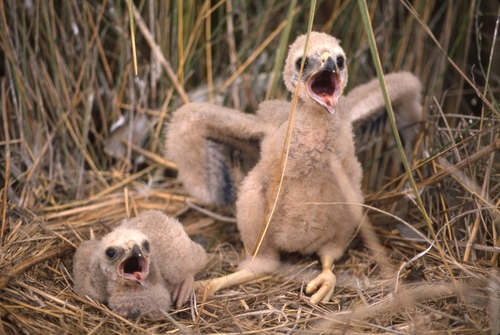
Little Eagle

Little Eagle

Hieraaetus morphnoides

Silhouette: Andy Wilson · PhyloPic

LCLeast ConcernNTVUENCR Endemic
Daily sighting probability <5% · Rare
at Kakadu National Park

In 3 days <5% in a week ~10%

26 Verified sightings at Kakadu National Park From 2019 to 2026
215 In all 9 parks
July Best month
☀️ Diurnal When it's spotted

About the Little Eagle

The little eagle (Hieraaetus morphnoides) is a very small eagle endemic to Australia. John Gould described the little eagle in 1841. The distinctive pygmy eagle has long been considered a subspecies, but a 2009 genetic study shows it to be distinctive genetically and warrants species status. It is a near relative of both the Palearctic booted eagle and the massive but now extinct Haast's eagle of New Zealand.

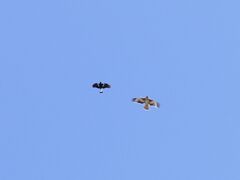
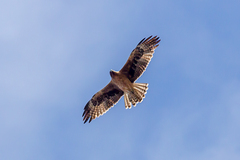
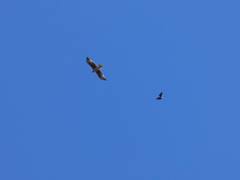
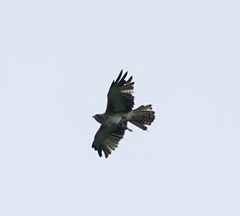
The little eagle is a medium-sized bird of prey, measuring 45–55 cm (17–21.5 inches) in length and weighing 815 g (1.8 lb), roughly the size of a peregrine falcon. It has fully feathered legs and a square-cut, barred tail. Wingspan is about 120 cm with males having longer wings in proportion to their bodies, but being nearly half the weight of females. It is a powerful bird and during flight has strong wing beats, glides on flat wings and soars on slightly raised or flat wings.

The little eagle occurs in light and dark colour forms and generally these colours change with age. The most common is the light form which is dark brown occurring on the back and wings with black streaks on the head and neck, and a sandy to pale under body. The dark form... Wikipedia →

Sounds

Call0:26

Australia · 2021

© Iain Woxvold · XC621121 · CC BY-NC-SA 4.0

Recording0:10

Australia · 2025

© Thomas Nataprawira · iNaturalist · CC BY-NC 4.0

Recording0:23

Australia · 2023

© Josh Magro · iNaturalist · CC BY-NC 4.0

Global Distribution

Parks Where Found

# Park Country Daily sighting probability
1 Hattah-Kulkyne National Park 🇦🇺 Australia
~10%
2 Flinders Ranges National Park 🇦🇺 Australia
~10%
3 Uluru-Kata Tjuta National Park 🇦🇺 Australia
<5%
4 Cape Range 🇦🇺 Australia
<5%
5 Ningaloo Marine Park 🇦🇺 Australia
<5%
6 Grampians National Park 🇦🇺 Australia
<5%
7 Rottnest Island 🇦🇺 Australia
<5%
8 Kakadu National Park 🇦🇺 Australia
<5%
9 Royal National Park 🇦🇺 Australia
<5%

Cities Where Found

# City Country Daily sighting probability
1 Perth 🇦🇺 Australia
<5%
2 Melbourne 🇦🇺 Australia
<5%
3 Brisbane 🇦🇺 Australia
<5%
4 Sydney 🇦🇺 Australia
<5%

Zoos & Centres Where Found

# Zoo / Centre Country
1 Featherdale Sydney Wildlife Park 🇦🇺 Australia In captivity

Before you go

What are the chances of seeing a Little Eagle in Kakadu National Park?

Rare

Under 5% of wildlife watchers report a Little Eagle sighting in Kakadu National Park on a given day, based on 26 verified sightings from GBIF citizen-science data from 2019 to 2026. It is the 155th most-seen of the 186 birds we can rate there. Over three days the chance rises to under 5%, and over a week to about 10%, if each day is a fresh chance.

When is the best time to see a Little Eagle in Kakadu National Park?

Any time of year

In every month with enough records, under 5% of wildlife watchers report a Little Eagle in Kakadu National Park on a given day, so our monthly data shows no clear season. February has too few records to rate.

What time of day is best to see a Little Eagle?

Between 10 am and 1 pm

Across all the parks we cover, that three-hour window holds the most Little Eagle sightings with a recorded time, and about 9 in 10 of them come between 6 am and 6 pm: it is a daytime animal.

Which relatives of the Little Eagle live in Kakadu National Park?

Same family: Accipitridae

The closest relatives of the Little Eagle that you can see in Kakadu National Park (family Accipitridae, Hawks, Eagles, and Kites) are Whistling Kite (about 80%), White-Bellied Sea-Eagle (about 40%) and Black Kite (about 30%), with each one's daily chance of a sighting.

Where does the Little Eagle sighting chance come from?

GBIF citizen-science records

It is estimated from how often the Little Eagle is recorded against all the birds logged in Kakadu National Park (26 verified sightings from 2019 to 2026), calibrated against known sighting rates. Figures are rounded to the nearest 10% because citizen-science data supports honest approximations, not decimals, and months with records from fewer than five people show "—". How it works.

← Back to Kakadu National Park