Asian Barred Owlet

Asian Barred Owlet

Glaucidium cuculoides

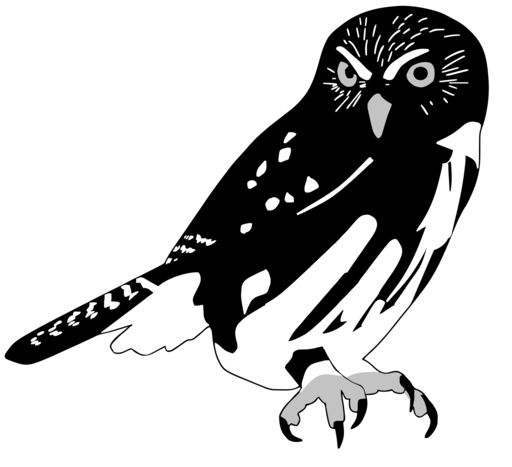
Silhouette: Edwin Price · PhyloPic

LCLeast ConcernNTVUENCR
Daily sighting probability ~30% · Possible
at Kaziranga National Park

In 3 days ~70% in a week ~90%

631 Verified sightings at Kaziranga National Park From 2019 to 2026
4,563 In all 11 parks
March Best month
🌅 Crepuscular When it's spotted

About the Asian Barred Owlet

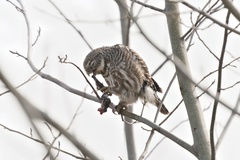
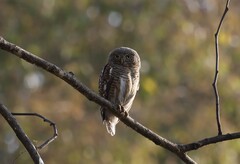
The Asian barred owlet (Glaucidium cuculoides), also known as the cuckoo owlet, is a species of pygmy owl native to the forests and shrublands of mainland Southeast Asia to the foothills of the Himalayas of northern Pakistan. It is a smaller owl, measuring 22–25 cm (8.7–9.8 in), making it one of the larger pygmy owls. They are primarily insectivorous but will eat lizards, small rodents and birds as well.

The Asian barred owlet is a small owl that sits at 22–25 cm (8.7–9.8 in). The males weigh 150–176 g (0.331–0.388 lb) and the females up to 240 g (0.53 lb). Like most owls in the true owl family, the females are usually larger than the males. They are dark brown or olive-brown with a white throat patch and are densely barred. Their breast and belly is whitish in colour with dark brown bars. Its tail and wings are dark brown with whitish bars. Unlike other pygmy owl species, they do not have false eyes on the back of their head. The juveniles have a streaked breast, not barred, and their head is a more ruddy brown colour. They are similar in appearance to the Javan owlet and collared owlet. The Asian barred owlet is mainly diurnal and will perch on bare branches to hunt... Wikipedia →

Sounds

Call0:28

China · 2026

© Bo Shunqi 薄顺奇 · XC1094947 · CC BY-NC-SA 4.0

Song1:07

Vietnam · 2024

© Jungmoon Ha · XC921469 · CC BY-NC-SA 4.0

Song1:16

China · 2024

© Bo Shunqi薄顺奇 · XC892159 · CC BY-NC-SA 4.0

Global Distribution

Parks Where Found

# Park Country Daily sighting probability
1 Kaziranga National Park 🇮🇳 India
~30%
2 Manas National Park 🇮🇳 India
~30%
3 Cuc Phuong National Park 🇻🇳 Vietnam
~30%
4 Cat Tien National Park 🇻🇳 Vietnam
~30%
5 Kaeng Krachan National Park 🇹🇭 Thailand
~30%
6 Doi Inthanon National Park 🇹🇭 Thailand
~20%
7 Royal Manas National Park 🇧🇹 Bhutan
~20%
8 Namdapha National Park 🇮🇳 India
~20%
9 Khao Yai National Park 🇹🇭 Thailand
~10%
10 Jim Corbett National Park 🇮🇳 India
~10%
11 Chitwan National Park 🇳🇵 Nepal
<5%

Cities Where Found

# City Country Daily sighting probability
1 Yangon 🇲🇲 Myanmar
~20%
2 Guwahati 🇮🇳 India
~10%
3 Tuen Mun 🇨🇳 China
~10%
4 Hangzhou 🇨🇳 China
~10%
5 Nanjing 🇨🇳 China
~10%
6 Bangkok 🇹🇭 Thailand
<5%
7 Chengdu 🇨🇳 China
<5%
8 Guangzhou 🇨🇳 China
<5%
9 Dehradun 🇮🇳 India
<5%
10 Jammu 🇮🇳 India
<5%

Zoos & Centres Where Found

# Zoo / Centre Country
1 Kadoorie Farm and Botanic Garden 🇭🇰 Hong Kong SAR China In captivity
2 Nanjing Hongshan Forest Zoo 🇨🇳 China In captivity
3 Night Safari 🇸🇬 Singapore In captivity
4 Singapore Zoo 🇸🇬 Singapore In captivity
5 River Wonders 🇸🇬 Singapore In captivity

Before you go

What are the chances of seeing an Asian Barred Owlet in Kaziranga National Park?

Possible

About 30% of wildlife watchers report an Asian Barred Owlet sighting in Kaziranga National Park on a given day, based on 631 verified sightings from GBIF citizen-science data from 2019 to 2026. It is the 73rd most-seen of the 323 birds we can rate there. Over three days the chance rises to about 70%, and over a week to about 90%, if each day is a fresh chance.

When is the best time to see an Asian Barred Owlet in Kaziranga National Park?

January to April

In those months about 40% of wildlife watchers report an Asian Barred Owlet in Kaziranga National Park on a given day, against about 10% in May and November, the lowest months. Those are among Kaziranga National Park's driest months, with about 100 mm of rain a month against 520 mm in June. June and July have too few records to rate.

What time of day is best to see an Asian Barred Owlet?

Between 1 and 4 am

Across all the parks we cover, that three-hour window holds the most Asian Barred Owlet sightings with a recorded time, and about half of them come between 6 am and 6 pm: it is most active around dawn and dusk.

Is Kaziranga National Park the best place to see an Asian Barred Owlet?

Yes

Of the 11 parks where we can rate Asian Barred Owlet sightings, Kaziranga National Park has the highest daily chance: about 30%. Next come Manas National Park (India, about 30%) and Cuc Phuong National Park (Vietnam, about 30%).

Which relatives of the Asian Barred Owlet live in Kaziranga National Park?

Same family: Strigidae

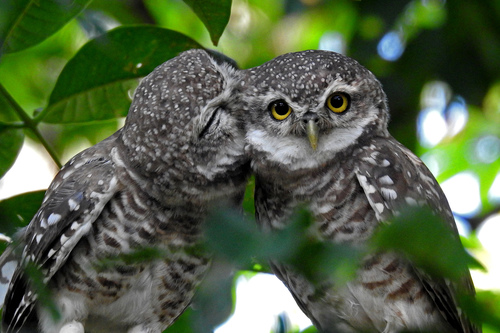
The closest relatives of the Asian Barred Owlet that you can see in Kaziranga National Park (family Strigidae, Typical Owls) are Spotted Owlet (about 30%), Dusky Eagle-Owl (about 10%) and Brown Fish-Owl (about 10%), with each one's daily chance of a sighting.

Where does the Asian Barred Owlet sighting chance come from?

GBIF citizen-science records

It is estimated from how often the Asian Barred Owlet is recorded against all the birds logged in Kaziranga National Park (631 verified sightings from 2019 to 2026), calibrated against known sighting rates. Figures are rounded to the nearest 10% because citizen-science data supports honest approximations, not decimals, and months with records from fewer than five people show "—". How it works.

← Back to Kaziranga National Park