
Brown Fish-Owl

Brown Fish-Owl

Ketupa zeylonensis

Silhouette: Ferran Sayol · PhyloPic

LCLeast ConcernNTVUENCR
Daily sighting probability ~10% · With luck
at Kaziranga National Park

In 3 days ~20% in a week ~40%

124 Verified sightings at Kaziranga National Park From 2019 to 2026
2,602 In all 19 parks
February Best month
🌅 Crepuscular When it's spotted

About the Brown Fish-Owl

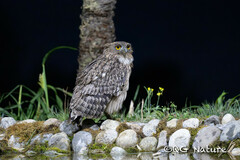
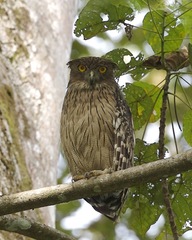
The brown fish owl (Ketupa zeylonensis) is a fish owl species in the family known as typical owls, Strigidae. It is native from Turkey to South and Southeast Asia. Due its wide distribution it is listed as Least Concern on the IUCN Red List. It inhabits forests and wooded wetlands. Of the four living species of fish owl, it is the most widely distributed, most common and best-studied. It occupies a range of over 7,000 km (4,300 mi).

The brown fish owl was formally described in 1788 by the German naturalist Johann Friedrich Gmelin in his revised and expanded edition of Carl Linnaeus's Systema Naturae. He placed it with the other owls in the genus Strix and coined the binomial name Strix zeylonensis. Gmelin based his description on the "Great Ceylonese horned owl" that had been described and illustrated by the naturalist Peter Brown in his book New Illustrations of Zoology. Joan Gideon Loten, an administrator in the Dutch East India Company had provided Brown with a picture of the owl that had been drawn by the Ceylonese artist Pieter Cornelis de Bevere. The brown fish owl is now placed in the genus Ketupa that was introduced in 1830 by the French naturalist René Lesson... Wikipedia →

Sounds

Duet0:06

China · 2021

© Geoff Carey · XC824089 · CC BY-NC-SA 4.0

Call0:15

India · 2017

© Vishal Jadhav · XC361783 · CC BY-NC-SA 4.0

Alarm call0:15

Vietnam · 2020

© Marta Celej · XC593653 · CC BY-NC-SA 4.0

Global Distribution

Parks Where Found

# Park Country Daily sighting probability
1 Wilpattu National Park 🇱🇰 Sri Lanka
~30%
2 Ranthambore National Park 🇮🇳 India
~20%
3 Bandhavgarh National Park 🇮🇳 India
~20%
4 Gir National Park 🇮🇳 India
~10%
5 Mudumalai National Park 🇮🇳 India
~10%
6 Minneriya National Park 🇱🇰 Sri Lanka
~10%
7 Jim Corbett National Park 🇮🇳 India
~10%
8 Royal Bardia National Park 🇳🇵 Nepal
~10%
9 Yala National Park 🇱🇰 Sri Lanka
~10%
10 Nagarhole National Park 🇮🇳 India
~10%
11 Kanha National Park 🇮🇳 India
~10%
12 Periyar National Park 🇮🇳 India
~10%
13 Kaziranga National Park 🇮🇳 India
~10%
14 Bandipur National Park 🇮🇳 India
~10%
15 Udawalawe National Park 🇱🇰 Sri Lanka
<5%
16 Chitwan National Park 🇳🇵 Nepal
<5%
17 Satpura National Park 🇮🇳 India
<5%
18 Sinharaja Forest Reserve 🇱🇰 Sri Lanka
<5%
19 Manas National Park 🇮🇳 India
<5%

Cities Where Found

# City Country Daily sighting probability
1 Savar 🇧🇩 Bangladesh
~10%
2 Thrissur 🇮🇳 India
<5%
3 Dehradun 🇮🇳 India
<5%
4 Kozhikode 🇮🇳 India
<5%
5 Lucknow 🇮🇳 India
<5%
6 Kathmandu 🇳🇵 Nepal
<5%

Zoos & Centres Where Found

# Zoo / Centre Country
1 Walsrode World Bird Park 🇩🇪 Germany In captivity
2 Assam State Zoo cum Botanical Garden 🇮🇳 India In captivity
3 Nehru Zoological Park 🇮🇳 India In captivity
4 Kadoorie Farm and Botanic Garden 🇭🇰 Hong Kong SAR China In captivity
5 Thiruvananthapuram Zoo 🇮🇳 India In captivity
6 National Zoological Gardens of Sri Lanka 🇱🇰 Sri Lanka In captivity
7 Thrissur Zoo 🇮🇳 India In captivity
8 Parassinikkadavu Snake Park 🇮🇳 India In captivity

Before you go

What are the chances of seeing a Brown Fish-Owl in Kaziranga National Park?

With luck

About 10% of wildlife watchers report a Brown Fish-Owl sighting in Kaziranga National Park on a given day, based on 124 verified sightings from GBIF citizen-science data from 2019 to 2026. It is the 170th most-seen of the 323 birds we can rate there. Over three days the chance rises to about 20%, and over a week to about 40%, if each day is a fresh chance.

When is the best time to see a Brown Fish-Owl in Kaziranga National Park?

February

In that month about 20% of wildlife watchers report a Brown Fish-Owl in Kaziranga National Park on a given day, against under 5% in April–May and August–December, the lowest months. That is one of Kaziranga National Park's driest months, with about 45 mm of rain against 520 mm in June. June and July have too few records to rate.

What time of day is best to see a Brown Fish-Owl?

Between noon and 3 pm

Across all the parks we cover, that three-hour window holds the most Brown Fish-Owl sightings with a recorded time, and about 7 in 10 of them come between 6 am and 6 pm: it is most active around dawn and dusk.

Which relatives of the Brown Fish-Owl live in Kaziranga National Park?

Same family: Strigidae

The closest relatives of the Brown Fish-Owl that you can see in Kaziranga National Park (family Strigidae, Typical Owls) are Spotted Owlet (about 30%), Asian Barred Owlet (about 30%) and Dusky Eagle-Owl (about 10%), with each one's daily chance of a sighting.

Where does the Brown Fish-Owl sighting chance come from?

GBIF citizen-science records

It is estimated from how often the Brown Fish-Owl is recorded against all the birds logged in Kaziranga National Park (124 verified sightings from 2019 to 2026), calibrated against known sighting rates. Figures are rounded to the nearest 10% because citizen-science data supports honest approximations, not decimals, and months with records from fewer than five people show "—". How it works.

← Back to Kaziranga National Park