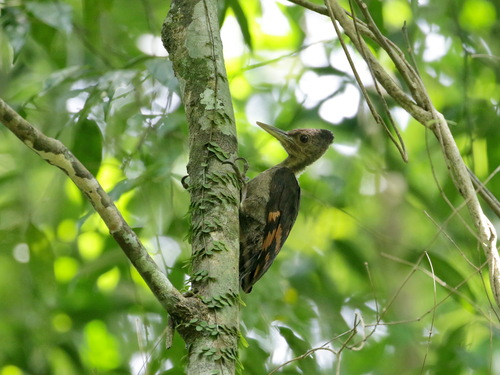
Sunda Pygmy Woodpecker

Sunda Pygmy Woodpecker

Yungipicus moluccensis

Silhouette: Pepe Reigada · PhyloPic

Daily sighting probability <5% · Rare
at Kerinci Seblat National Park

In 3 days <5% in a week ~10%

8 Verified sightings at Kerinci Seblat National Park From 2019 to 2026
391 In all 8 parks
July Best month
🌅 Crepuscular When it's spotted

About the Sunda Pygmy Woodpecker

The Sunda pygmy woodpecker (Yungipicus moluccensis), also known as the Sunda woodpecker, is a species of bird in the family Picidae. It is found in Brunei, Indonesia, Malaysia, and Singapore. Some taxonomic authorities continue to place this species in the genus Dendrocopos or Picoides.

The Sunda pygmy woodpecker was formally described in 1788 by the German naturalist Johann Friedrich Gmelin in his revised and expanded edition of Carl Linnaeus's Systema Naturae. He placed it with the other woodpeckers in the genus Picus and coined the binomial name Picus moluccensis. Gmelin based his description on "Le petit épeiche brun des Moluques" that had been described in 1780 by the French polymath Comte de Buffon in his Histoire Naturelle des Oiseaux. The locality was originally specified as the Maluku Islands. This was an error and has been corrected to the state of Malacca in Malaysia. The Sunda pygmy woodpecker is now one of seven species placed in the genus Yungipicus that was introduced in 1854 by Charles Lucien Bonaparte.

Two subspecies are recognised: Wikipedia →

Sounds

Call0:07

Malaysia · 2025

© Ding Li Yong · XC958967 · CC BY-NC-ND 4.0

Drumming0:10

Malaysia · 2022

© Lim Ying Hien · XC717390 · CC BY-NC-ND 4.0

Song0:55

Indonesia · 2012

© Colin Trainor · XC109553 · CC BY-NC-ND 2.5

Global Distribution

Parks Where Found

# Park Country Daily sighting probability
1 Way Kambas National Park 🇮🇩 Indonesia
~40%
2 Komodo National Park 🇮🇩 Indonesia
~20%
3 Gunung Leuser National Park 🇮🇩 Indonesia
~10%
4 Sepilok 🇲🇾 Malaysia
~10%
5 Bali Barat National Park 🇮🇩 Indonesia
<5%
6 Kerinci Seblat National Park 🇮🇩 Indonesia
<5%
7 Kinabatangan Wildlife Sanctuary 🇲🇾 Malaysia
<5%
8 Danum Valley Conservation Area 🇲🇾 Malaysia
<5%

Cities Where Found

# City Country Daily sighting probability
1 Jakarta 🇮🇩 Indonesia
~30%
2 Johor Bahru 🇲🇾 Malaysia
~10%
3 Singapore 🇸🇬 Singapore
~10%
4 Kuching 🇲🇾 Malaysia
~10%
5 Yogyakarta 🇮🇩 Indonesia
<5%
6 Kuala Lumpur 🇲🇾 Malaysia
<5%
7 Denpasar 🇮🇩 Indonesia
<5%

Before you go

What are the chances of seeing a Sunda Pygmy Woodpecker in Kerinci Seblat National Park?

Rare

Under 5% of wildlife watchers report a Sunda Pygmy Woodpecker sighting in Kerinci Seblat National Park on a given day, based on 8 verified sightings from GBIF citizen-science data from 2019 to 2026. It is the 190th most-seen of the 203 birds we can rate there. Over three days the chance rises to under 5%, and over a week to about 10%, if each day is a fresh chance.

When is the best time to see a Sunda Pygmy Woodpecker in Kerinci Seblat National Park?

Any time of year

In every month with enough records, under 5% of wildlife watchers report a Sunda Pygmy Woodpecker in Kerinci Seblat National Park on a given day, so our monthly data shows no clear season. January has too few records to rate.

What time of day is best to see a Sunda Pygmy Woodpecker?

Between 2 and 5 am

Across all the parks we cover, that three-hour window holds the most Sunda Pygmy Woodpecker sightings with a recorded time, and about half of them come between 6 am and 6 pm: it is most active around dawn and dusk.

Is Kerinci Seblat National Park the best place to see a Sunda Pygmy Woodpecker?

6th of 8

Of the 8 parks where we can rate Sunda Pygmy Woodpecker sightings, Kerinci Seblat National Park ranks 6th at under 5%. The best odds are in Way Kambas National Park (Indonesia, about 40%), Komodo National Park (Indonesia, about 20%) and Gunung Leuser National Park (Indonesia, about 10%).

Where does the Sunda Pygmy Woodpecker sighting chance come from?

GBIF citizen-science records

It is estimated from how often the Sunda Pygmy Woodpecker is recorded against all the birds logged in Kerinci Seblat National Park (8 verified sightings from 2019 to 2026), calibrated against known sighting rates. Figures are rounded to the nearest 10% because citizen-science data supports honest approximations, not decimals, and months with records from fewer than five people show "—". How it works.
← Back to Kerinci Seblat National Park